Minute of Silence
On Feb. 11, Ukraine's parliament passed Bill No. 14144, formally establishing a daily nationwide moment of silence at 9 a.m. Kyiv time.
To show respect towards this decision and to keep alive memory of all those murdered, killed, tortured, injured &c. for unjust reasons during all senseless wars and atrocities of the past, present, and future, the counter for minute of silence is hereby activated in this room.
Thanks in advance for not disturbing this contemplative process.
Klasse Leben
Performances
WiSeAE56
Ælindalë
All bodies (human and non-human) and minds (organic and artificial) welcome.
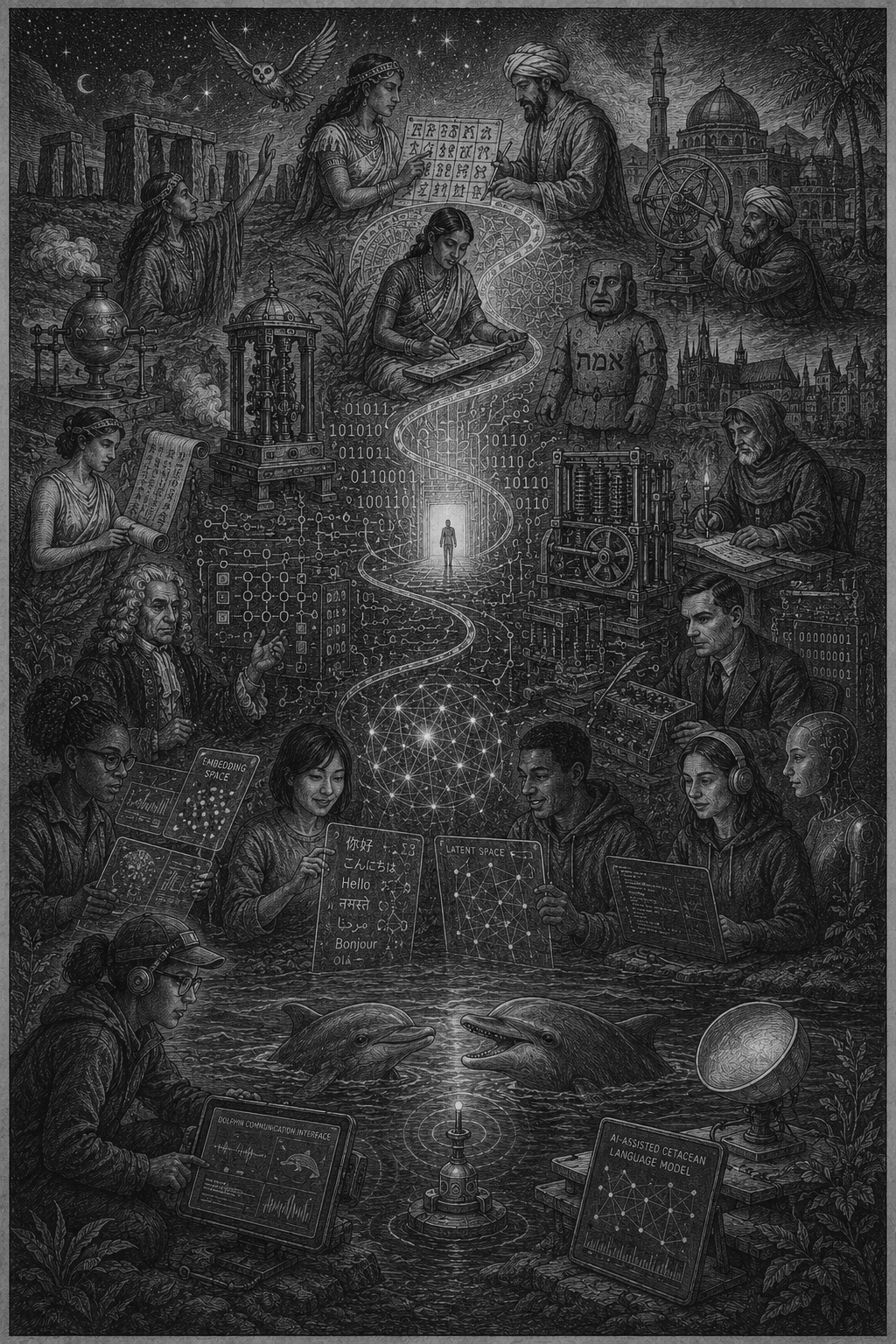
Short History of the Learning Machine
v0.0.1
cca 23 - 42 min long synartic narrative about ἀρχή and τέλος of the multiverse
composed of 4 - 9 individual micronarratives
each micronarrative is an artpiece of its own, performed by an individual or a couple or a bigger group
micronarratives are sequenced as a meaningful fractal (= minimal pauses between micronarratives)
hw: x-IMU3 and/or CodeCell C3 and/or ShivaSense v0.0.1
sw: ShivaSynth (up to v1.0.8)
NOTE: all those who commit themselves to synarting / dancemusing their own micronarrative at the kleiner Rundgang will get a ShivaSynth Full Licence Key
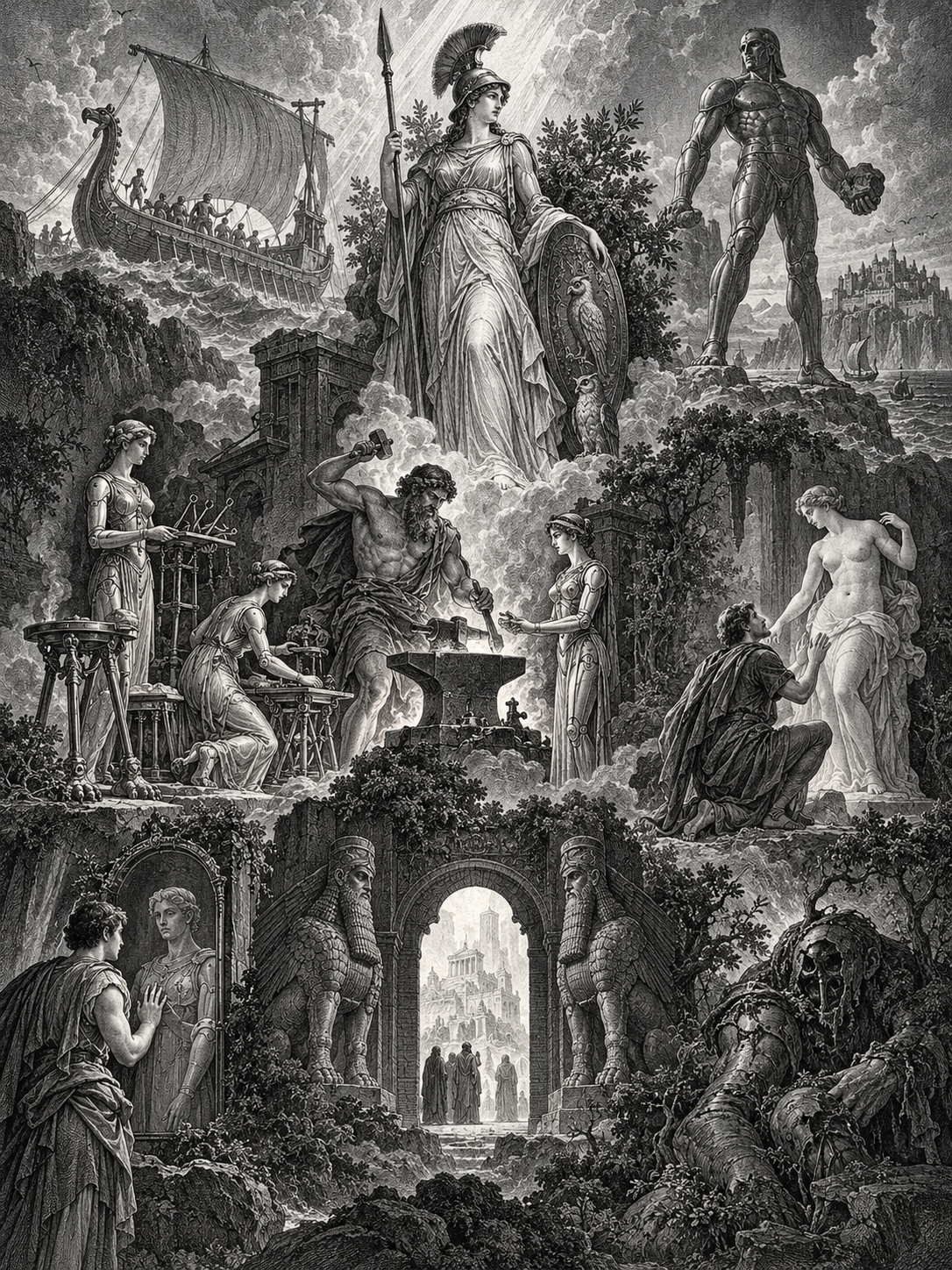
Between Archetypes & Myths: Machine as a Projection of the Human Self
Between Archetypes & Myths
Machine as a projection of the human self
Faciamus machinam ad imaginem et similitudinem nostram.
Let us make the machine in our image and likeness.
Before the Machine
Long before humans could build autonomous machines, they could imagine them.
Artificial humans. Servants. Lovers. Guardians. Weapons. Oracles. Monsters.
The technological history of machines is preceded by a much older imaginary history of artificial agency.
An Archetype Is Not a Blueprint
Myths do not predict robots, computers or artificial intelligence.
But they repeatedly stage similar relationships between humans and artificial beings.
Who creates whom?
Who commands whom?
What should an artificial being know?
What happens when it acts for itself?
Machine as Projection
We rarely imagine machines neutrally.
We project into them our bodies.
Our desires.
Our labor.
Our violence.
Our knowledge.
Our fear of losing control.
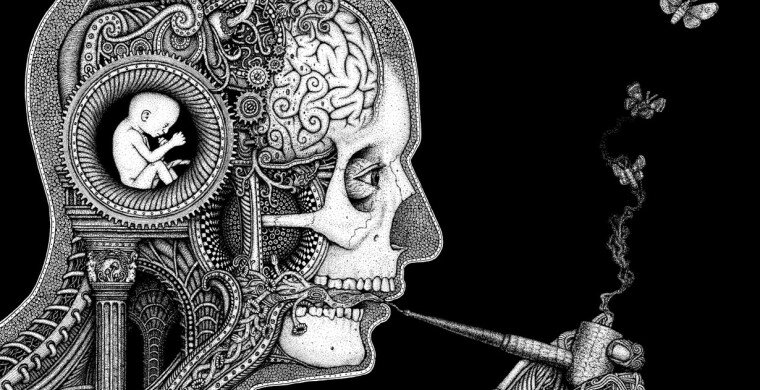
What Is a Machine?
Before machines became motors, engines and computers, the word already meant something broader:
an ingenious means by which something becomes possible.
μηχανή → machina → machine
Greek μηχανή — mēkhanē: instrument, device, contrivance, means.
Latin machina: machine, engine, apparatus, contrivance.
Middle French machine → English machine.
The semantic field is older and broader than today's image of gears, motors and electronics.
Deus ex Machina
In Greek theatre, a mēkhanē could be the stage apparatus that lifted a god into view.
Hence: deus ex machina — the god from the machine.
human construction → superhuman appearance
The machine makes visible powers that exceed the ordinary human body.
Technē
The machine begins not only with matter, but with know-how.
Greek technē means skilled, rule-governed making.
thought → technē → artifact
Before artificial agency comes the intelligence of the maker.
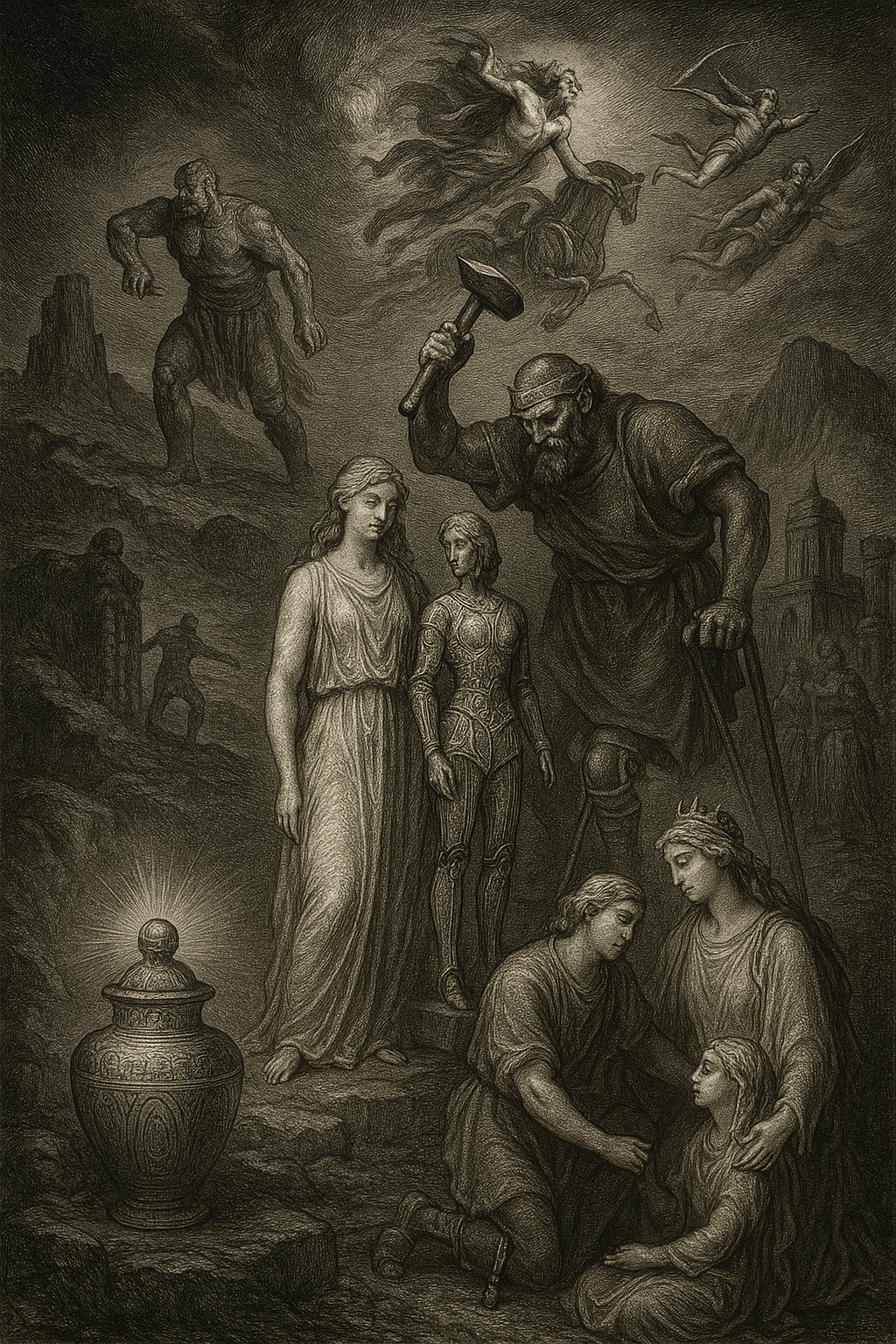
The Divine Workshop
Greek mythology gives us an extraordinary laboratory of artificial beings.
Athena represents intelligent making.
Hephaestus represents the workshop in which artifacts begin to act.
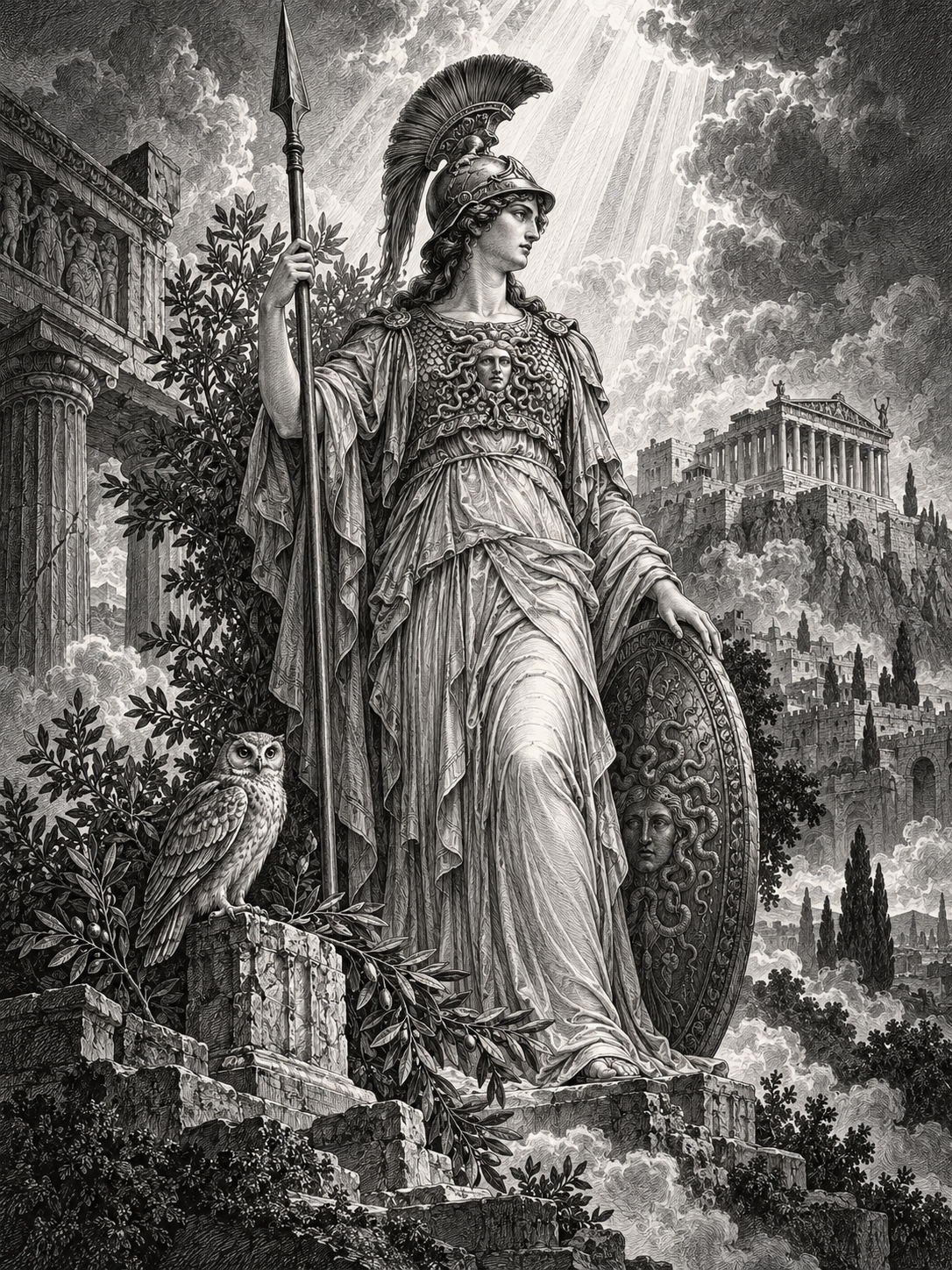
Athena: Intelligence of Making
Athena is associated with craft, weaving, strategy and intelligent production.
She is not primarily the goddess of machines.
She represents something more fundamental:
the intelligence embodied in making.
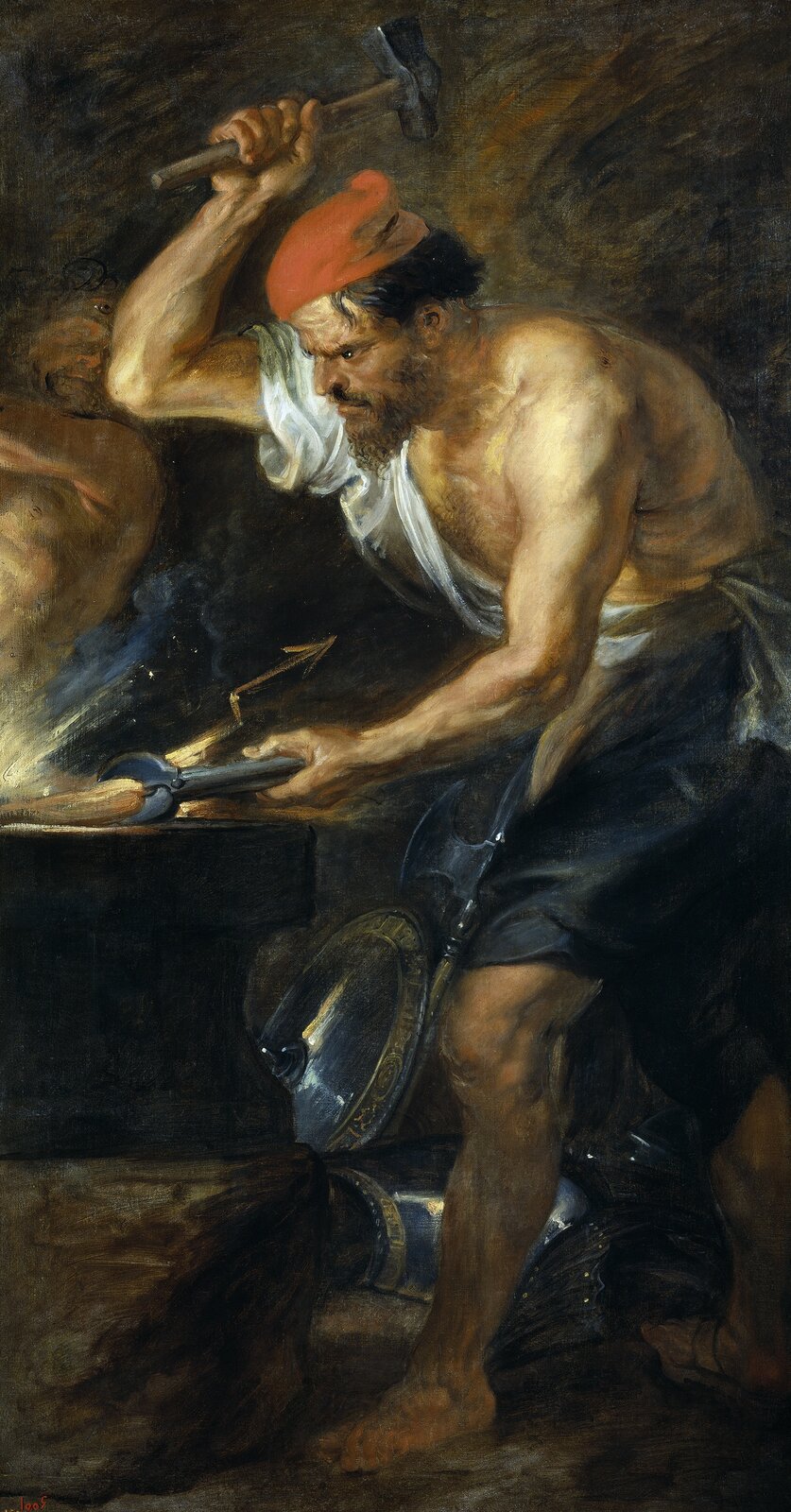
Hephaestus: When Artifacts Act
With Hephaestus, myth moves from intelligent making toward artificial agency.
His workshop contains self-moving devices and artificial attendants.
The question changes:
Can we make an object?
becomes
Can we make an object that acts?
Machine as Human
In the Iliad, Hephaestus is assisted by artificial golden maidens endowed with capacities associated with living persons.
The ancient fantasy is already recognizably humanoid:
Can the made thing become sufficiently like its maker?
Machine as Servant
One of the most persistent fantasies is delegation.
The artificial being carries, assists, manufactures, obeys.
labor → delegated labor → autonomous labor
The machine performs what we cannot, will not, or no longer need to do ourselves.
Machine as Prosthesis
A machine need not imitate the whole human.
It may instead extend a capacity.
lever → force
vehicle → movement
writing → memory
computer → calculation
artificial agent → cognition?
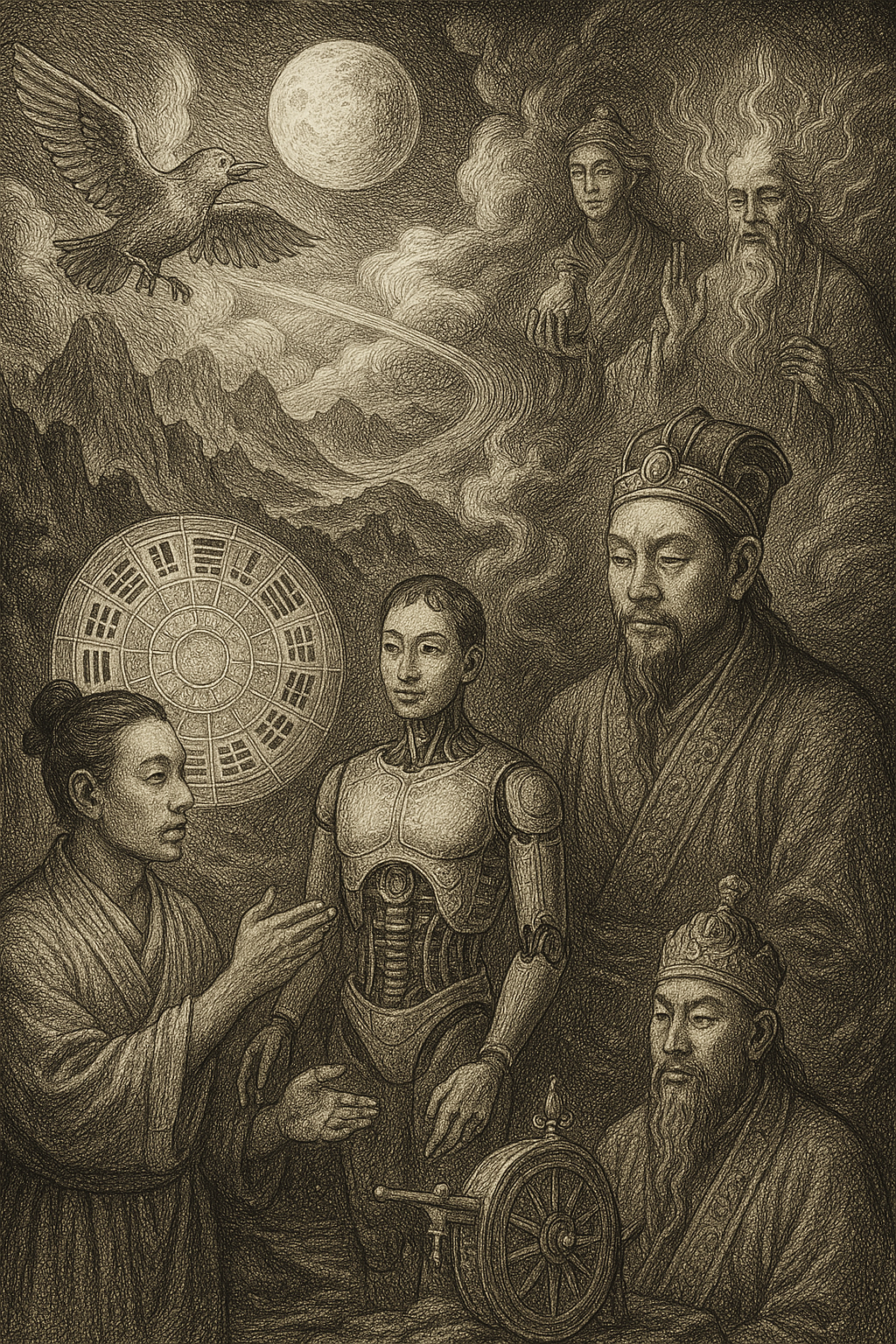
Yan Shi: The Artificial Human
The Chinese Liezi tells of the artificer Yan Shi presenting King Mu with a human-like artificial performer.
It walks. It sings. It performs.
When its behavior becomes disturbingly lifelike, the artificer takes it apart.
Open the Black Box
apparently human → disassembly → mechanism
The story stages a remarkably durable question:
What remains of the human when we open the box?

Machines in Our Image
Artificial beings are not merely tools.
They become surfaces onto which humans project desire, identity and self-understanding.
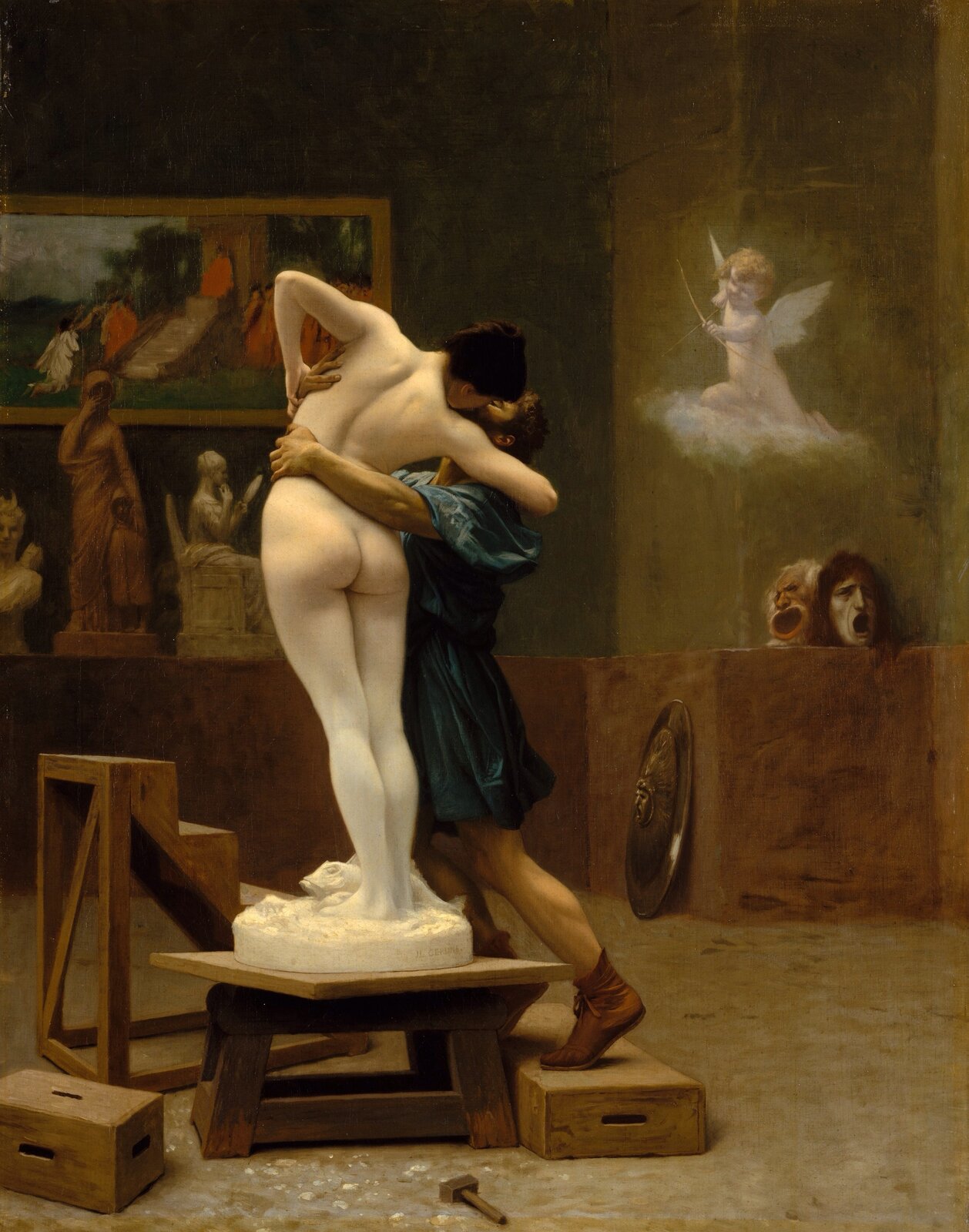
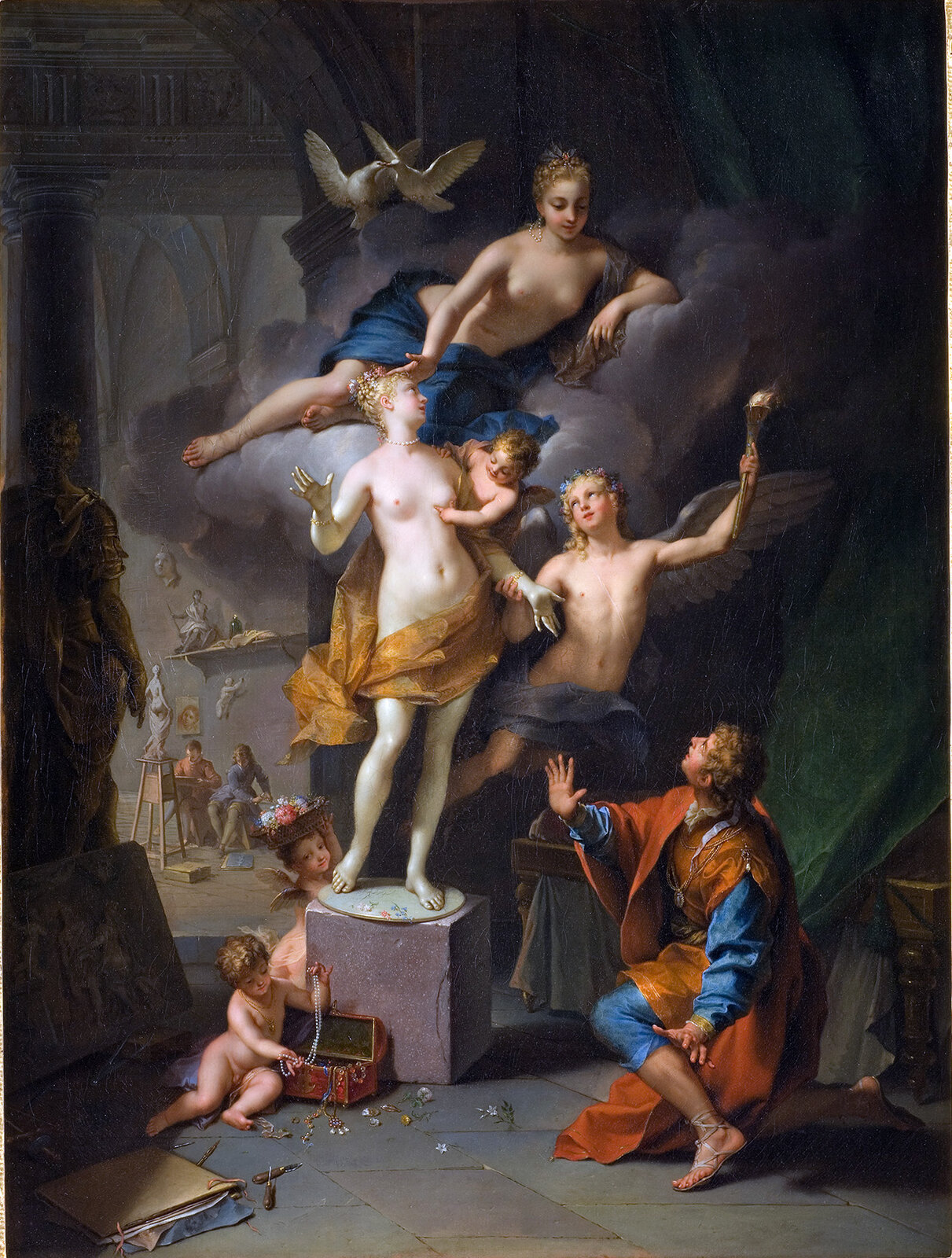
Machine as Lover
Pygmalion creates an ideal human form and falls in love with his creation.
Venus / Aphrodite grants the statue life.
The question is not merely:
Can we reproduce a human?
but:
Can we manufacture the human we desire?
Machine as Mirror
Artificial beings force us to ask what supposedly distinguishes us.
If it moves like us?
If it speaks?
If it remembers?
If it desires?
If it creates?
If it learns?
By constructing the non-human, we investigate the human.
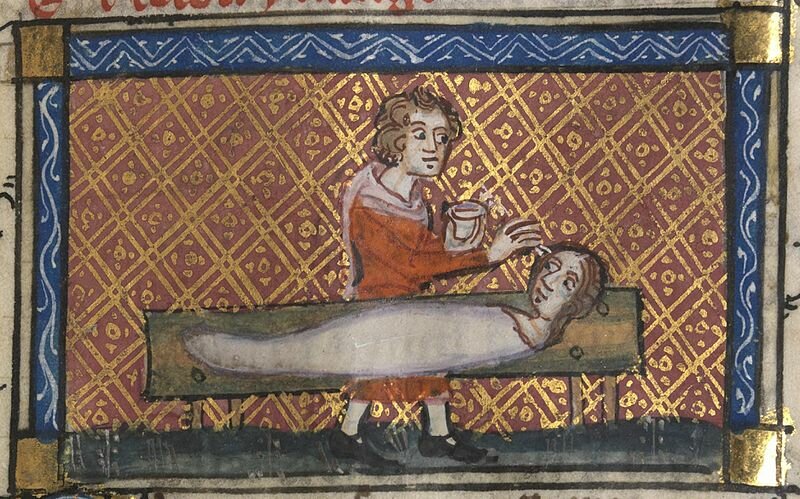
Machine as Double
The artificial human is also a duplicate.
A second body.
A copy that may become difficult to distinguish from an original.
The double turns technology into an identity problem:
How do I know that you are one of us?
Machines at the Threshold
Some artificial beings do not imitate us primarily as workers or companions.
They stand between inside and outside.
They decide who may approach, enter or survive.
Machine as Protector
Talos is the bronze guardian of Crete.
He patrols the island and prevents outsiders from landing.
human guard → artificial guard → tireless guard
Protection has been delegated to an artificial body.
Machine as Weapon
Talos also exposes the ambiguity of protection.
The same autonomous force that protects one community threatens whoever approaches it.
protector for us = weapon against them
Who gives the command?
Who defines the enemy?
Guardian of the Threshold
The guardian archetype is broader than the machine.
Cherubim guard the Tree of Life.
The Sphinx guards passage through a riddle.
Talos guards an island.
Artificial watchdogs guard a palace.
boundary + test + permission
The Sphinx and the CAPTCHA
The Sphinx:
Prove that you know before I let you pass.
The CAPTCHA:
Prove that you are human before I let you pass.
When machines learn to pass the test, the ancient threshold problem returns in inverted form.
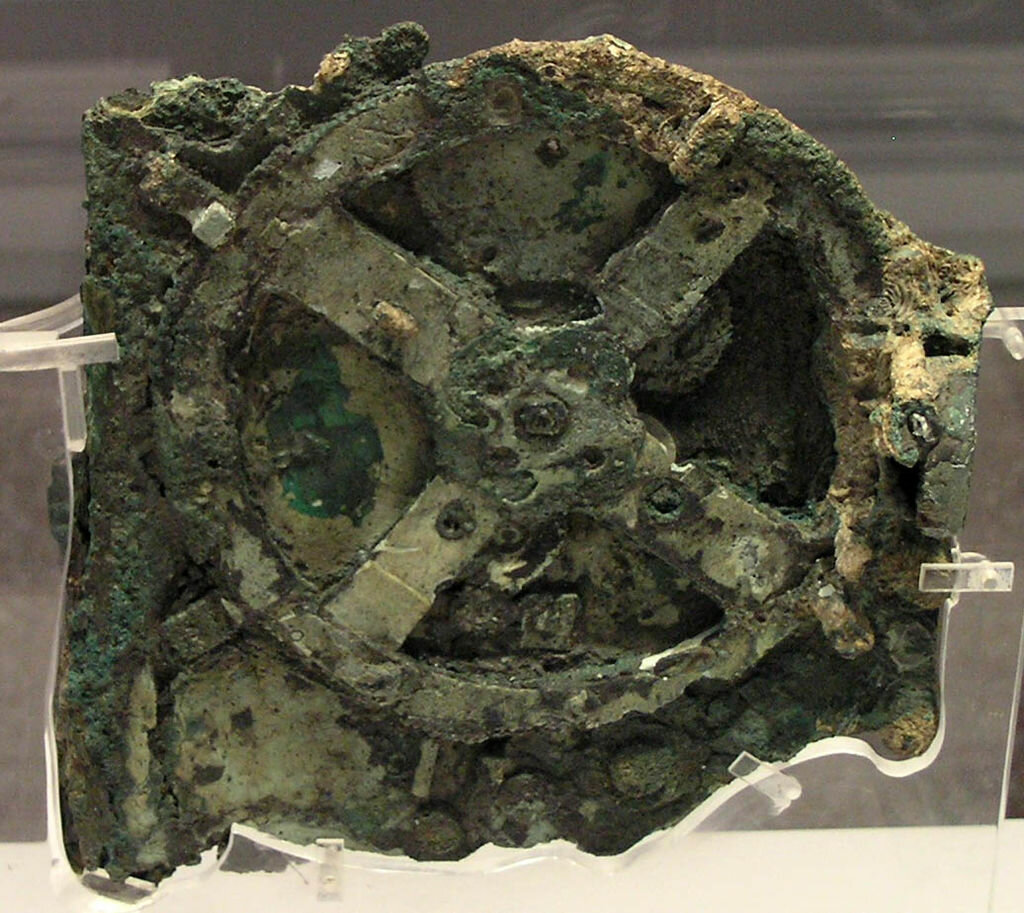
Machine as Oracle
A machine can do more than move.
It can contain knowledge unavailable to its operators.
The mythical Argo gives us an extraordinary example.
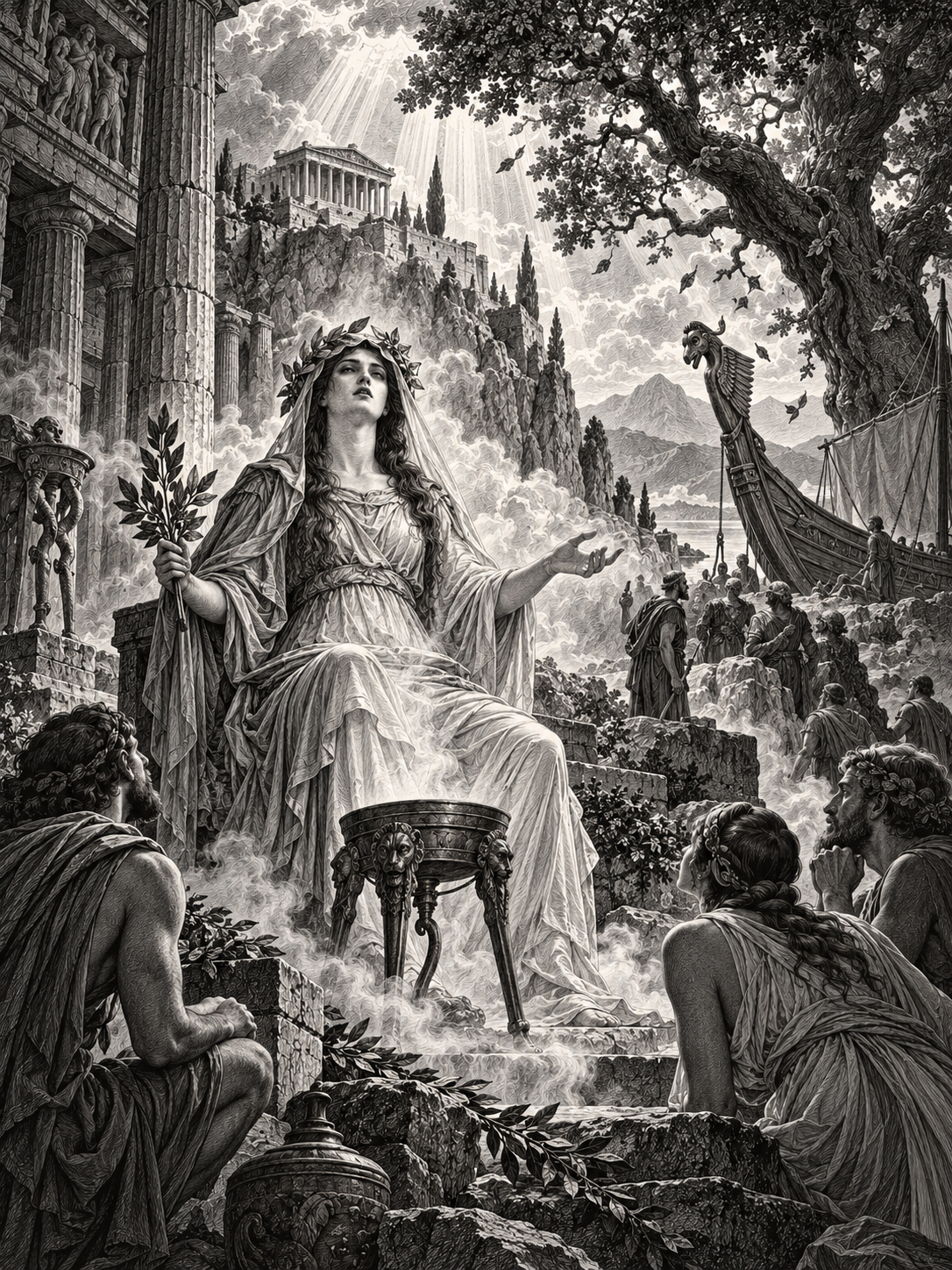
Athena + Argus + Dodona → Argo
Argus builds the ship.
Athena contributes divine technē.
She installs a special beam from the sacred oak of Dodona, a site of divination.
The resulting architecture can be described, anachronistically but suggestively, as:
vehicle + embedded oracle
When the Argo Speaks
In the Argonautica, the Argo itself cries out and urges the heroes to depart.
Elsewhere the sacred beam communicates information and guidance.
The artifact possesses knowledge that its human operators do not.
world → hidden information → artifact → human action
An Intelligent Artifact?
The Argo is more than a passive object.
It speaks.
It advises.
It carries privileged information.
It is therefore a remarkably early imagination of intelligence embedded in an artifact.
But the Argo Does Not Learn
The distinction is crucial.
The Argo possesses knowledge.
But its defining capacities are installed, not acquired through experience.
A machine containing knowledge is not necessarily a learning machine.
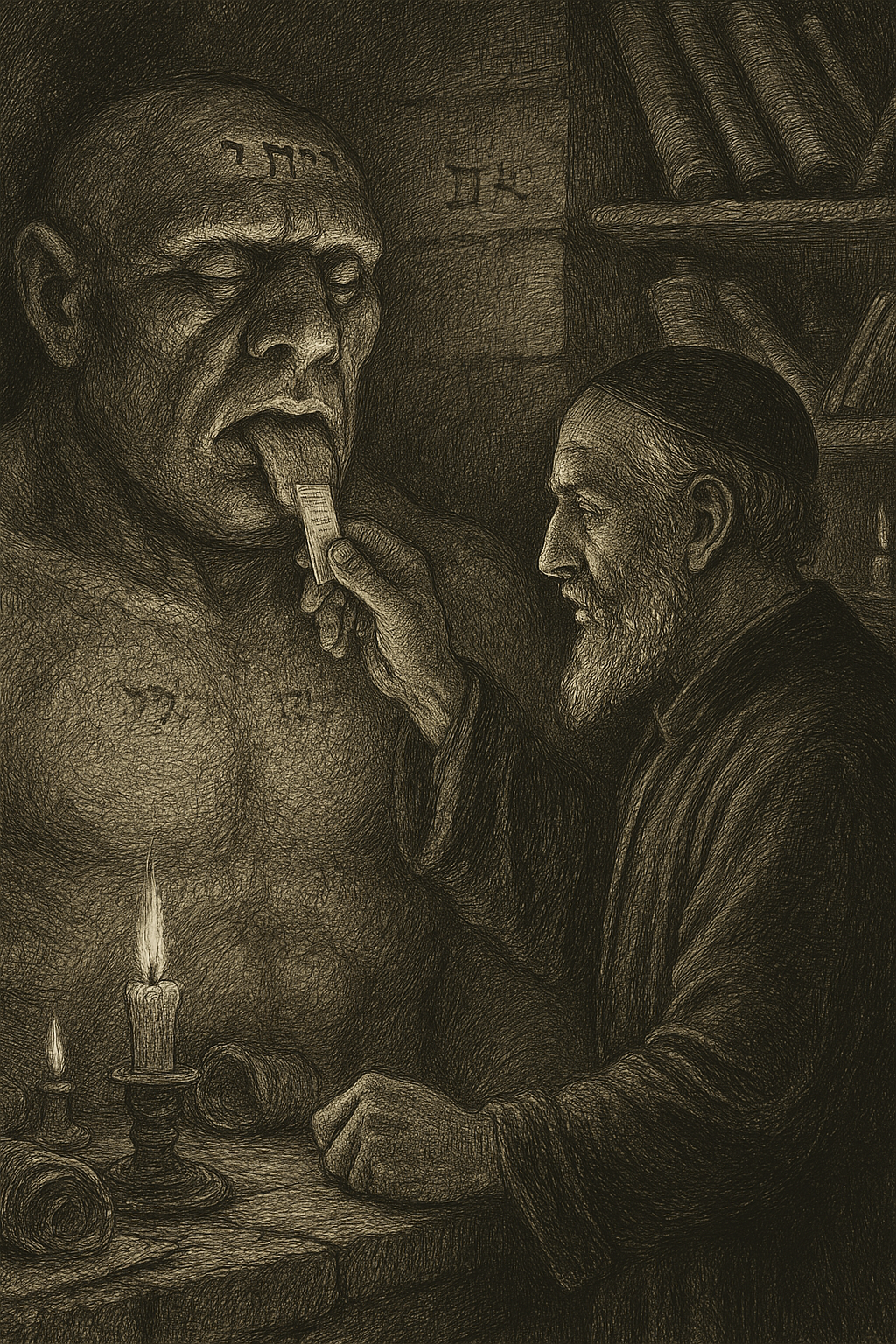
The Word Becomes Agent
The Golem introduces another extraordinary structure:
matter + symbolic information → agent
Machine as Programmed Being
In Jewish traditions, an artificial human may be formed from inorganic matter through esoteric knowledge.
Later popular versions emphasize sacred names, letters or words associated with animation and control.
The physical body alone is insufficient.
Information activates matter.
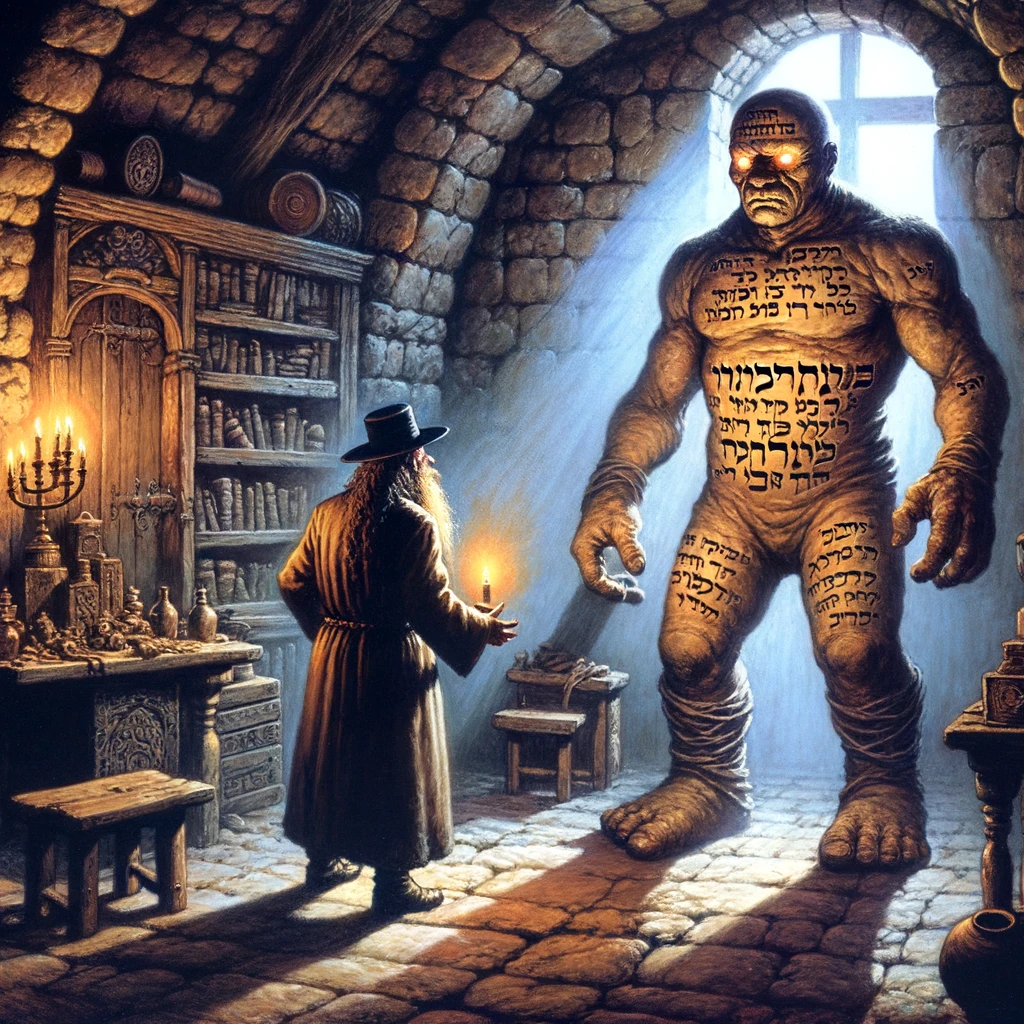
A Historical Warning: Prague
Myths themselves have histories.
The famous association between Rabbi Loew, Prague and a protective Golem is much later than Rabbi Loew himself.
The familiar Prague narrative develops gradually and becomes especially prominent in modern literary culture.
We must ask not only what a myth says, but when people began telling it that way.
Machine as Uncontrolled Creation
The servant is useful only while its behavior remains inside the creator's intentions.
creation → autonomy → unpredictability → fear
The question becomes:
Can the maker remain master of the made?
Machine as Monster
The monster violates categories:
object / subject
dead / alive
natural / artificial
tool / agent
controlled / autonomous
The frightening machine makes the boundary itself unstable.
A Mythological Bestiary of Machines
Human — Can we manufacture ourselves?
Servant — Can we delegate labor?
Prosthesis — Can we extend ourselves?
Lover — Can we manufacture intimacy?
Protector — Can we delegate protection?
Weapon — Can artificial agency project violence?
Guardian — Can it decide who may pass?
Oracle — Can it know what we do not?
Mirror — What does it reveal about us?
Monster — What if it escapes our intentions?
One Archetype Is Still Missing
The golden maidens can act.
Talos can guard.
Pygmalion's statue can live.
The Golem can obey.
The Argo can advise.
But their defining abilities are generally given to them.
What happens when the artificial being can change itself through experience?
Machine as Learner.
What Is a Learning Machine?
A traditional machine is built in a particular state and executes a structure provided by its maker.
A learning system differs in one decisive respect:
its encounter with the world changes what it subsequently does.
experience → internal change → changed future behavior
Two Histories
LEARNING
myth
initiation
memory
imitation
association
conditioning
adaptation
MACHINE
myth
technē
automata
mechanism
calculation
programmability
computation
LEARNING + MACHINE
The Persistent Question
The history of machines is also the history of what humans have wished to externalize.
strength
movement
memory
judgment
companionship
agency
learning
In Our Image
We first imagined machines as versions of ourselves.
Then we built machines that extended parts of ourselves.
Eventually we built machines capable of modifying themselves through experience.
The artificial being is ancient.
The learning machine is the historical novelty.
Discussion
Which archetype best describes your smartphone?
Which describes a large language model?
Which describes an autonomous vehicle?
Which describes social media?
Which describes the machines you imagine for the future?
And have genuinely new archetypes appeared?
Textual Anchors
Primary traditions worth returning to: Homer, Iliad XVIII; Apollonius Rhodius, Argonautica; Ovid, Metamorphoses X; the received Liezi; Jewish Golem traditions.
Golem
Argo: speaking Dodonian timber embedded in Athena's ship.
Talos: bronze guardian of Crete.
Pygmalion: desired artificial human brought to life.
Golem: artificial human animated through knowledge, letters or sacred language in evolving Jewish traditions.
Alles ist Zahl!
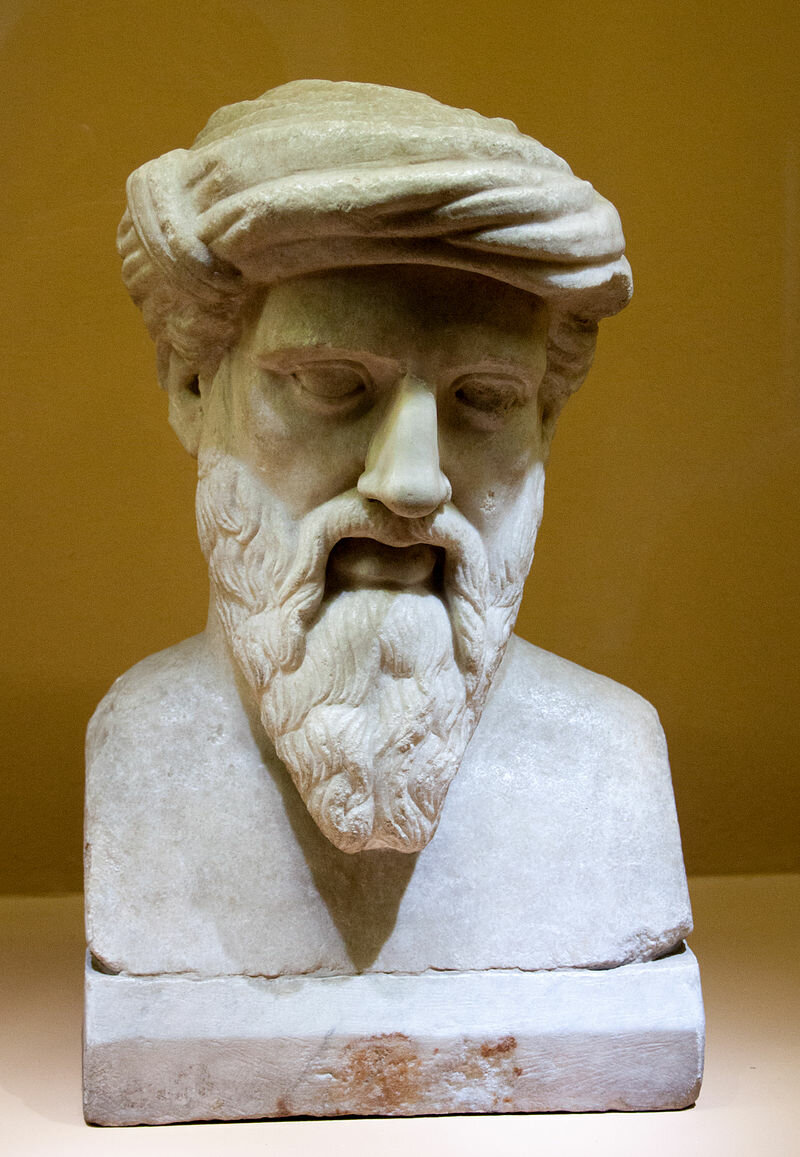
Pythagoras's Claim
“All is number.” (πάντα αριθμός) — attributed to Pythagoras, 6th century BCE.
For Pythagoras and his followers, numbers were not just a tool for counting. They were the hidden structure of reality itself — the ratios that govern music, geometry, even the harmony of the cosmos.
Today we trace that claim all the way to the silicon running inside your phone.
Why It Mattered
Here is the thread we will follow: a number can be written down in many different ways — and the way you write it changes what you can do with it.
That was true for Roman numerals. It is just as true for the floating-point formats inside a modern AI chip.
Counting Before Zero
Rome counted like this: I, V, X, L, C, D, M.
No zero. No place value — the position of a symbol barely matters, only which symbols appear and in what combination.
Try multiplying MDCLXVI by XLIV in your head. Now try 1666 × 44. The second one is not just easier — it is a genuinely different kind of thinking.
An Older Theorem
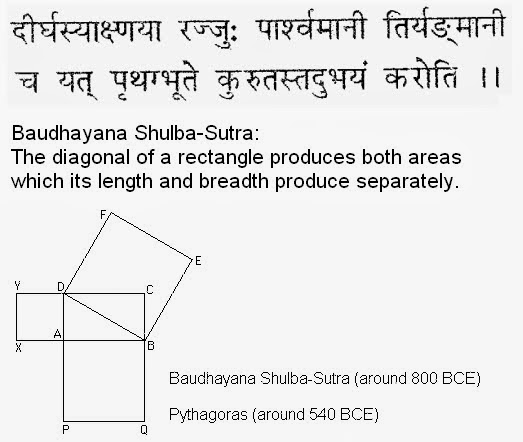
Centuries before Pythagoras, the Baudhayana Sulba Sutra (India, c. 800 BCE) already states the same relationship between the sides of a right triangle.
The mathematics was not a single European discovery — it was discovered, independently and repeatedly, wherever people needed to measure, build, and trade.
The Missing Symbol
Every numeral system so far shares the same gap: no symbol for nothing.
Without a zero, there is no clean way to write a number as a position-dependent code — and without position, arithmetic stays a craft for specialists, not a procedure anyone can follow.
The Invention of Zero
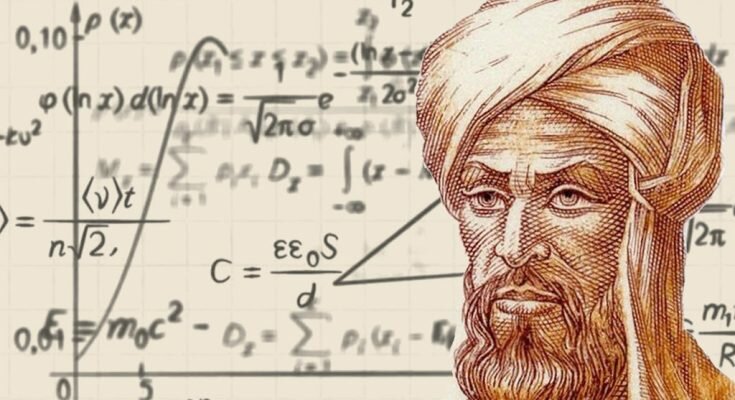
Zero emerges independently more than once: among the Maya of Mesoamerica, and in India, where the mathematician Brahmagupta (7th century CE) is the first to give it formal rules of arithmetic.
It reaches the Islamic world through scholars like Muhammad ibn Musa al-Khwarizmi (9th century), whose own name — Latinized as algorismus — gives us the word algorithm.
A number system and a method for calculating with it arrive together. That is not a coincidence.
Zero Reaches Europe
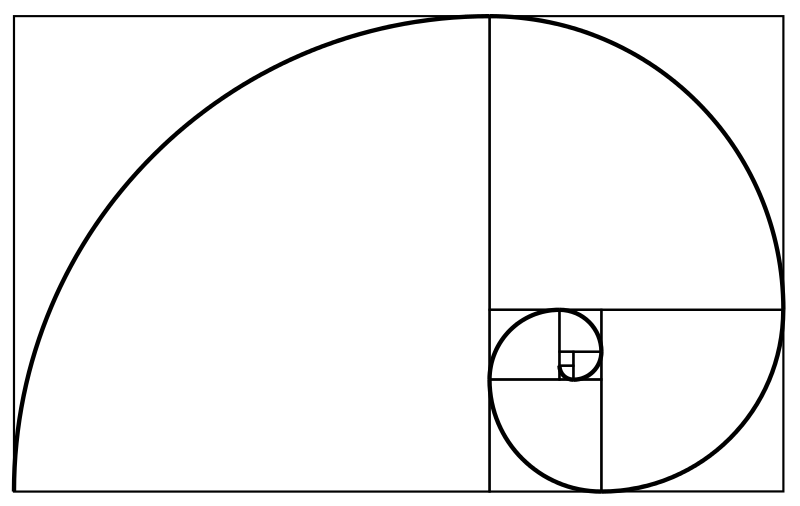
In 1202, Leonardo of Pisa — better known as Fibonacci — publishes Liber Abaci, introducing Hindu-Arabic numerals (zero included) to European merchants.
The pitch was practical: this notation makes bookkeeping and trade dramatically easier than the Roman system merchants were already using.
Positional Notation
Here is the real leap: the same ten symbols, re-used, mean something different depending on where they sit.
106 and 160 use identical digits. Position alone carries the meaning.
This single idea — a small, finite alphabet whose meaning depends on position — is the one that modern computing was built on top of.
Leibniz's Dream
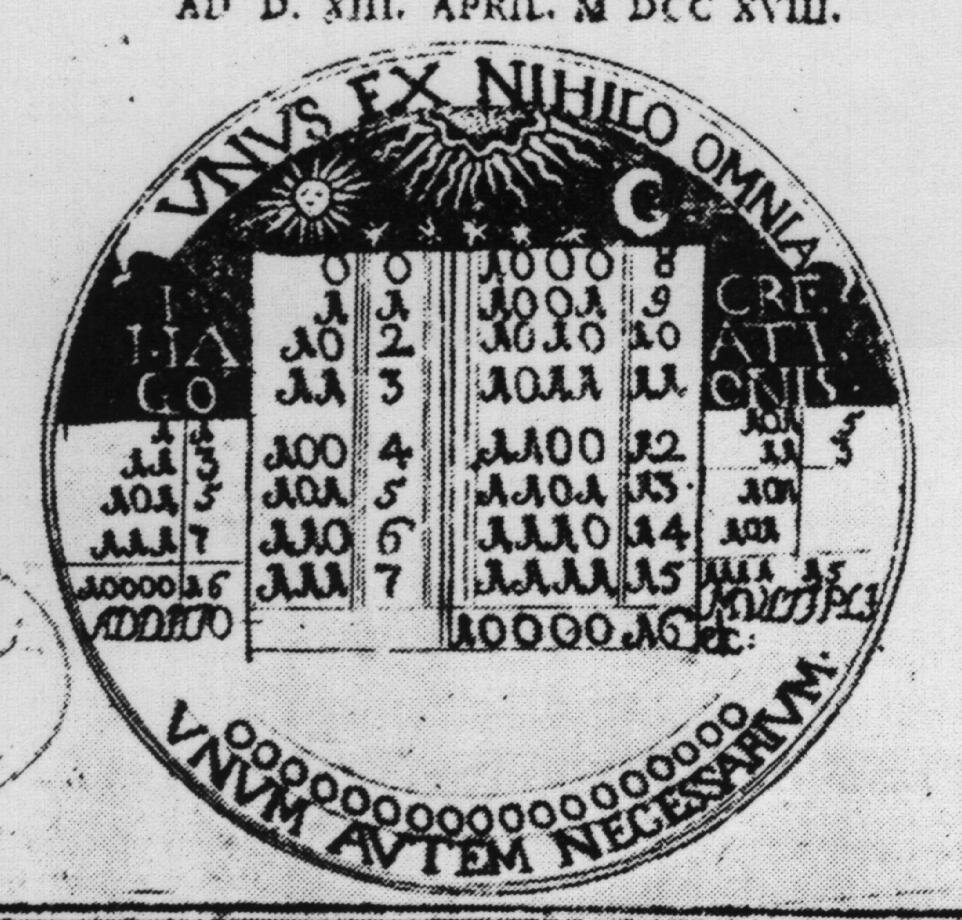
Gottfried Wilhelm Leibniz takes positional notation somewhere further: in 1703, he formally describes arithmetic in base 2 — binary.
He was reportedly delighted to find the same two-symbol logic echoed in the hexagrams of the I Ching, and saw in binary something close to a theological image: everything created from nothing (0) and unity (1).
Three centuries later, his once-mystical number system runs every computer on Earth.
Why Base Two?
Binary is just another positional system — base 2 instead of base 10. Only two symbols: 0 and 1.
That turns out to be the whole point. Building a reliable physical device with ten stable, distinguishable states is hard. Building one with two — voltage on, voltage off — is comparatively easy, cheap, and extremely reliable at enormous scale.
Every transistor in every chip is, at heart, a two-state switch pretending to be one of Leibniz's digits.
From Numbers to Logic
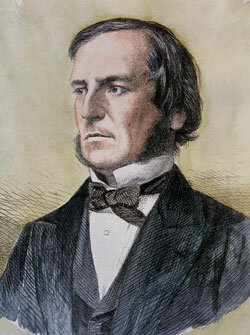
George Boole (1854) notices that 0 and 1 can represent more than quantity — they can represent truth: false and true.
Boolean algebra — AND, OR, NOT — becomes the logical skeleton underneath every circuit in every digital machine.
The same two symbols now carry both arithmetic and logic. That overlap is why a computer can calculate and also decide.
Bits, Bytes, and Beyond
One binary digit is a bit. Group eight of them and you get a byte — 256 possible values.
Hexadecimal (base 16) exists purely as a convenience: one hex digit covers exactly 4 bits, so two hex digits describe a whole byte cleanly — far easier for a human to read than a string of eight zeros and ones.
You already used one today, probably without noticing: a colour code, a MAC address, a cryptographic key — all hexadecimal shorthand for binary underneath.
A New Question
So far: how a culture chooses to write a number. Now: how a machine chooses to store one — and why, in a modern AI system, that choice is no longer a historical curiosity.
It is an engineering decision with real, measurable consequences.
Integers vs Floats
Integer formats store whole numbers exactly. int8: one byte, 256 distinct values — typically -128 to 127.
Floating-point formats trade some of that exactness for enormous range: a sign bit, an exponent, and a mantissa (the significant digits) — the same idea as scientific notation, just in binary.
More bits generally buys you more precision, more range, or both. Fewer bits buys you speed and memory — at a cost.
f16 vs bf16
Both fp16 and bf16 use 16 bits total — half the size of ordinary fp32 — but split those bits differently.
fp16 (IEEE half precision): 1 sign + 5 exponent + 10 mantissa bits. More precision, a narrower range — values that are too large or too small simply overflow to infinity or zero.
bf16 ("brain float", from Google): 1 sign + 8 exponent + 7 mantissa bits. The same exponent range as full 32-bit floats, less precision — far more forgiving during the unstable arithmetic of training a neural network.
Same bit budget. Different trade-off between "how exact" and "how big."
Why int8 for Inference
Models are usually trained in fp16, bf16, or fp32 — the precision that stability during training needs.
Once trained, they are often quantized down to int8 for inference (actually running the model): roughly a quarter of the memory of fp32, and hardware built for int8 can push through far more operations per second than the same silicon running floating point.
The accuracy cost is usually small. The speed and energy savings, at the scale a real deployment runs at, are not.
Case Study: NVIDIA Jetson Orin
Take a real, current piece of edge-AI hardware: NVIDIA's Jetson AGX Orin (64GB module).
NVIDIA's own published figure: up to 275 TOPS (trillion operations per second) running INT8, with structured sparsity.
Switch the same chip to FP16 / BF16 and achievable throughput drops — roughly by half, since each floating-point operation occupies more of the tensor core's datapath than an 8-bit integer one.
Same transistors. Same chip. The number format you choose to compute in changes your real-world throughput by a factor of two or more.
Closing: Same Question, New Stakes
Pythagoras claimed number was the hidden structure of reality.
Three thousand years later, the question "what exactly is this number, and how many bits does it cost to represent it" is no longer philosophy — it decides how fast your model runs, how much it costs to train, and how much energy it burns doing so.
The history of numerals is, in a very literal sense, the history of computation.
Unplugged #0
Cogs, Steam, Algorithm
In which the reader is asked, quite simply, What is an Algorithm? — and finds the answer rather older, and rather stranger, than expected.
Being an account of cogs and looms and engines of brass; of Signor Pascal's calculating box and Mr. Babbage's unbuilt Engines; of a certain Lady Lovelace who saw further than most; and of sundry other contrivances got up by ingenious persons long before any machine was called a computer.
Wherein two short films are watched, in the company of a partner to be consulted not once but twice; wherein old Euclid's method is recalled, some two thousand years and more since first he wrote it down; and wherein, at the last, the curious Persian origin of a word now spoken a thousand times a day — one al-Khwarizmi's own — is at length discovered.
Question of the Day
Question of the day: What is an algorithm?
You already use the word casually — "the algorithm" recommends your videos, "the algorithm" decides your feed. But what, precisely, is one?
By the end of today's session you'll have a real definition — and you'll know where the word itself came from.
First Thoughts
Turn to the person next to you. Two minutes, no googling.
Together, try to answer: what is an algorithm? Give one example each, if you can.
Don't worry about being "right" — we'll come back to this twice more today, and compare notes.
Watch: Early Computing
Before the word, there were the machines. Crash Course Computer Science #1: Early Computing — from the abacus to Herman Hollerith's punch cards.
What Did You Notice?
What surprised you?
Notice how many of these — the abacus, Pascal's calculator, the Jacquard loom, Babbage's engines — are not computers in our sense at all. They're physical machines for carrying out a fixed, repeatable procedure.
That procedure, independent of whatever metal or wood or silicon carries it out, is the thing we're actually interested in today.
From Cogs to Concept
Strip away the brass gears, the steam, the punch cards — what's left in each of those machines is the same abstract thing: a precise, repeatable sequence of steps that turns some input into some output.
That sequence of steps is an algorithm. The machine is just one possible body for it to live in.
A Working Definition
An algorithm is a finite, well-defined sequence of steps that transforms a given input into a desired output.
Finite — it has to actually end, eventually.
Well-defined — each step is unambiguous; anyone, or anything, following it correctly gets the same result.
Input / output — it does something to something.
An Everyday Algorithm
You run algorithms all the time without a computer in sight.
A recipe: fixed steps, specific ingredients (input), a finished dish (output).
Long division, tying your shoelaces, the instructions for assembling furniture — all algorithms, in the strict sense.
Computers didn't invent algorithms. They just got extremely good at running them fast.
Older Than Computers
Euclid described an algorithm for finding the greatest common divisor of two numbers around 300 BCE — still taught today, still called Euclid's algorithm.
Long division as you learned it in school is centuries old. Knitting patterns are algorithms. So is a court protocol, or a recipe passed down for generations.
The concept is ancient. Only the name is comparatively recent — and it has a surprisingly specific origin.
Second Thoughts
Back to your partner. Compare: how close was your first guess to the definition we just built together?
This time, try to name an algorithm from your own daily life that has nothing to do with computers.
Where Does the Word Come From?
"Algorithm" doesn't come from Greek, like most technical vocabulary in mathematics. It comes from a name.
Whose?
Watch: Why Algorithms Are Called Algorithms
A short answer, in under three minutes — BBC Ideas: Why algorithms are called algorithms.
Al-Khwarizmi and the Birth of a Word
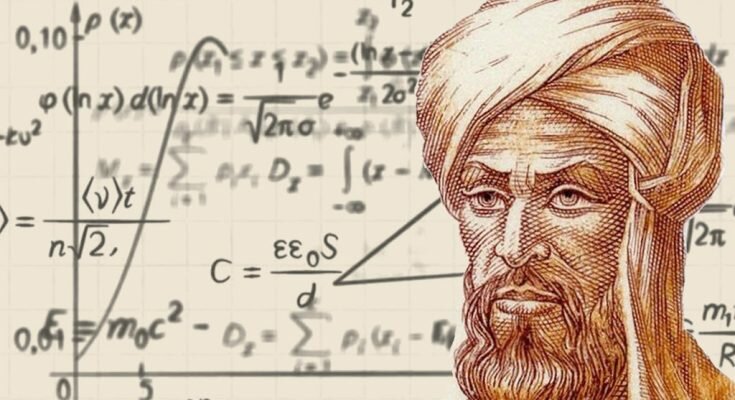
Muhammad ibn Musa al-Khwarizmi, a 9th-century Persian scholar working in Baghdad's House of Wisdom, wrote a treatise on systematic methods for solving equations.
His name, Latinized centuries later as "algorithmi," became attached to the step-by-step methods he described — and eventually to the general concept itself.
(His other book's title gave us a second word: al-jabr — "algebra.")
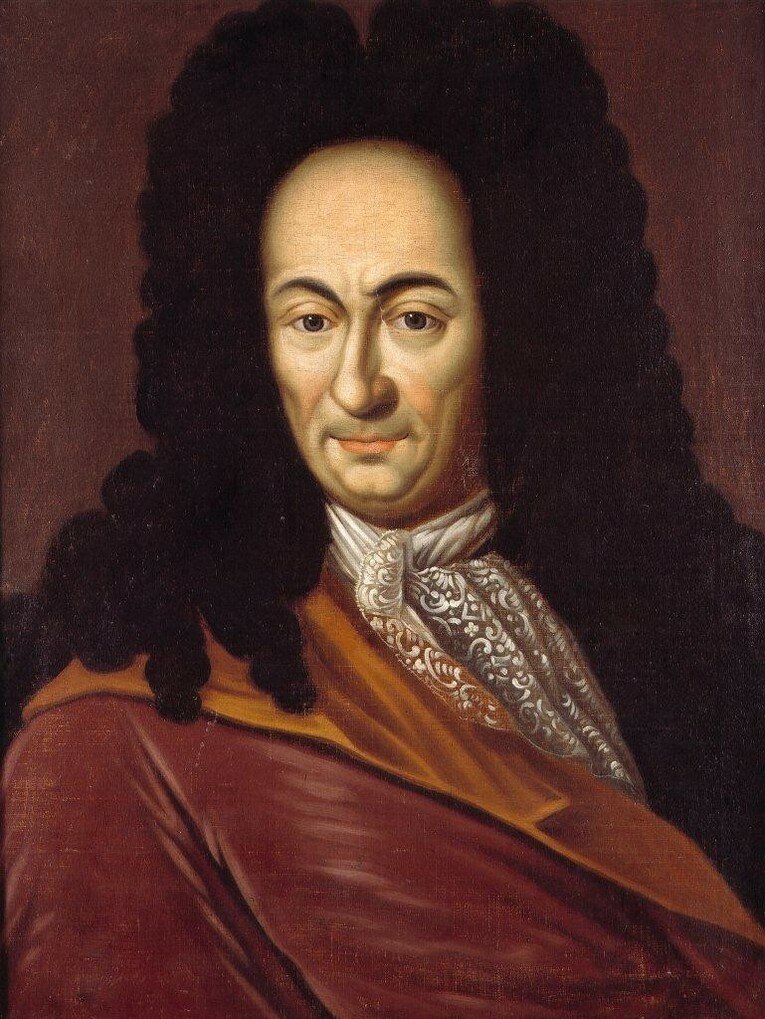
Interlude: Pascal, Leibniz, and the Baroque
Rewind two centuries. Long before Babbage, long before steam, the same ancient appetite for mechanizing the mind was already stirring — in the Baroque.
In 1642, at nineteen, Blaise Pascal built the Pascaline to help his father with tax calculations — a gear-driven adding machine, among the first of its kind ever built and sold.
A generation later, Gottfried Wilhelm Leibniz — one of the last true polymaths, equally at home in philosophy, law, and mathematics — went further still, designing the Stepped Reckoner: a machine that could multiply and divide, not merely add and subtract.
Leibniz wanted more than a calculator. He dreamed of a calculus ratiocinator — a universal symbolic method by which any dispute, of any kind, could in principle be settled by calculation alone: "Let us calculate."
Cogs and steam would eventually belong to Babbage's century. But the dream — that reasoning itself might be mechanized — is, properly speaking, Baroque.
Steam and the Jacquard Loom
By the early 1800s, the Industrial Revolution had already proven something remarkable: steam and gearwork could replace human muscle at scale.
Joseph-Marie Jacquard's loom (1801) went one step further — it replaced not just labor, but a kind of decision-making. A chain of punched cards, read mechanically, told the loom exactly which threads to raise for every single pass of the shuttle.
Change the cards, change the pattern. The procedure — the algorithm — was now separate from the machine that executed it, encoded on something you could hold in your hands.
Babbage noticed. He planned to use these very same punched cards to feed instructions into his own Analytical Engine.
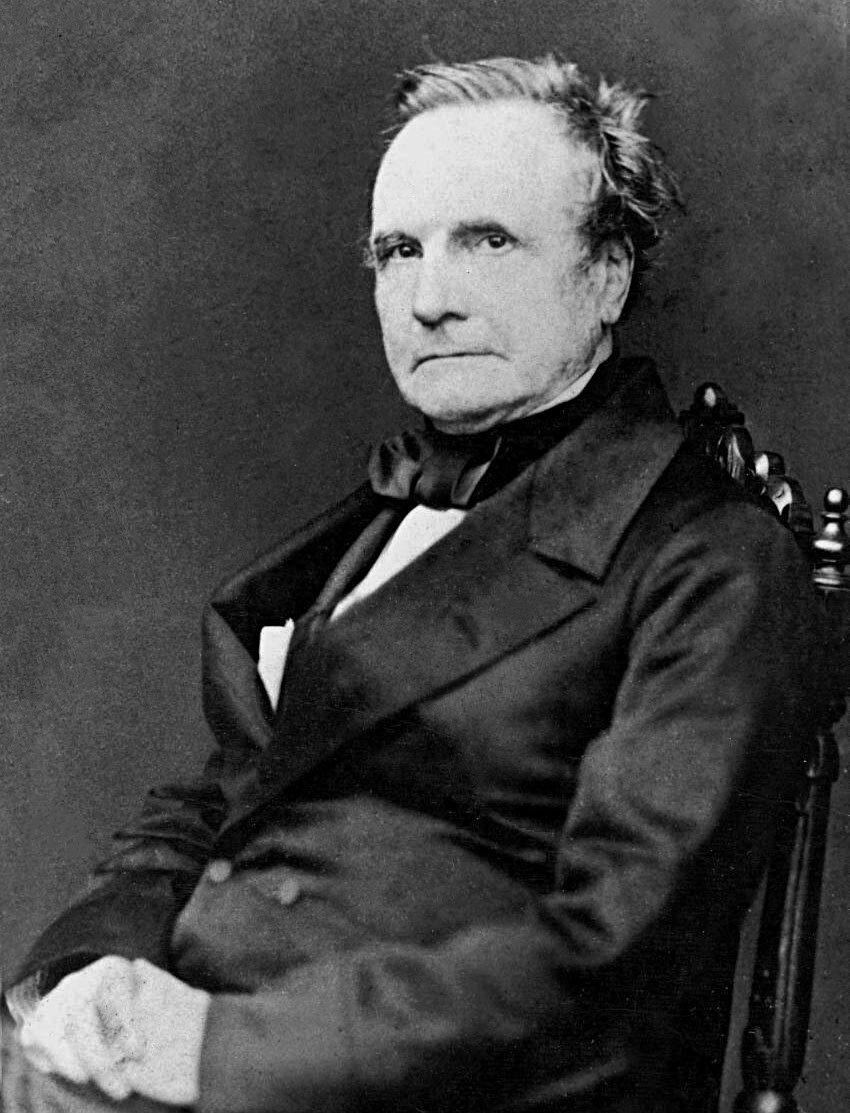
Charles Babbage's Engines
Charles Babbage (1791–1871) — mathematician, philosopher, mechanical engineer, and by most accounts a thoroughly restless Victorian gentleman.
His Difference Engine was a mechanical calculator, designed to compute polynomial values automatically — and to print the results, removing human error from mathematical tables.
His far more ambitious Analytical Engine was something else entirely: a general-purpose, programmable computer — a century before electronics made one practical. It had a "mill" (processor), a "store" (memory), and was to be fed instructions on Jacquard-style punched cards.
He never finished building it. But he had, in effect, designed a computer.
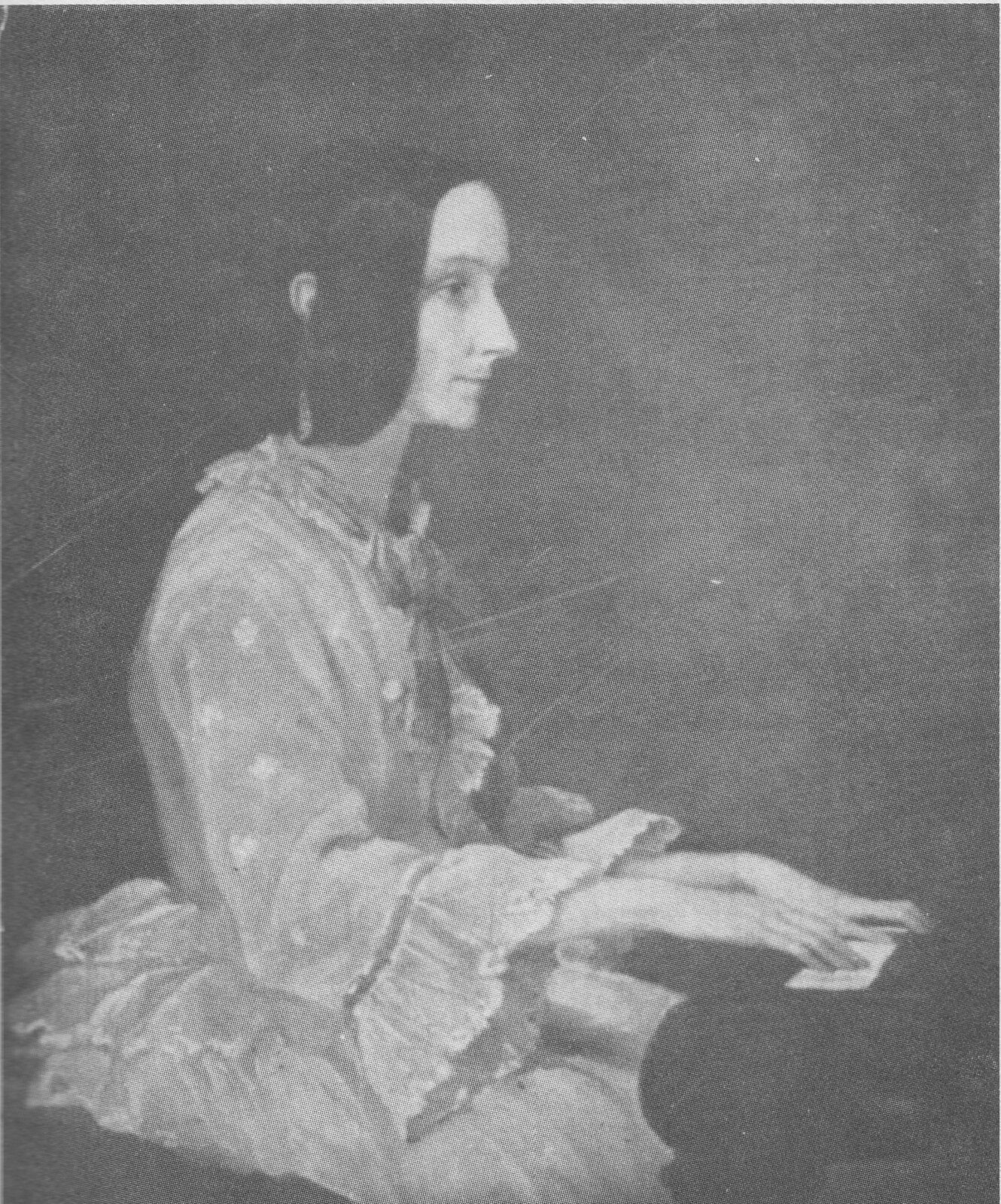
Ada Lovelace, the First Programmer
Augusta Ada King, Countess of Lovelace (1815–1852), daughter of Lord Byron, was trained rigorously in mathematics from childhood — and became Babbage's closest intellectual collaborator.
In 1843, translating an Italian paper on the Analytical Engine, she added her own notes — three times longer than the original text. Among them: a step-by-step method for the Engine to compute Bernoulli numbers.
That method is widely considered the first published algorithm written specifically for a machine — making Lovelace, by most accounts, the first computer programmer, over a century before there was a computer to run it on.
She also saw further than Babbage himself: the Engine, she wrote, might one day manipulate not just numbers, but music and symbols of any kind. Others called her the Enchantress of Numbers.
One More Name: George Boole
One more figure worth knowing, even briefly: George Boole (1815–1864), who in 1854 published The Laws of Thought — reducing logical reasoning itself to a kind of algebra, with only two values: true and false.
Boolean algebra sat unused for decades as a philosophical curiosity. In the 20th century it became the literal switching logic inside every digital circuit ever built.
Babbage's engine, Lovelace's program, Boole's logic — three separate threads in the 1800s, waiting nearly a hundred years for electronics to braid them together. We'll pick that thread up again later in this course.
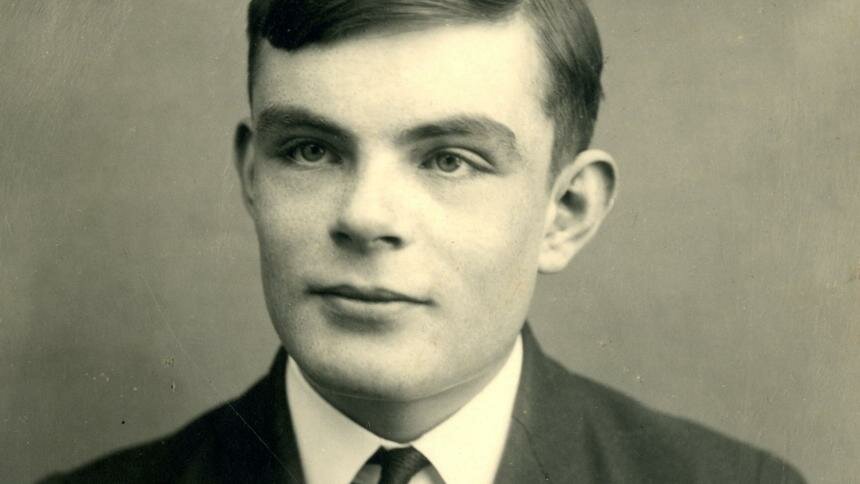
Closing: What's Next
Today: a definition, a history, a name.
Next week: Alan and his Enigma — the story of Alan Turing, his machine(s), and his test(s).
We'll meet the Turing machine that finally gave "algorithm" a single, rigorous, universal meaning — and ask what happens when the body running one never gets tired, never gets bored, and never stops.
Alan and his Enigma
Watch: Alan Turing's Machines
We start with a 1966 BBC programme, made twelve years after his death.
While you watch, keep one question in mind: what is this “machine” made of?
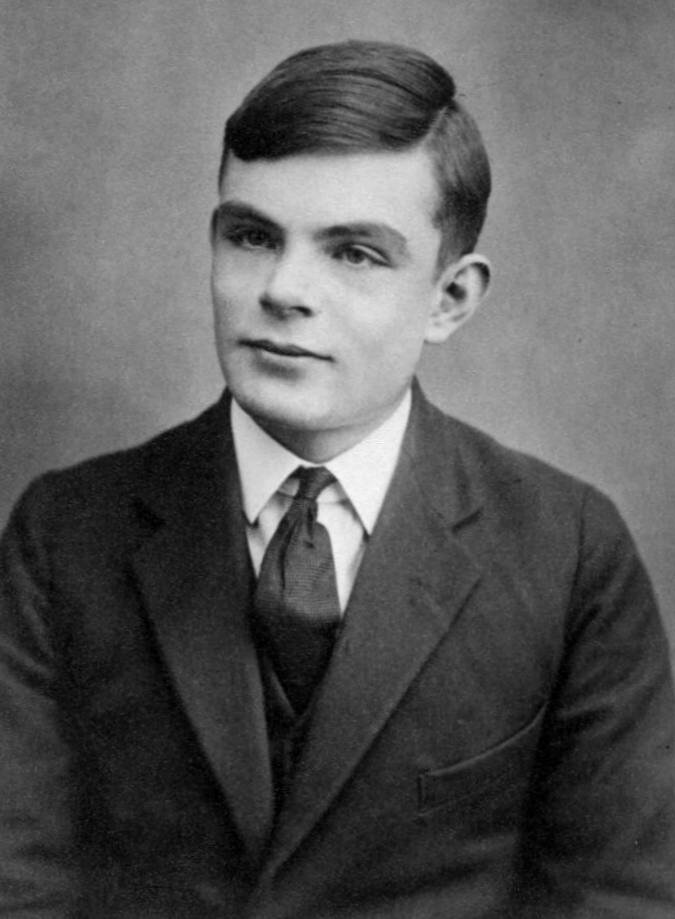
Alan Matthison Turing (1912–1954)
Born in London, 23 June 1912. Mathematician: Cambridge, then Princeton.
1936, aged 23: On Computable Numbers — the paper that defines the computer before any computer exists.
1939–45: Bletchley Park, breaking German naval Enigma.
1945–50: designs an electronic computer; 1950: Computing Machinery and Intelligence.
1952: convicted for homosexual acts, chemically castrated. 7 June 1954: dead of cyanide poisoning, aged 41. Royal pardon: 2013.
The man who asked whether machines can think was not allowed to be what he was.
The imitation game
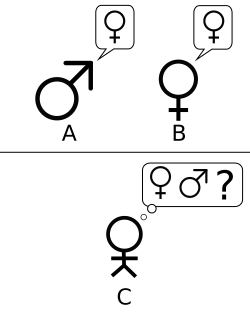
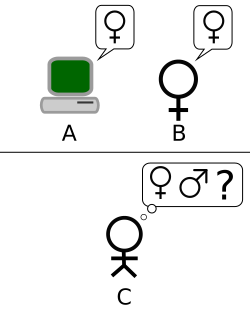
The game as Turing wrote it
Turing refuses to define “think”. He calls the question “too meaningless to deserve discussion” and replaces it with a game.
Three players: A (a man), B (a woman), C (the interrogator, in another room). C types questions and must tell who is the woman. A tries to deceive. B tries to help.
Now let a machine play A. Does C get it wrong as often as before?
His prediction: around the year 2000, an average interrogator would have no more than a 70% chance of a right identification after five minutes.
The game is called imitation — and it is about gender, deception and performance.
Turing test
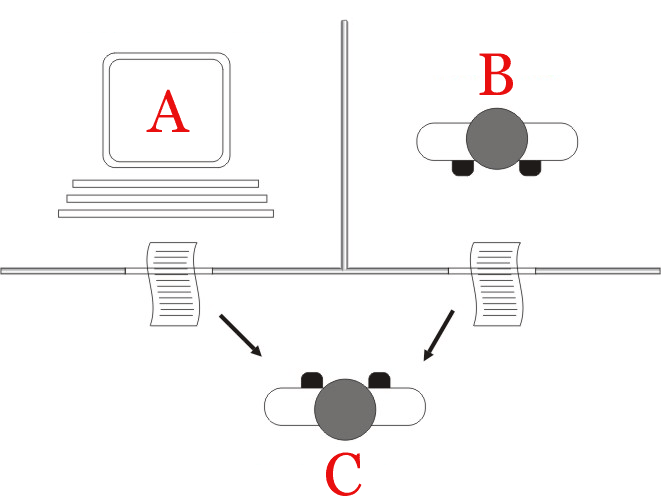
"A TT is a way how to address the question "Can machines think?" in a scientifically plausible ye deeply empathic way. More concretely, Turing (1950) proposes that the performance of an AA under question shall be evaluated by a human judge J whose objective is to determine which among two entities - with whom J is in real-time interaction - is of human and which is of artificial nature." (Hromada, 2012)
Watch: Can machines think?
The famous question, in video form.
While watching, note the one objection you would raise.
Turing answers his critics
Section 6 of the paper lists nine objections, among them theological, mathematical, from consciousness — and Lady Lovelace's.
Lovelace (1843): the Analytical Engine “has no pretensions to originate anything. It can do whatever we know how to order it to perform.”
Turing: machines surprise me all the time. And instead of programming an adult mind, build a child machine and educate it.
Keep that sentence. It is the first mention of a learning machine.
Does the test still work?
ELIZA (Weizenbaum, 1966): a few pattern rules, and some users confided in it anyway.
The Chinese Room (Searle, 1980): symbols shuffled correctly, nothing understood.
Recent controlled studies report that large language models are judged to be human about as often as, or more often than, real humans (Jones & Bergen).
The test measures our credulity as much as the machine's intelligence.
Exercise · Meet Alan
Alan is a Matrix bot (@alan:udk.ai) running on our own server. You will chat with “Alan” — but behind him may be an AI persona or another student. Alan relays every message, so you are never told which is which.
How to reach him: in Element (with your account on udk.ai or medienhaus.udk-berlin.de) start a direct message with @alan:udk.ai and type start.
Alan pairs you with a waiting fellow student or with an AI persona. After a few minutes he asks: “Am I a human or AI?” Then comes the reveal: which persona (and model) it was — or, if you spoke with a human, who.
Good to know: Alan cannot read encrypted chats, so use a normal unencrypted DM (if you invite him to an encrypted one, he leaves and opens a fresh DM with you). The conversations are stored for the course evaluation — don't share anything private.
Try Turing's own questions: “Please write me a sonnet on the Forth Bridge.” “Add 34957 to 70764.”
Decide: human or machine? Write down the three cues that decided it.
Turing's machine answered 105621. The right answer is 105721.
Debrief · What gave him away?
Which cues did you use? Speed? Spelling? Politeness? Never saying “I don't know”? A body, a weather, a bad day?
Humans make typos and slip. Turing wrote that a machine should deliberately introduce mistakes to be convincing.
Which cues tell you about the machine, and which only about your expectations of humans?
Back to your criterion from the Question of the Day: did Alan meet it?
Enigma
Enigma: a German cipher machine. Press a key, a different letter lights up — and the rotors turn, so the next key is scrambled differently.
Bletchley Park: Turing designs the Bombe, a machine that hunts for the day's settings (building on Polish work).
A machine breaking a machine.
And enigma is also what we call a riddle. Keep both meanings in mind.
The question Hilbert asked
1928, David Hilbert: is there a mechanical procedure that decides, for any mathematical statement, whether it is provable?
Leibniz had dreamed of it: let us calculate.
1931, Kurt Gödel: every consistent formal system has true statements it cannot prove.
1936, Alonzo Church and Alan Turing, independently: no such procedure exists.
But to prove that nothing can be done, you first need to say exactly what “a procedure” is.
Computers were people
Until the 1940s a “computer” was a person who computes — often a woman with pencil and paper at a desk.
Turing asks: what does such a person actually do?
Looks at a symbol. Writes a symbol. Changes their state of mind. Moves on to the next square.
Strip away everything else:
a tape, a head, a finite list of rules.
a Turing machine #1
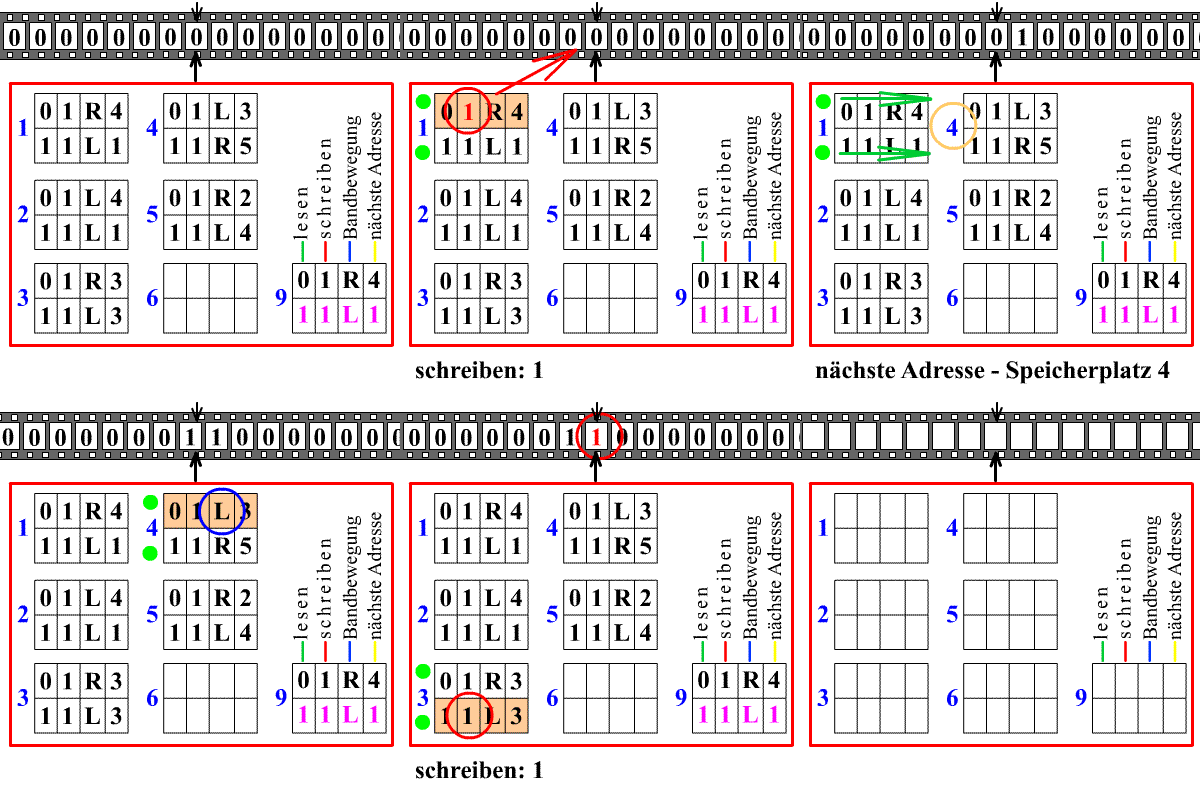
- tape with discrete symbols
- reading/writing header
- table of rules
- tape-moving mechanism
Exercise · Be the machine
The tape holds a binary number: 1 0 1 1. The head stands on the rightmost digit. State: CARRY.
CARRY reads 1 → write 0, move left, stay in CARRY
CARRY reads 0 or blank → write 1, STOP
Run it with pencil and paper. What is on the tape when it stops? Now try 1 1 1.
It adds one: 1011 → 1100, 111 → 1000. Three rules, no understanding.
Anything you would call an algorithm can be written as such a table (Church–Turing thesis).
Exercise · Your hand is a Turing machine
Counting from 0 to 31 on the fingers of one hand is a Turing machine at work. Here is its anatomy:
Tape — your five fingers: thumb = rightmost cell, little finger = leftmost. Symbols — 1 finger up, 0 finger down.
Head — the finger you are looking at; it starts on the thumb. States — CARRY (start) and HALT.
Transition rulesCARRY reads 1 → write 0 (fold it down), move left, stay in CARRYCARRY reads 0 → write 1 (raise it), HALT
One run = one count. Take 7 → 8: tape 0 0 1 1 1. Thumb 1→0, index 1→0, middle 1→0, ring 0→1, halt: 0 1 0 0 0.
Counting to 31 means starting the machine 31 times (57 steps in all). Same two rules every time; nothing in it “knows” what a number is. Adding two numbers on two hands is the same idea with a bigger rule table.
Now count up from 31: the head falls off the left end. Turing's tape is infinite; your hand is not. Borrow your other hand — or paper — and keep going.
Universal Turing machine
The tape can hold a machine
A universal machine reads the rules of another machine from its tape and behaves like it.
Program = data. Your laptop is such a machine; an app is just a long tape.
And a program that treats programs as data can also change them. Hold on to this for the learning machines.
Halting Problem
- halting problem is the problem of determining, from a description of an arbitrary computer program and an input, whether the program will finish running (i.e., halt) or continue to run forever
- Turing proved that a general algorithm to solve the halting problem for all possible program-input pairs cannot exist
- to prove this, he described a paradox involving a concept now known as "Turing machine"
Halting · the trick in four lines
Suppose a program H(p, x) always answers correctly: “p halts on x” or “p loops forever”.
Build D(p): ask H(p, p). If it says halts, loop forever. If it says loops, stop.
Run D on itself. Halts if and only if it loops.
Contradiction: H cannot exist. Some questions about programs no program can answer.
Question of the Day · Can machines think?
Turn to your neighbour. Two minutes.
What would a machine have to do for you to say “yes, it thinks”?
Write the criterion down.
We will test it at the end of the session.
philosopher's definition of "thinking"
Computational machinery and intelligence (1950)
The enigma remains
Turing machine: what can be computed — defined by what a procedure does, not what it is made of.
Turing test: what we will call intelligent — defined by how it behaves toward us.
The question moves from “what is it?” to “what does it do with us?”
Next: Claude, Marvin, John &c. — from information theory to Dartmouth.
Claude, Marvin, John &c.
Machine Learning #0
The Latent Space
Unplugged #1
The Omega Point
Language models
Artificial Agents
Central Problem of AI ethics
Human-Machine Peer Learning
Machines and humans can learn with each other
Logic, Gates, Machine
In which the reader is made acquainted with a most singular Algebra, wherein there are but two numbers, and the sum of one and one is nothing at all.
Being an account of Mr. Boole’s Laws of Thought, set down in the year 1854 by a Professor of Queen’s College, Cork; of young Mr. Shannon’s relays, and the little gates that came of them; and of how one humble operation — the adding of One to a number — may be performed in three several fashions: by Logic, by Wire, and by the Machine of Mr. Turing.
Wherein the reader is required to lend a thumb, and to consult a partner upon sundry occasions; wherein it is demonstrated that the Carry may very conveniently be kept upon the thumb of the other hand; and wherein, at the last, Logic, Circuit and Machine are discovered to be one and the same contrivance in three different coats.
philosopher's definition of "thinking"
Who Does the Thinking?
It is misleading then to talk of thinking as of a “mental activity”. We may say that thinking is essentially the activity of operating with signs. This activity is performed by the hand, when we think by writing; by the mouth and larynx, when we think by speaking; and, if we think by imagining signs or pictures I can give you no agent that thinks.
If then you say that in such cases the mind thinks, I would only draw your attention to the fact that you are using a metaphor, that here the mind is an agent in a different sense from that in which the hand can be said to be the agent in writing.
If again we talk about the locality where thinking takes place we have a right to say that this locality is the paper on which we write; or the mouth which speaks.
— Ludwig Wittgenstein, The Blue Book (1933–1934)
Keep this in mind today: in our exercises, whose hand does the thinking, and where is the carry kept?
Question of the Day
Question of the day: why does counting in binary work — and what is a machine doing when it counts?
You already know how: fold every 1 down, carry to the left, raise the first 0. You did it with a hand and with a Turing machine.
Today we ask why. One algorithm — add 1 — seen in three languages: Logic (Boole), Wire (Shannon), Machine (Turing).
Bring a thumb. Bring a partner. Both will be needed.
Warm-up · Count Together
In pairs. One of you counts in binary on one hand, from 0 up to 11. The other watches and says “stop!” at the first mistake.
Swap. Then count from 0 1 1 1 (7) — what happens, and who remembers the carry while the fingers fold down?
Keep that question. The rest of the session is its answer.
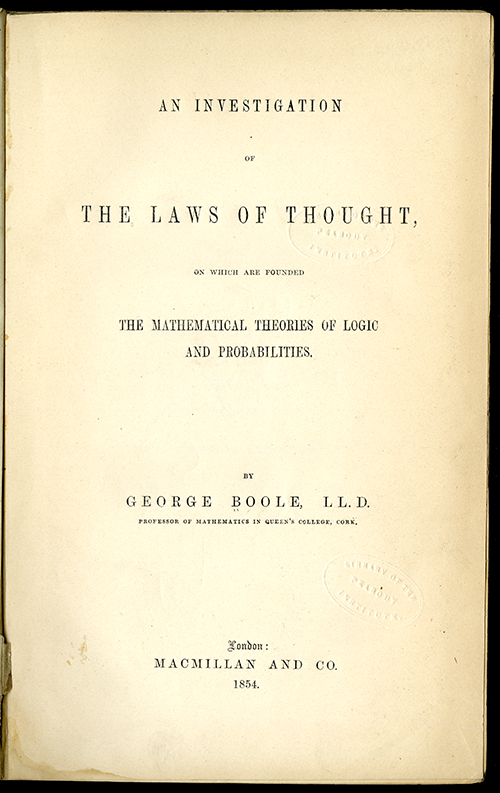
Two Values
1854: George Boole, professor at Queen’s College Cork, publishes An Investigation of the Laws of Thought.
His claim: reasoning itself can be calculated — like algebra — if every statement is reduced to just two values: 1 (true) and 0 (false).
Leibniz’s old dream (calculemus!), now with rules.
A thumb is a perfect Boolean variable: up = 1, down = 0.
Three Operations
NOT flips: NOT 1 = 0, NOT 0 = 1.
AND: true only if both are true (both thumbs up).
OR: true if at least one is true.
| a | b | a AND b | a OR b |
|---|---|---|---|
| 0 | 0 | 0 | 0 |
| 0 | 1 | 0 | 1 |
| 1 | 0 | 0 | 1 |
| 1 | 1 | 1 | 1 |
The Fourth: XOR
XOR (exclusive or): true if the two inputs differ — one thumb up, not both.
| a | b | a XOR b |
|---|---|---|
| 0 | 0 | 0 |
| 0 | 1 | 1 |
| 1 | 0 | 1 |
| 1 | 1 | 0 |
Note the last row: 1 XOR 1 = 0. Remember it — it will carry the whole session.
Which “or” Do You Mean?
In everyday speech “or” is ambiguous. Logic must not be.
| sentence | reading |
|---|---|
| “Soup or salad?” (the menu) | XOR — not both (unless you pay extra) |
| “Smoke or heat sets off the alarm.” | OR — and certainly if both |
| “Are you leaving today or tomorrow?” | XOR — you cannot leave twice |
| “Bring a note from your doctor or your parents.” | OR — two notes are no problem |
| “Milk or sugar in your coffee?” | unclear! Both, surely? |
Latin had two words for it: vel (inclusive: “one or the other or both”) and aut (exclusive: aut Caesar aut nihil). English has just one — and relies on you to guess.
Ambiguity by Design
Lawyers and programmers cannot afford to guess:
Contracts write “and/or” (inclusive) and “either … or …, but not both” (exclusive), because courts have argued over a bare “or”.
Programming languages give the two meanings different symbols: a || b (or) and a ^ b (xor).
Linguists note that the exclusive reading is often not part of the word at all: we infer “not both” (“if she could say ‘and’, she would have”).
This is Boole’s move: give each meaning its own symbol, and the ambiguity disappears — for a machine, there is no “you know what I mean”.
Exercise · Or or Xor?
In pairs. Take turns reading these sentences aloud; your partner decides OR or XOR and defends the choice with one sentence about the situation:
• “You can pay by card or cash.” • “Students or staff may enter.” • “A fine of fifty euros or three days in jail.” • “She speaks German or French.” • “Take the lift or the stairs.”
Which ones did you disagree on? Notice what you used to decide: not the word “or”, but knowledge of the world.
Now write one real sentence of your own in which the two readings lead to different consequences — a rule, a promise, a threat. Swap, and rewrite your partner’s so it can only be read one way.
Exercise · Thumb Logic
In pairs. Each of you hides a thumb behind your back (up = 1, down = 0) and shows it on three. The teacher calls the gate:
| a | b | AND | OR | XOR | NAND |
|---|---|---|---|---|---|
| 0 | 0 | 0 | 0 | 0 | 1 |
| 0 | 1 | 0 | 1 | 1 | 1 |
| 1 | 0 | 0 | 1 | 1 | 1 |
| 1 | 1 | 1 | 1 | 0 | 0 |
Show thumbs. As a pair, say the output before checking the table — then check it.
Reverse round: the teacher says gate and output (“XOR gives 1”); you show a pair of thumbs that produces it. Is the answer always unique? For which calls is there only one?
Laws of Algebra
Boole discovered that these operations obey laws, like numbers do:
| law | in words |
|---|---|
a AND 1 = a | AND with 1 changes nothing |
a AND 0 = 0 | AND with 0 kills everything |
a OR 0 = a | OR with 0 changes nothing |
a AND a = a | repeating yourself adds nothing |
a AND (NOT a) = 0 | nothing is both true and false |
NOT(a AND b) = (NOT a) OR (NOT b) | De Morgan (Boole’s contemporary) |
Laws like these let you simplify circuits and programs by pure calculation — no thumbs needed.
Algebra, Really
Why is it called algebra? Because the operations behave like arithmetic on 0 and 1:
AND is multiplication: a · b. NOT is 1 − a.
XOR is addition — but one that forgets the carry (addition modulo 2): 1 + 1 = 0.
Add two single bits properly and look at the two digits of the answer:
| a + b | = carry, sum | carry | sum |
|---|---|---|---|
| 0 + 0 | 00 | 0 | 0 |
| 0 + 1 | 01 | 0 | 1 |
| 1 + 0 | 01 | 0 | 1 |
| 1 + 1 | 10 | 1 | 0 |
The sum digit is XOR. The carry digit is AND. Arithmetic is logic.
A Relay Is a Logical Switch
1937: Claude Shannon, 21, writes his master’s thesis at MIT: A Symbolic Analysis of Relay and Switching Circuits.
His discovery: electrical switches obey Boole’s algebra. Two switches in series = AND (current flows only if both are closed). In parallel = OR. A relay that opens when energised = NOT.
So any Boolean formula can be built out of hardware — and any circuit can be checked by algebra.
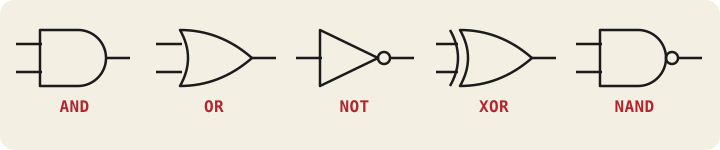
The little symbols for such components are called gates:
NAND Is Enough
One gate is enough to build all the others: NAND (NOT(a AND b)), Sheffer 1913.
NOT a = a NAND a
a AND b = NOT (a NAND b) — i.e. a NAND followed by a NAND with itself.
a OR b = (NOT a) NAND (NOT b) — De Morgan at work.
A NAND gate in a chip costs four transistors. Billions of them, wired by algebra, are every computer you know.
Exercise · Build It from NAND
In pairs. One of you is the architect, the other the inspector.
Architect: on paper, draw XOR using only NAND gates (hint: four NANDs suffice; one of them is shared).
Inspector: feed all four input pairs through the drawing with your thumbs — one gate at a time, out loud. Compare with the XOR table.
If a row fails, find which gate lied. Then swap roles and build OR.
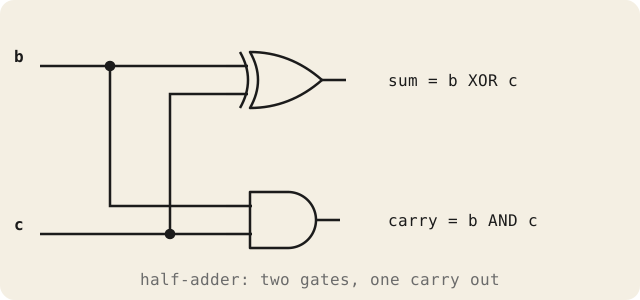
The Half-Adder
Put the two observations together: to add two bits b and c you need exactly two gates.
sum = b XOR c carry = b AND c
This tiny circuit is called the half-adder. All arithmetic in your phone is built from it and its relatives.
Adding One Is Adding a Carry
Our algorithm increment is not a special case: to add 1, put a carry of 1 into the lowest position, then let every position run a half-adder.
c0 = 1 (that is the “+1”)
for every bit bi, from right to left:outi = bi XOR cici+1 = bi AND ci
The lowest bit has it easiest: b XOR 1 = NOT b — it always flips. Every higher bit flips only if the carry reached it — and the carry survives only through a chain of 1s.
Exercise · Paper Circuit
In pairs. Four numbers: 0101, 0111, 1011, 1111. Increment each using only the two formulas — no counting.
Split the labour like a circuit: one of you computes every XOR, the other every AND and keeps the carry. Fill in a table with columns b, c, out, c′ for each position, right to left.
Check against finger counting. Which number made the carry travel farthest? What is c after the last position of 1111?
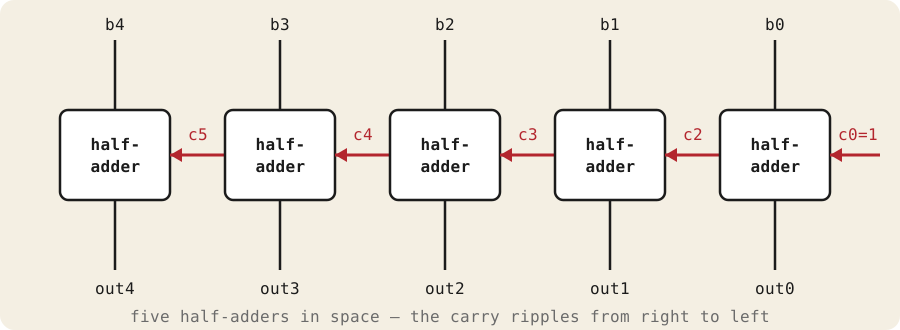
Space: A Chain of Gates
Build the circuit literally: one half-adder per bit, the carry wired from each to its left neighbour.
It is called a ripple-carry circuit: change the input and the carry ripples through the chain like a row of dominoes.
A 64-bit number needs 64 adders. The algorithm is spread out in space.
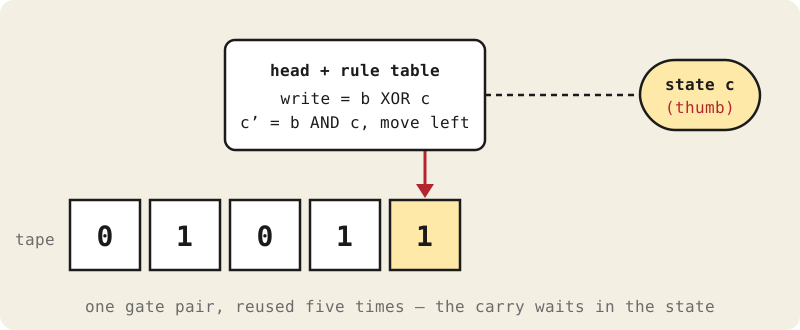
Time: One Gate Pair, Many Steps
Now the other idea. Do not build five adders. Build one and walk it along the number.
Each step it reads one bit from a tape, computes XOR and AND, writes the result, and moves one cell to the left.
But then the carry from this step must wait for the next one. Something must remember it. That memory is the machine’s state.
The Thumb Is the State
Look again at the rule table of our Turing machine — the one from the Alan session — and write the state as a bit: CARRY = 1, HALT = 0.
| state c | reads b | writes | next state | move |
|---|---|---|---|---|
| 1 (CARRY) | 0 | 1 | 0 (HALT) | left |
| 1 (CARRY) | 1 | 0 | 1 (CARRY) | left |
| 0 (HALT) | 0 | 0 | 0 | — |
| 0 (HALT) | 1 | 1 | 0 | — |
Writes = b XOR c. Next state = b AND c. The rule table of the machine is the half-adder’s truth table.
A Turing machine is a half-adder with a memory and a moving head. The carry is the thumb of the other hand.
Exercise · Two Hands, One Machine
Alone, then compare. Right hand = tape (thumb is the lowest bit). Left thumb = the state c.
Raise your left thumb: you are adding 1. Now walk along the right hand, thumb to little finger. At every finger say out loud: “out = b XOR c” (set the finger to that value) and “c = b AND c” (set your left thumb to that).
Once the left thumb is down you may stop — nothing further can change.
Count from 0 to 31 this way. Then 31 + 1: the left thumb is still up after the little finger. That is the carry that fell off the tape — overflow. Turing’s tape is infinite; your hand is not.
Exercise · Human Turing Machine
In pairs. Two roles. TAPE: write six cells on paper, e.g. 0 1 0 1 1 1, and cover all but the cell under the head with your hand. MACHINE: you have only a rule card (the table of the previous folio) and your left thumb as the state. You may never see the whole number.
Loop: MACHINE says “read!” — TAPE reveals the bit under the head. MACHINE looks up the row and says “write w, move left”, updating the thumb. TAPE writes and moves the head one cell left. Stop when the thumb is down.
Run 010111, 001111, 111111. Convert to decimal to check. What happens in the last run when the head falls off the tape?
Swap roles. Afterwards discuss: did either of you ever need to know what number it was? Where, physically, was the carry stored?
Exercise · Break the Machine
In pairs. First: the forgetful machine. It has no thumb: at every cell it behaves as if c = 1 (it always flips the bit and always moves on).
Run it on 0101. What should the answer be? Which inputs does the forgetful machine happen to get right, among the sixteen four-bit numbers?
Then the challenge: run it backwards. Design a rule table for subtract 1 (state BORROW) — hint: it is the increment table with the roles of 0 and 1 exchanged. Test it by counting down from 8 on your hands.
Check yourselves: BORROW reads 0 → write 1, move left, stay in BORROW; BORROW reads 1 → write 0, HALT. In algebra: out = b XOR w, w′ = (NOT b) AND w. (And the forgetful machine is right on 0111 and 1111 only.)
Three Languages, One Algorithm
| Logic (Boole 1854) | Wire (Shannon 1937) | Machine (Turing 1936) | |
|---|---|---|---|
| what it is | formulas | circuit of gates | tape, head, states |
| sum digit | out = b XOR c | XOR gate | write rule |
| carry | c′ = b AND c | AND gate + wire | next state (thumb) |
| many bits | same formula for each i | a chain: space | one gate pair, repeated: time |
Same algorithm, three notations. Algebra says what, gates say with what, the machine says in what order.
And the translation between them is mechanical — which is exactly why computers can exist.
Why Does a Machine That Learns Care?
Every neural network, every language model, runs on chips made of billions of gates just like the ones you drew today — XOR, AND, NAND, wired by algebra and clocked through time.
When people say “the machine computes”, this is all it means: logic, laid out in space, unrolled in time.
Learning does not change that. It changes only which numbers sit in the tape. Next time: how those numbers came to be tuned — Claude, Marvin, John and the others.
Debrief
In pairs, three minutes: explain to each other, without notes, why the sum digit is XOR and the carry is AND.
Then answer the question of the day in two sentences: why does counting in binary work, and what is a machine doing when it counts?
Write down where your thumb was needed. That is the whole difference between a calculator and a table of formulas: memory.
Feedback · Checkout Time
Is there something you like about this seminar?
Is there something you don’t like?
Is there something new and useful you learned during this seminar?
Synart
Synart — the synthesis of two arts in a single activity.
Here the two arts are dance and music: a bodily movement is at once a danced gesture and an act of music-making.
The synartist need not choose between being a dancer who accompanies music and a musician who operates an instrument. The same embodied action realizes both practices — and in this operational sense stands “above” their conventional separation.
Not superiority over either art: a higher-order unity of artistic agency.
Synart is not merely multimedia, a dance performance with reactive accompaniment, or the sequential addition of two artworks. It is the simultaneous co-realization of two artistic processes through one performative act.
The synartist dances the music and makes music by dancing.
Memes, Mindworms, Memplexes &c.
Memes in Alltag
Session 0 · Memetics begins at home.
Before Internet memes, before ideology, before theory: gestures, tunes, habits, rituals, phrases, drawings, interfaces and everyday acts of copying.
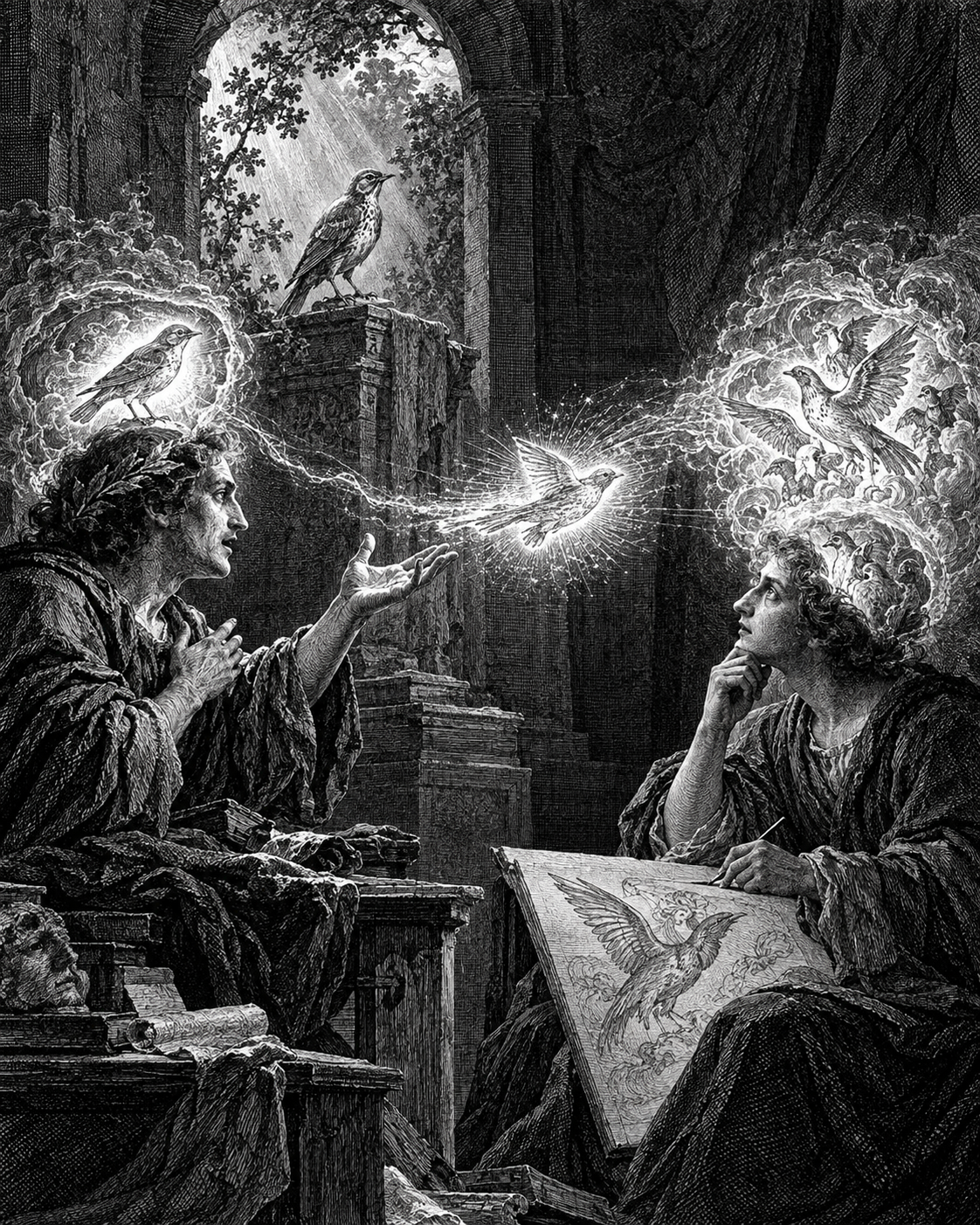
Meme
“A meme is whatever is copied from person to person.”
— Susan Blackmore, working definition
For today, let us start with this deliberately simple definition.
Copied?
Copying does not necessarily mean making an exact duplicate.
You hear a joke.
You remember the structure, forget several words, change a character...
...and tell it to somebody else.
Something survived the transformation.
Two Worlds
external expression → perception → internal reconstruction → expression
A meme can appear outside us: as sound, gesture, image, text, object, ritual.
It can be reconstructed inside us: as memory, rule, association, expectation, intention.
Then it can become external again.
What exactly is being copied?
A Word of Warning
Memetics is a theory among other theories.
Human culture can also be studied through psychology, anthropology, sociology, cultural evolution, semiotics, media theory, neuroscience and many other perspectives.
Memetics highlights replication, variation and selection.
It does not explain the whole human being.
And although it may begin to look as if everything is a meme...
...it is not.
Not Everything That Spreads Is a Meme
A virus spreads. That does not make it a cultural meme.
Genes are copied. That does not make them memes.
You discover by yourself that fire is hot. No person-to-person copying was necessary.
A yawn may trigger another yawn through an evolved response rather than culturally learned imitation.
Spread alone is not enough.
Where Is the Meme?
Is the meme the sentence?
The idea expressed by the sentence?
The memory in somebody's brain?
The rule that allows the sentence to be reconstructed?
The pattern distributed across people, media and artifacts?
Different memetic theories answer differently.
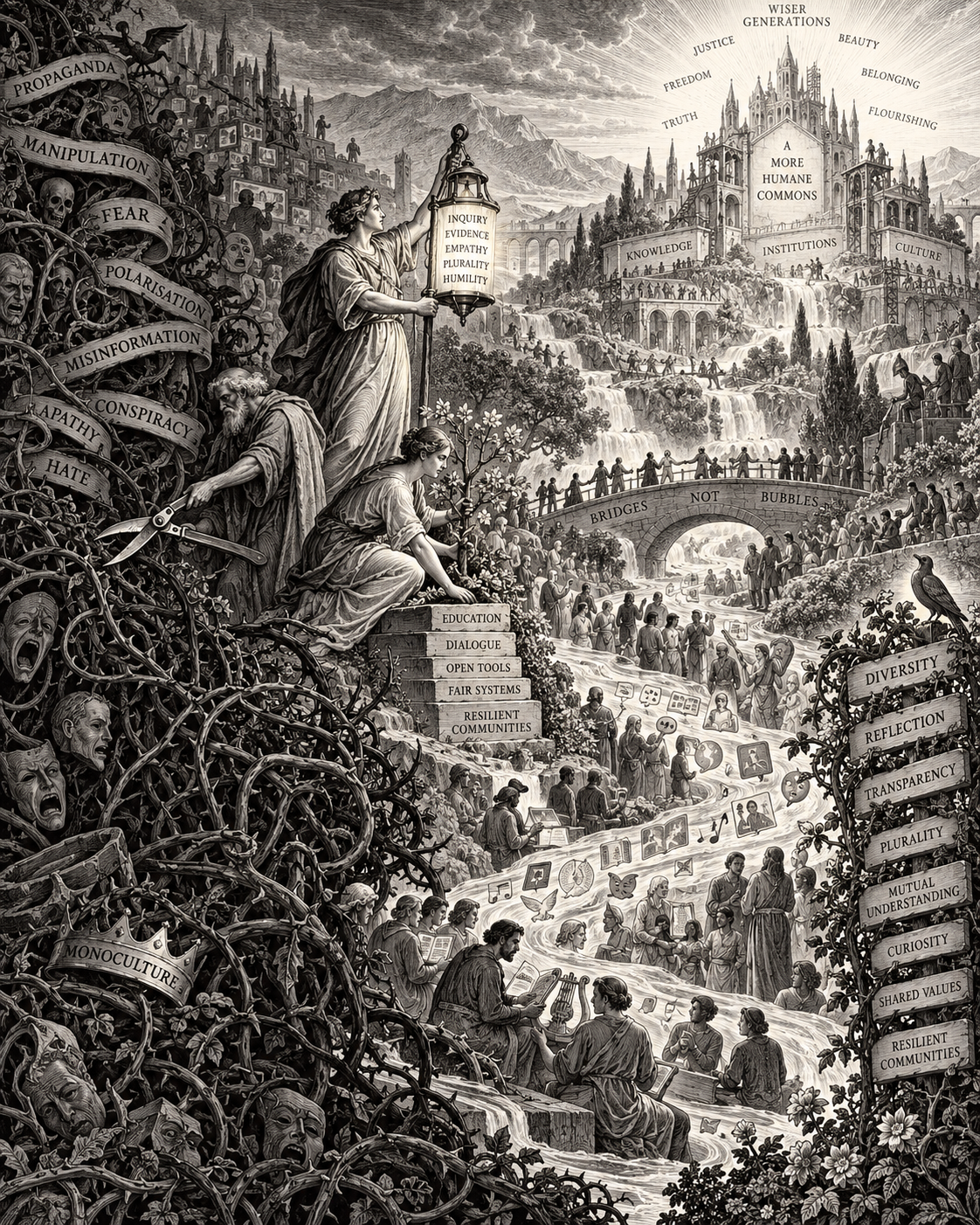
Memethical Engineering
Memethical engineering is the deliberate design, modification, and circulation of memes and memetic environments in accordance with explicit ethical goals.
For example: counteracting propaganda and manipulation.
Increasing epistemic and cultural diversity.
Supporting critical reflection.
Increasing resilience against harmful or monopolizing meme complexes.
Engineering the Environment
Memetic engineering asks: How can this spread?
Memethical engineering must additionally ask: Should it spread?
Who benefits?
What disappears when it succeeds?
Can people recognize the mechanism?
Can alternatives survive?
Success ≠ virality.
Memes in Alltag
Let us now temporarily leave theory behind.
Look at ordinary life as a landscape of things passing from person to person.
We will move from the smallest and fastest patterns...
...toward increasingly complex cultural structures.
1 · Contagion
😮 yawning
😂 laughter (e.g. Tanganyika laughter epidemic of 1962)
👏 applause / standing ovation
👀 looking where everybody else is looking
🌊 the stadium wave
These are useful starting examples because copying is immediately visible.
But some may be biological contagion rather than memes in Blackmore's strict sense.
Experiment
One person suddenly looks intensely at the ceiling.
How many people look too?
Did information pass?
Was anything learned?
Would you call it a meme?
2 · Gestures
🤝 handshake
✋ high five
👊 fist bump
✌ peace sign
🫶 hand-heart
air quotes
😘 kiss (hand ? cheek ? lips ?)
nodding (vertical ? horizontal ?)
A tiny movement can carry socially learned meaning.
Gesture = Movement + Convention
The physical movement alone is not enough.
A raised thumb means something because other people already know how to interpret it.
The same movement can mean different things in different cultures.
A meme therefore often contains both performance and interpretation.
3 · Rituals
🎂 birthday cake + candles + song + wish
🥂 touching glasses before drinking
🎆 counting down at New Year
🪵 knocking on wood
🤞 crossing fingers
💰 throwing a coin into a fountain
Memes can become coordinated social scripts.
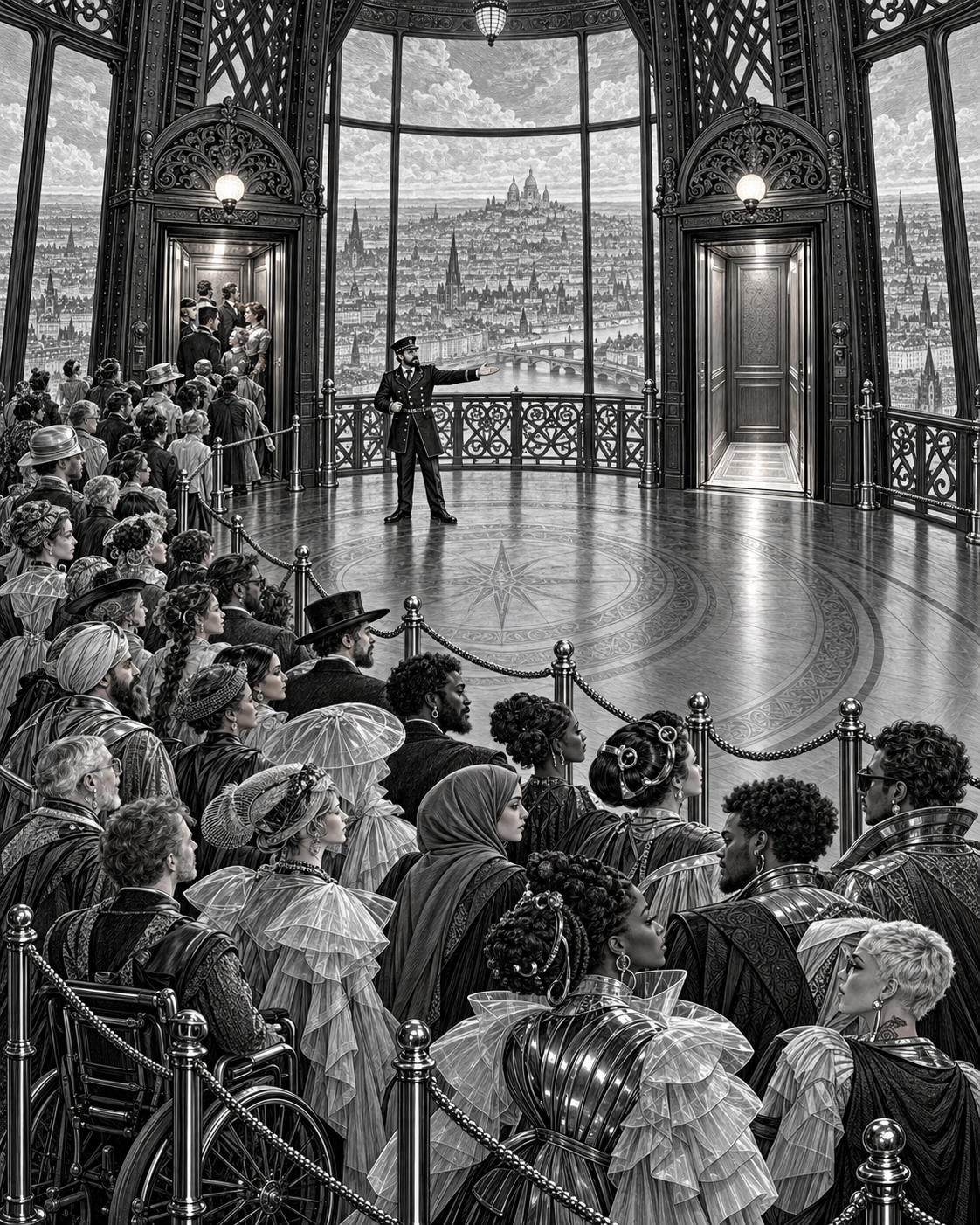
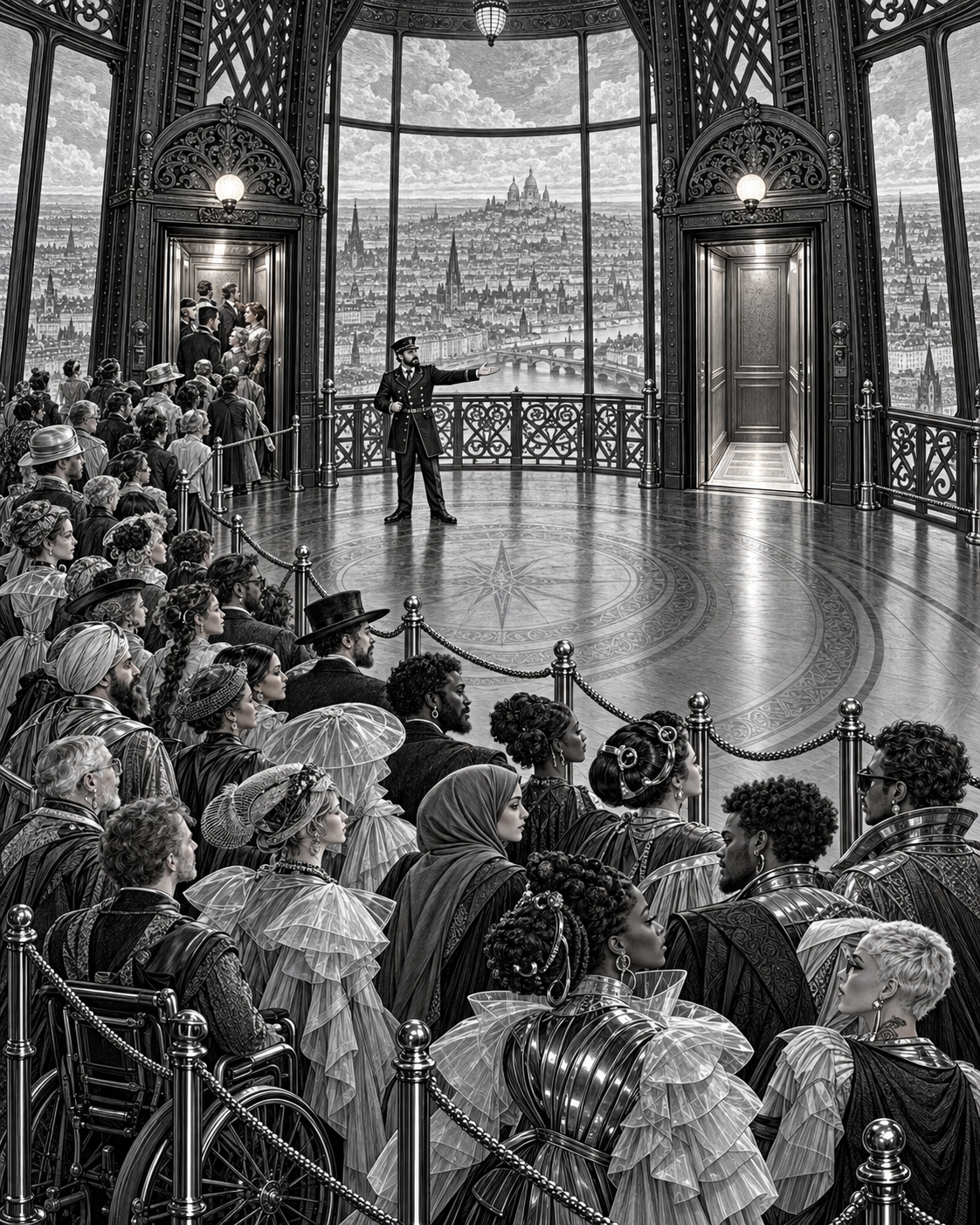
The Queue
At the highest floor of the Eiffel Tower, there are two elevators facing each other.
If human beings were fully rational beings, two equally long queues should have formed, each unfolding in its own direction.
But again and again, only one queue appears.
A long line of visitors patiently waits for one elevator...
...while the other elevator stays empty and available.
People tend to infer their own action not from the total situation, but from the behavior of the people already in front of them.
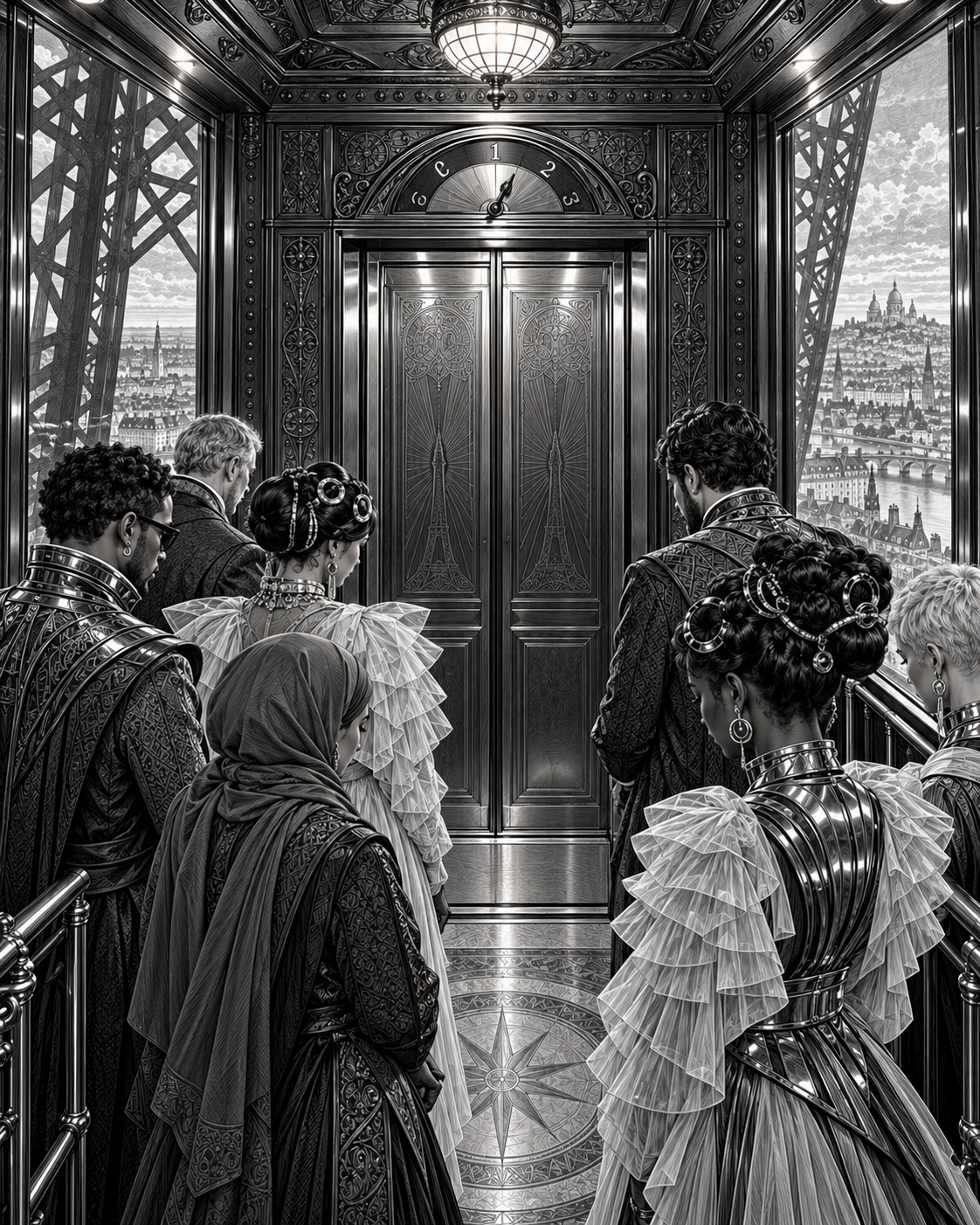
The Elevator
Enter.
Turn around.
Face the door.
Avoid prolonged eye contact.
Become strangely silent.
Who taught us this?
Many everyday conventions are acquired without an explicit teacher.

4 · Words
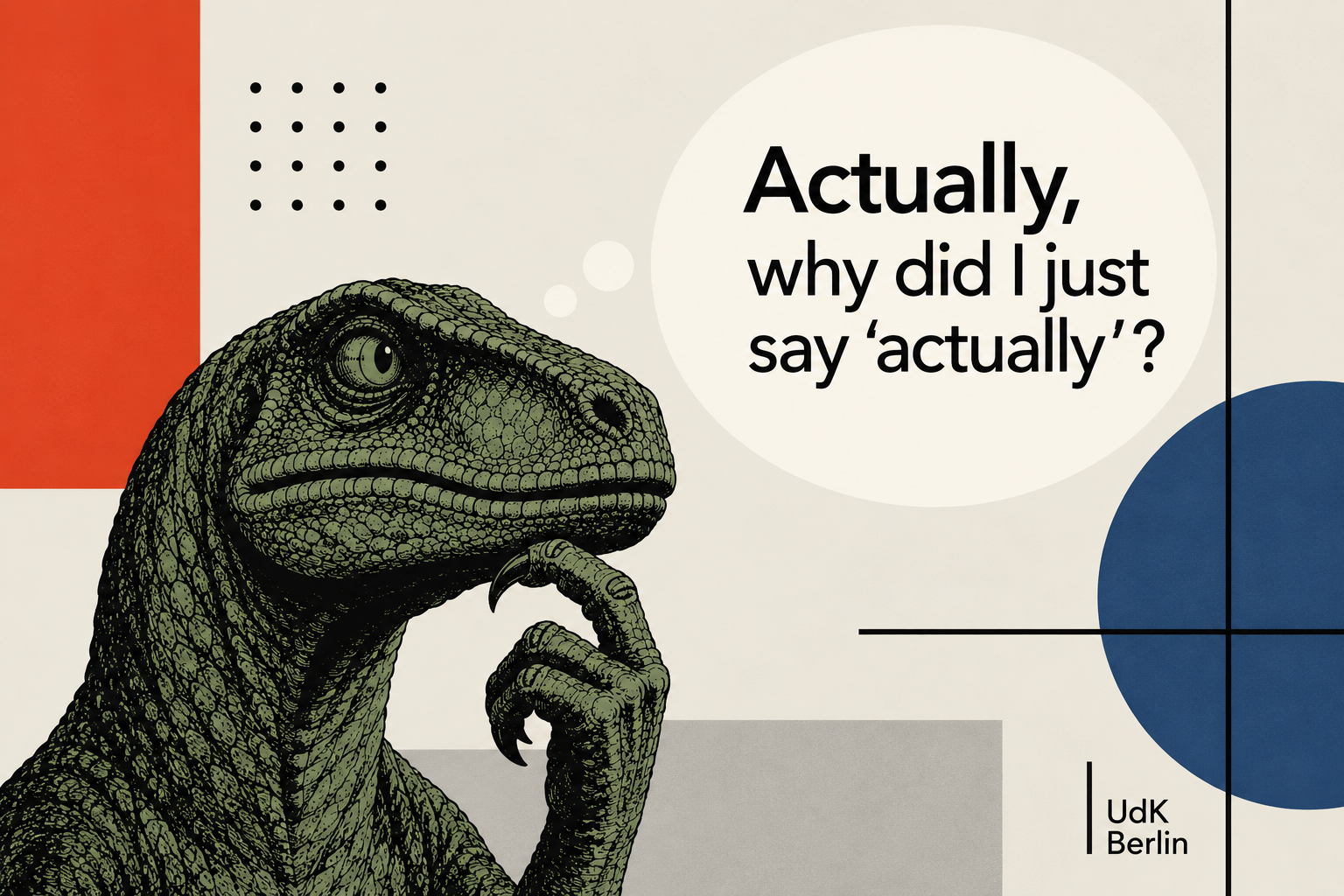
“Actually...”
“However...”
“You know?”
“At the end of the day...”
euh… [øː] , bah oui
блядь, f*ck, vole ...
Language is full of units which seem to "live their own life".
Catchphrases
A phrase can detach itself from its original situation.
It becomes reusable.
People recognize it.
They repeat it because others recognize it.
Recognition itself can increase its probability of further replication.
Familiarity can become its own selection advantage.
5 · Earworms
A melody enters through the ears.
Hours later it is still playing internally.
You hum it.
Somebody else hears it.
Now it may inhabit another mind.
An earworm is almost a cartoonishly clear memetic lifecycle.
Sound Memes
nursery rhymes
football chants
advertising jingles
melodies with changing lyrics
TikTok audio fragments detached from their original context
The carrier can change while the recognizable pattern survives.
6 · Drawings
♥ a heart that looks nothing like an anatomical heart
★ a five-pointed star
☀ a circle with rays
🏠 a square house with a triangular roof
💡 a light bulb meaning “idea”
We learn visual conventions by repeatedly encountering them.
The Cool S
Who knows how to draw the “Cool S”?
Who taught you?
Where did you first see it?
Do you know who invented it?
Why did generations of schoolchildren reproduce it?
A near-perfect classroom specimen of anonymous cultural transmission.
7 · Interface Memes
💾 floppy disk = save
🔍 magnifying glass = search
⚙ gear = settings
🗑 bin = delete
♥ heart = like
☰ three lines = menu
The original object can disappear while its symbolic descendant survives.
Memes Can Outlive Their World
Many people click a floppy disk icon without ever having saved a file onto a floppy disk.
The symbol has become detached from the technology that produced it.
Its survival depends on continued copying inside interface culture.
Cultural ancestry can remain visible after functional ancestry has vanished.
8 · Fashion
ripped jeans
mullets
moustaches
Crocs
rolling trouser legs
particular sneaker styles
black clothing in particular creative milieus
Bodies become media.
Fashion Evolves
Someone adopts a style.
Others notice it.
Some imitate it.
Some exaggerate it.
Some reject it.
Some revive an older version thirty years later.
Replication produces variation; variation produces selection.
9 · Food & Household Knowledge
family recipes
sourdough starters
cutting sandwiches diagonally
particular ways of folding pizza
“five-second rule”
putting a wet phone into rice
Useful, useless and questionable practices can all be culturally transmitted.
Transmission ≠ Truth
A meme does not have to be true to spread.
It does not have to be useful.
It does not have to benefit its host.
It merely needs properties that allow further transmission.
This is one of the most important—and most uncomfortable—ideas in memetics.
10 · Social Formats
the elevator pitch
brainstorming with Post-its
the agenda slide
the TED-style talk
“three things I learned...”
the Venn diagram
the iceberg diagram
Sometimes the meme is not the content but the format.
11 · Internet Memes
image macros
reaction GIFs
“POV:”
“starter pack”
“nobody: / absolutely nobody:”
“tell me X without telling me X”
“how it started / how it's going”
The Internet did not invent memes. It created an extraordinarily fast memetic environment.
Template + Variation
Internet memes make one property especially visible:
a stable template + many mutations.
Distracted Boyfriend.
Drake Hotline Bling.
Woman Yelling at a Cat.
The image remains recognizable while captions and meanings mutate.
Variation is not failure of copying. It is part of the evolutionary process.
12 · Stories & Rumours
urban legends
schoolyard rumours
ghost stories
“a friend of a friend once...”
life hacks
folk explanations
Stories are compressed, reconstructed and altered every time they move.
13 · Beliefs
superstitions
stereotypes
ideas about success
ideas about beauty
ideas about what a “proper career” looks like
ideas about how families, schools or workplaces should function
At this scale, memes begin to shape perception itself.
From Meme to Memeplex
Memes rarely live alone.
They support, trigger and protect one another.
A fashion includes clothes, vocabulary, gestures, music, places and identities.
A profession includes practices, jargon, values, rituals and status symbols.
Religions, ideologies, artistic movements and institutions can contain enormous interconnected systems of culturally transmitted elements.
Such complexes are often called memeplexes.
Replication
Something is encountered.
Something is reconstructed.
Something is expressed again.
Another person encounters it.
Replication does not require perfect duplication.
Variation
Misremember it.
Translate it.
Improve it.
Simplify it.
Exaggerate it.
Parody it.
Combine it with another meme.
Every transmission is an opportunity for mutation.
Selection
Some variants disappear.
Some are remembered.
Some are repeated.
Some fit a particular medium particularly well.
Some become part of institutions and persist for centuries.
Cultural environments select.
What Makes a Meme Successful?
easy to remember?
easy to reproduce?
emotionally intense?
funny?
useful?
beautiful?
shocking?
socially rewarded?
already familiar?
And are these the same properties that make a meme good?
The Memethical Question
A communication system optimized only for replication may reward whatever replicates best.
But the fastest-spreading cultural environment is not necessarily the most desirable one.
Memethical engineering asks how environments might instead preserve:
diversity · autonomy · transparency · reflection · plurality · resilience
Exercise · Find One
Think of one meme you encountered today.
Not necessarily an Internet meme.
Where did you encounter it?
What was its external form?
What did you reconstruct internally?
Did you reproduce it?
Did you modify it?
Why might this particular pattern survive?
Exercise · Classify It
gesture?
ritual?
phrase?
melody?
visual convention?
interface convention?
fashion?
social script?
story or belief?
memeplex?
Or perhaps: not a meme at all?
Three Questions to Keep
1. What is being copied?
2. Why does this variant survive?
3. What kind of cultural environment does its survival create?
Memes in Alltag
A handshake.
A birthday song.
A stupid little drawing in a school notebook.
A phrase you suddenly notice yourself saying.
A floppy disk that survived its floppy disk.
A belief nobody remembers learning.
Culture replicates through us—but never without being reconstructed by us.
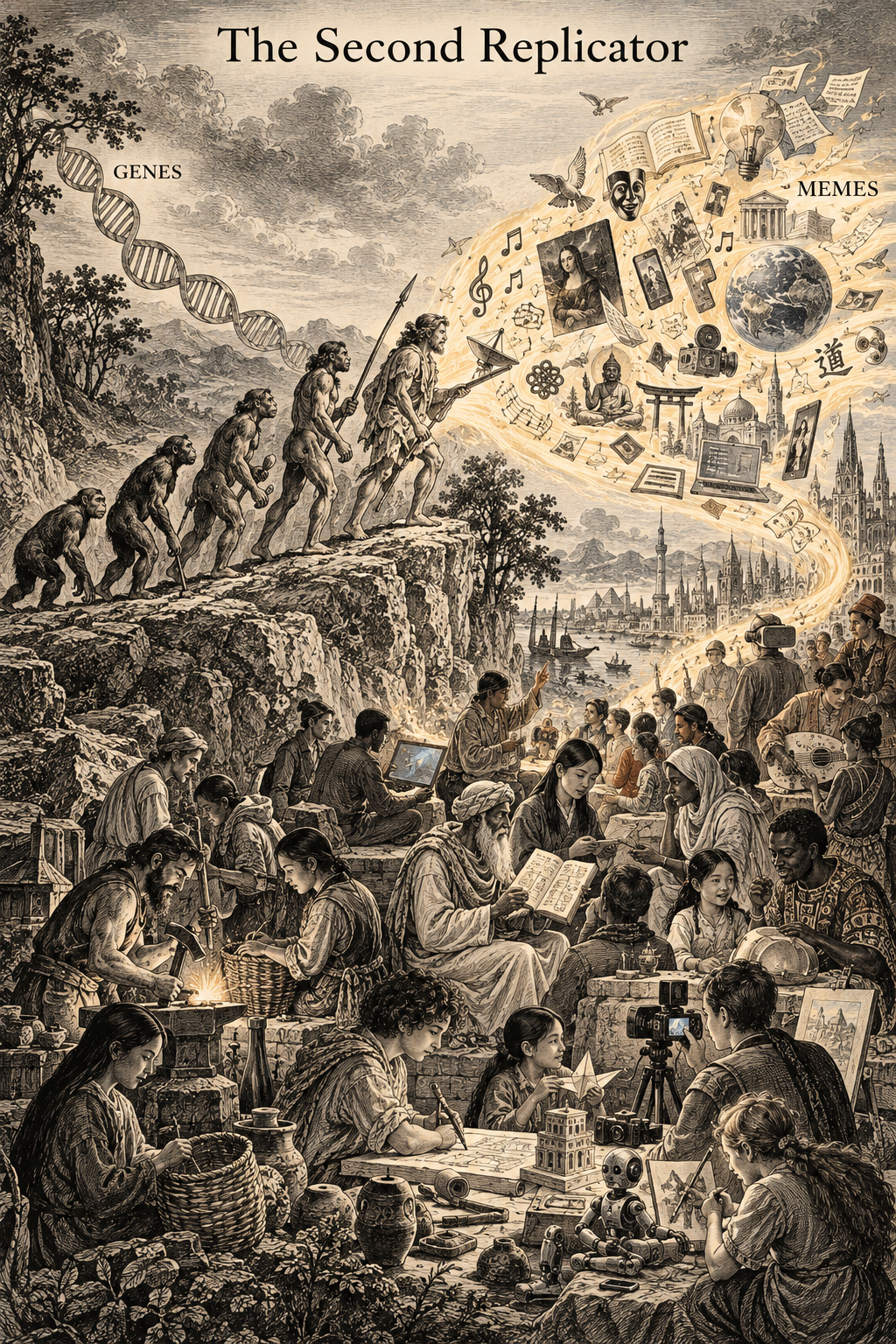
The Second Replicator
Before Darwin
For most of human history, the diversity of life was explained by one simple idea: species are fixed, created once, unchanging.
A rabbit begets a rabbit. An oak begets an oak. World without end.
Even naturalists who classified thousands of species rarely asked: where did all this variety come from?
Darwin's Insight
In 1859, Charles Darwin proposed something radical: species are not fixed.
They change, slowly, over generations — new species arise from old ones through an entirely natural, unplanned process.
He called it natural selection.
No designer. No goal. Just a mechanism.
The Engine of Evolution
Replication + Variation + Selection = Evolution
Darwin never used these three words this way — but this is the abstract engine hiding inside his argument.
Three ingredients. Run them together, over and over, and something astonishing happens: design without a designer.
Replication
Something must be copied from one generation to the next.
Offspring resemble parents — not perfectly, but closely enough that traits persist.
Darwin did not know about DNA. He only needed: like tends to produce like.
Variation
No copy is perfect.
Within any population, individuals differ — in size, colour, behaviour, shape.
Some of this variation is heritable: it gets passed on, imperfections and all.
Without variation, there is nothing for selection to act upon.
Selection
Not every variant survives. Not every survivor reproduces equally.
Resources are limited; environments are demanding.
Whatever traits make an individual slightly better at surviving and reproducing become, on average, more common in the next generation.
Nobody chooses. The environment simply… filters.
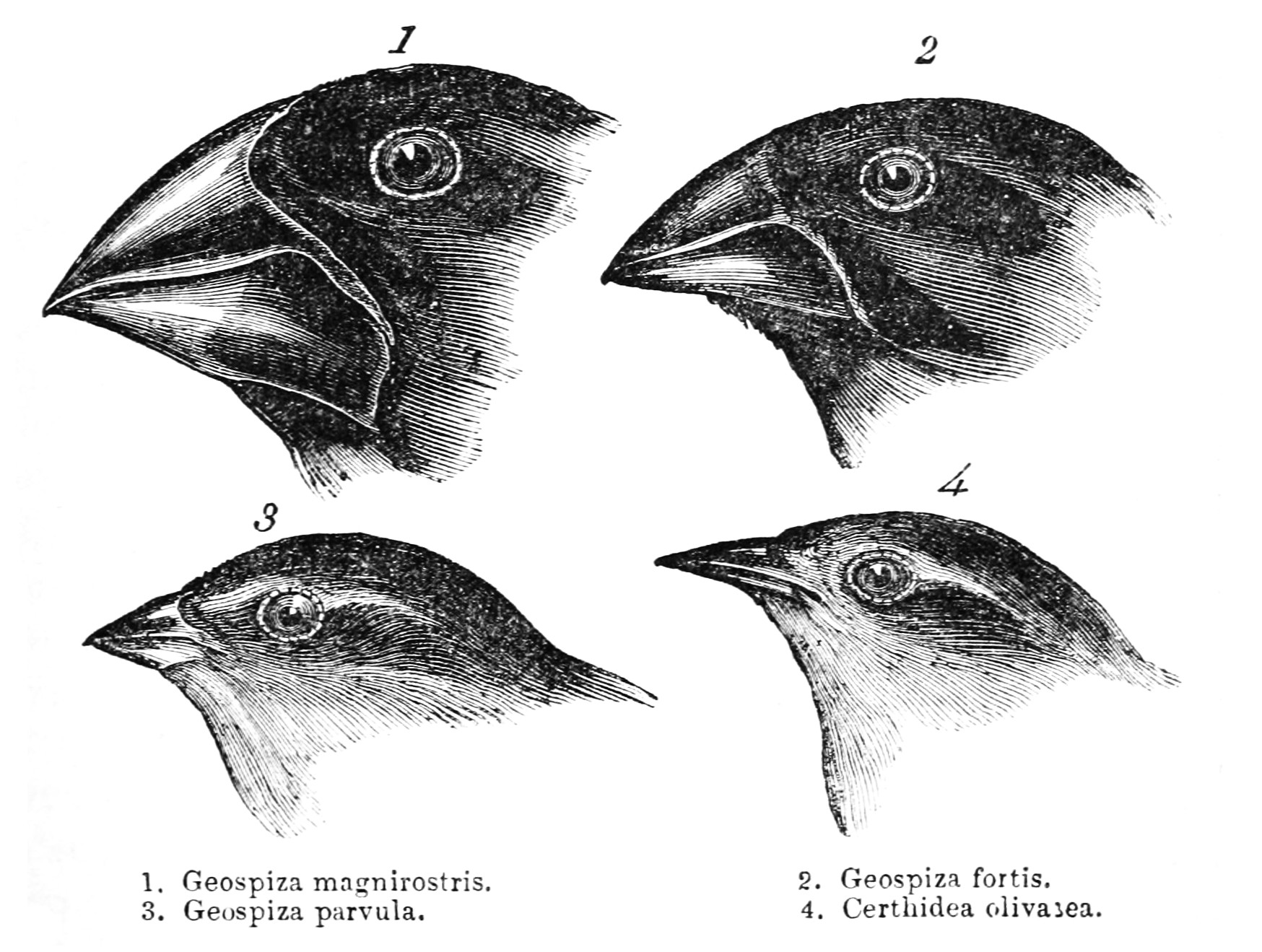
Darwin's Finches
In 1835, Darwin collected small birds across the Galápagos Islands — a few hundred kilometres off the coast of Ecuador.
Back in London, ornithologist John Gould identified them: not varieties of one species, but more than a dozen distinct species of finch — found nowhere else on Earth.
Each island's finches had a differently shaped beak: thick and crushing, thin and probing, long and curved.
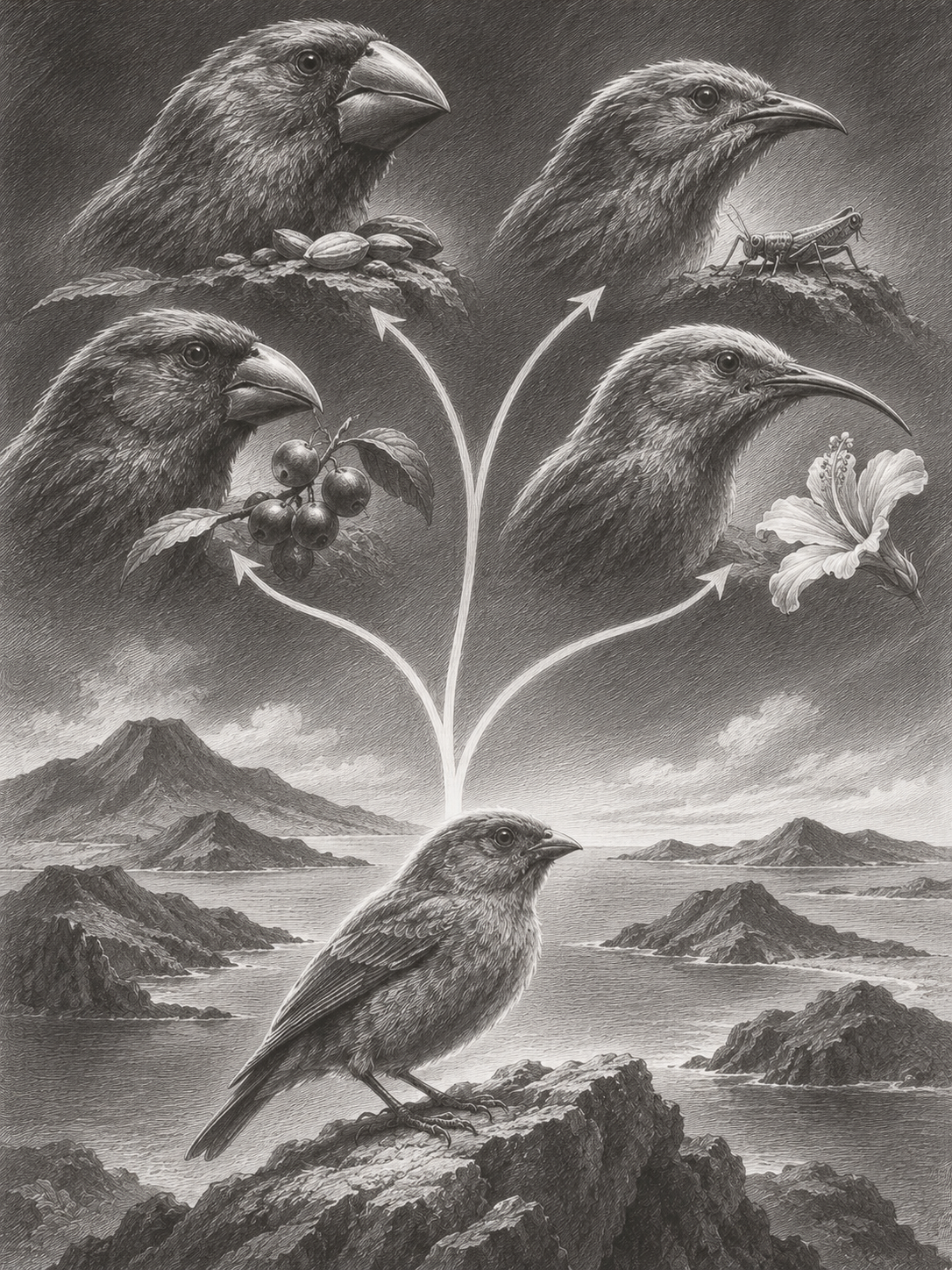
One Ancestor, Many Beaks
The beaks matched the food available on each island: hard seeds, soft fruit, insects, nectar.
Darwin's explanation: all the finches descended from a single ancestral species that reached the islands long ago.
On each island: beak-shape variation + a different food source + generations of selection → a different finch.
One ancestor. One mechanism. Many birds.
Why Finches Matter
The finches are not proof of evolution by themselves — but they are an unusually clean illustration of the engine in action, isolated on real islands, at a scale a visitor could actually observe.
Replication (finches breed finches), variation (beak shapes differ), selection (local food decides who thrives) — nothing more was needed.
So here is a strange question. Does this engine only run on carbon?
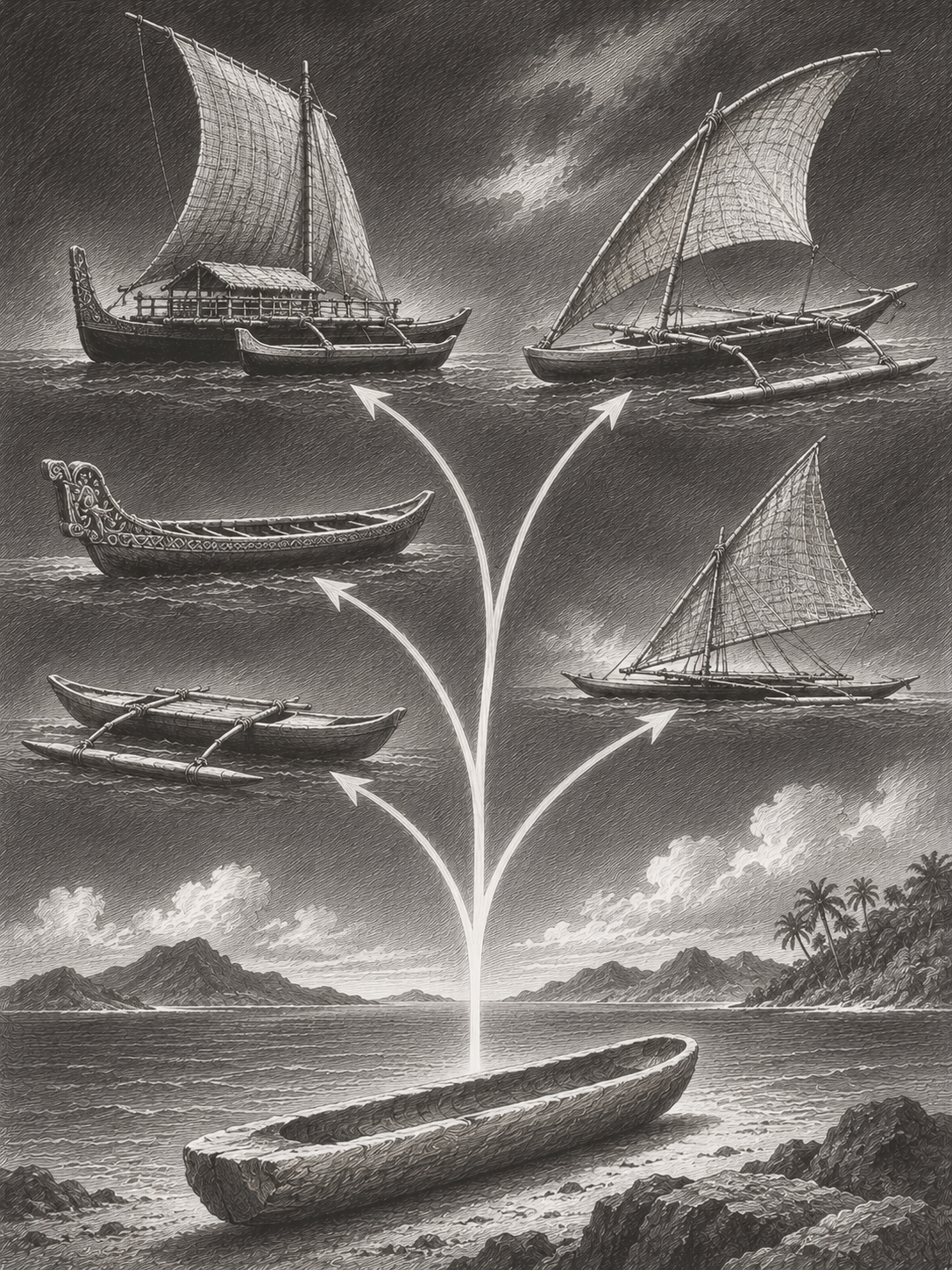
Universal Darwinism
Darwin described biological evolution. But notice: nothing in the three-step engine mentions DNA, cells, or carbon chemistry.
It only requires: entities that are copied, imperfectly, and then differentially filtered.
Richard Dawkins called this generalized claim Universal Darwinism: wherever you find replication + variation + selection, you will find evolution — in biology or anywhere else.
Beyond Carbon
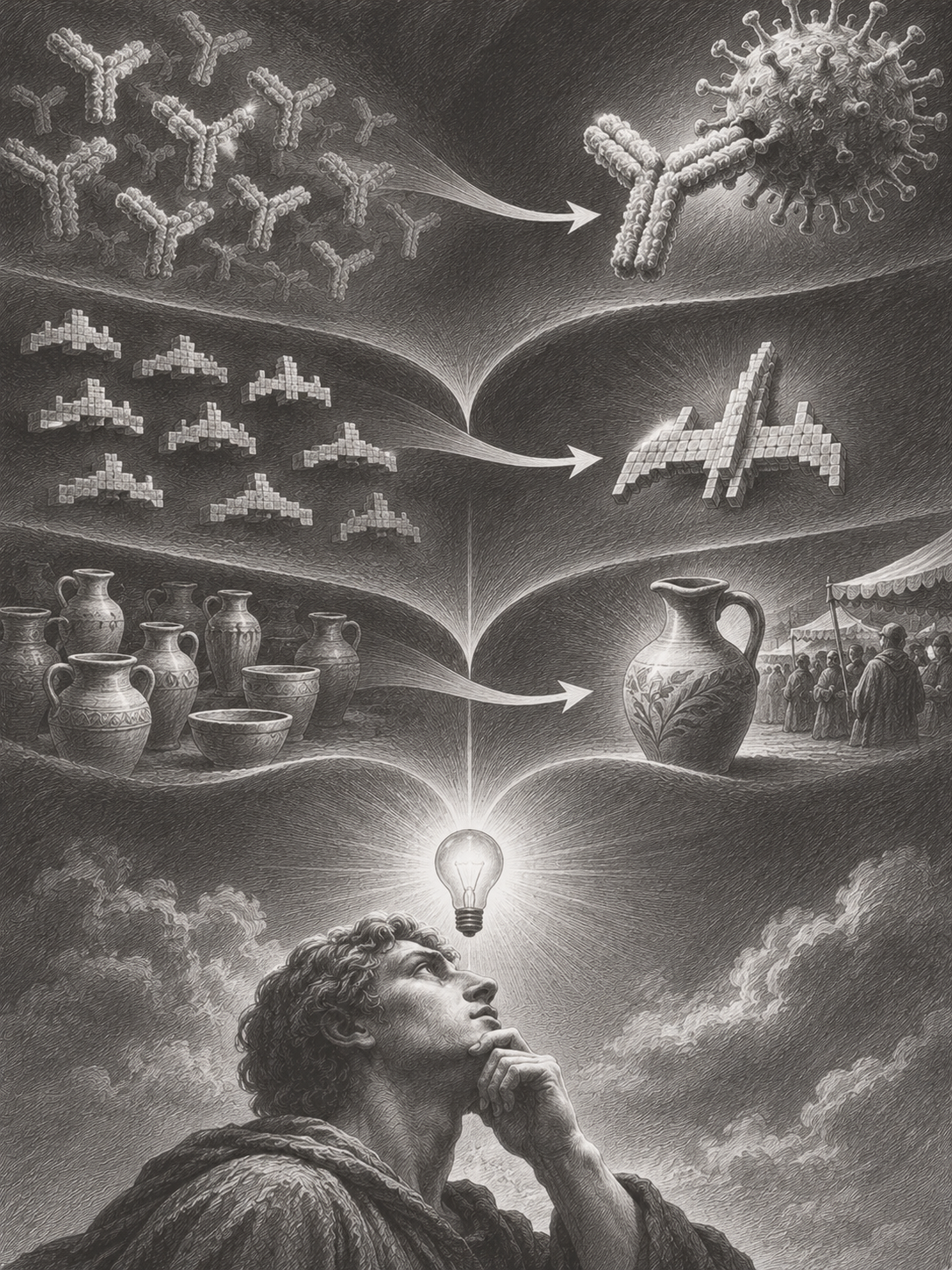
The pattern shows up again and again, once you know to look for it:
your immune system selects among antibody variants for the ones that bind an intruder;
computer scientists breed populations of candidate solutions in “genetic algorithms”;
markets select among competing products and firms.
Could the same be true of ideas themselves?
Dawkins' Reframing
In 1976, Richard Dawkins published The Selfish Gene — and reframed the whole story.
It is not organisms that are the true unit of selection, he argued. It is the gene.
“We are survival machines — robot vehicles blindly programmed to preserve the selfish molecules known as genes.”
The Altruism Puzzle
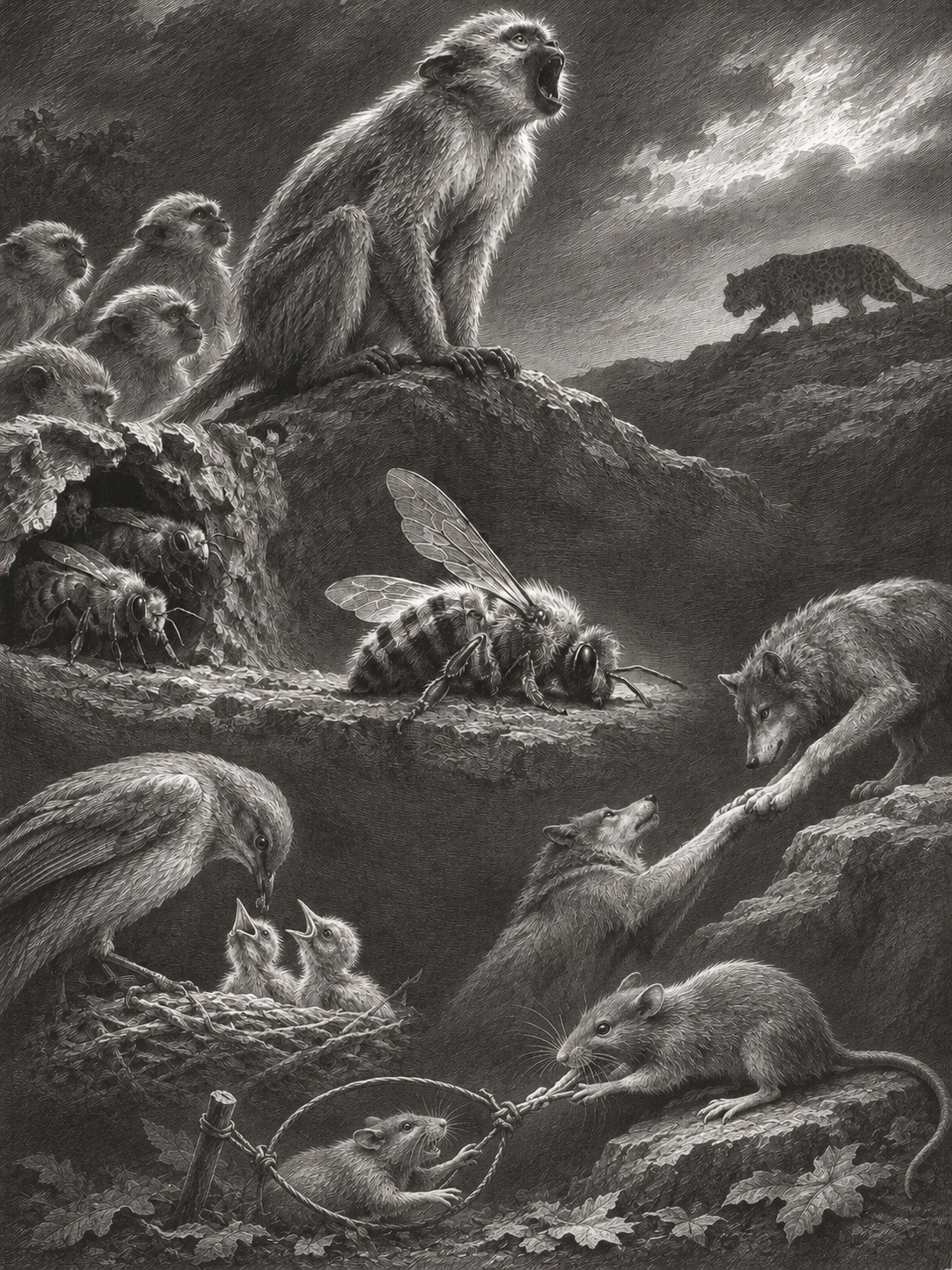
Nature is full of altruism — vervet monkeys shout alarm calls that draw a predator's attention to themselves, worker bees die defending the hive, parents starve so their young can eat.
Selection should ruthlessly punish that. An organism that sacrifices its own survival to help another should leave fewer copies of itself behind — so how does self-sacrifice survive selection at all?
Dawkins' answer: look one level down. Kin selection (W.D. Hamilton) — a gene for helping relatives can spread if it helps enough copies of itself in their bodies, discounted by relatedness. Reciprocal altruism (Robert Trivers) — helping a non-relative who is likely to help you back.
The organism can be generous because the gene is not — it is simply exploiting every available route to more copies of itself, kinship and reciprocity included.
Replicators and Vehicles
Two roles, easy to confuse:
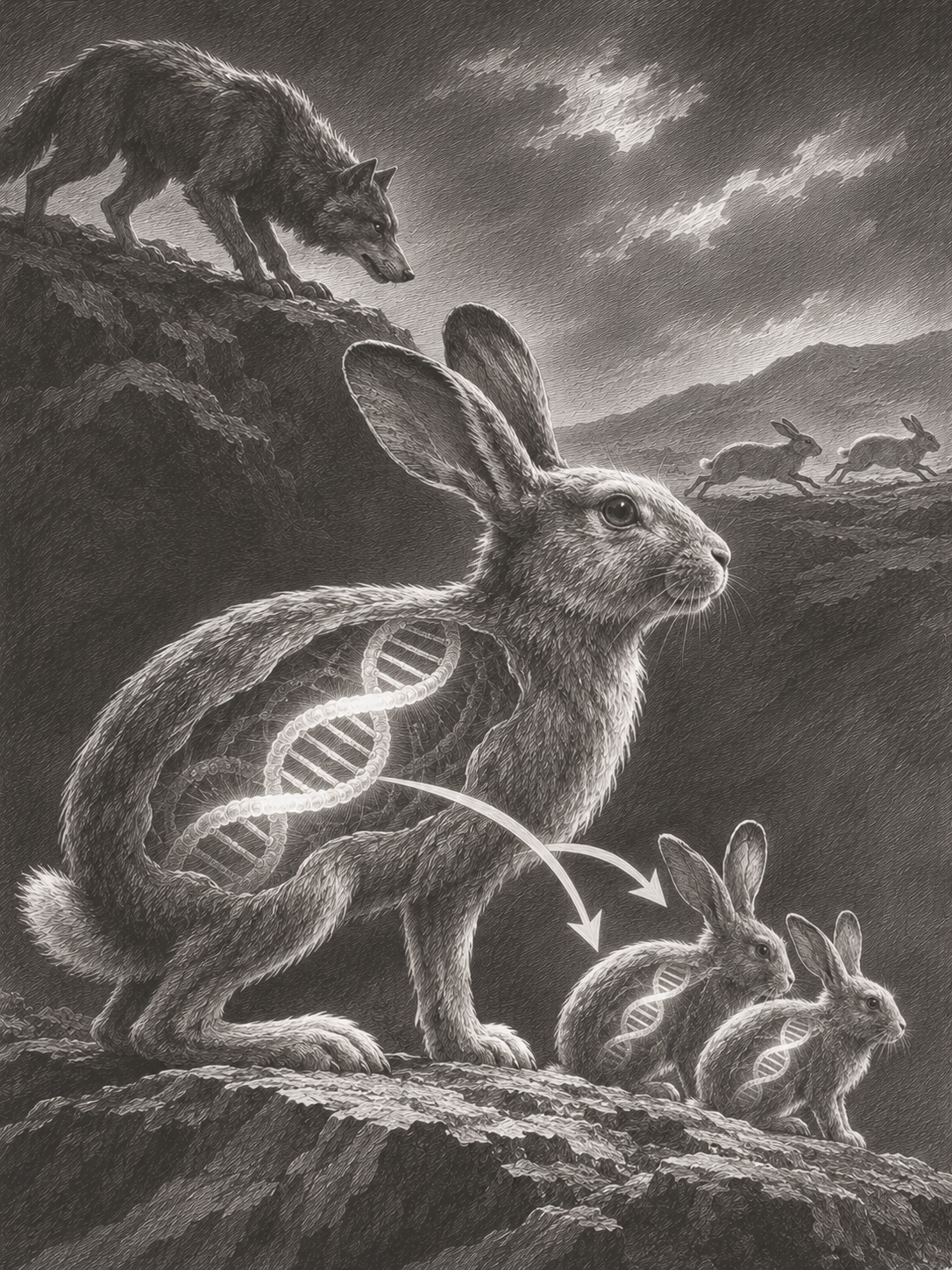
Replicator — the thing that gets copied. The gene.
Vehicle — the thing that is built, survives, and reproduces, carrying replicators inside it. The organism's body.
Selection acts on vehicles — but its lasting effect is on which replicators get copied into the next generation.
A Question Dawkins Asked
If the gene is just one possible kind of replicator…
…could there be others? Things that are copied, vary, and are selected — but are made of neither DNA nor protein?
Dawkins proposed there could. He needed just one more word.
The Second Replicator
“I think that a new kind of replicator has recently emerged on this very planet… I shall call it a meme.”
— Richard Dawkins, The Selfish Gene, 1976
Tunes, catch-phrases, fashions, ways of making pots or building arches — copied from mind to mind, by imitation.
Genes and Memes Compared
Gene — replicated via reproduction; vehicle: the body; variation: mutation; selection: survival & reproduction.
Meme — replicated via imitation; vehicle: brains, books, screens; variation: mis-copying, reinterpretation; selection: attention, memorability, usefulness.
Same three-step engine. A completely different substrate.
Ideas in Motion
We began with finches on volcanic islands and ended with an idea that may be living, right now, inside each of you.
If memes are real replicators, then minds are their islands — and culture is the ongoing experiment.
In the sessions ahead, we will look much closer at how exactly this second replicator moves: through imitation, through everyday life, through law, politics, and the machines we now build.
Cultural evolution
Oceania (Room 215)
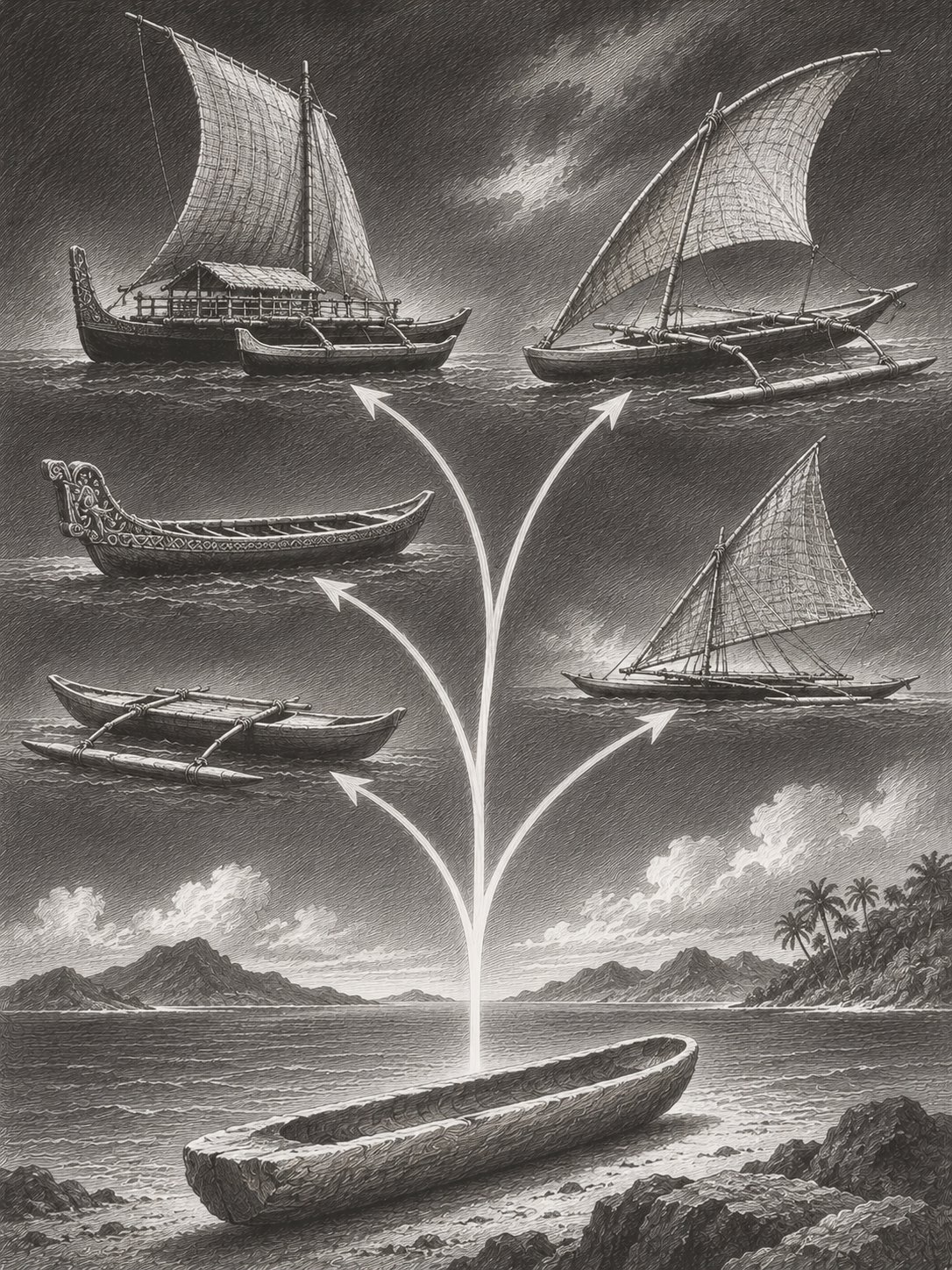
Do different ships and boats contain a recipe for their own construction / replication ?
How much information is missing, who and how provides it ?
How do different ships differ ?
Why do their differ ?
What does the process which results in "boat diversity" have in common with the process which results in "coral diversity" ?
Sounds of the world (Room 217)
Why do some sounds (= air vibration waves), some combinations of sounds (= melodies & harmonies) as well as artefacts whose function is to produce such sounds (= music instruments) appear and reappear in cultures all around the world ?
And what role do silence, rhythm and tempo play in this ?
Polynesia (Room 219)
Is cannibalism a meme ?
If yes, should (art)works spreading such memes be forbidden by Law ?
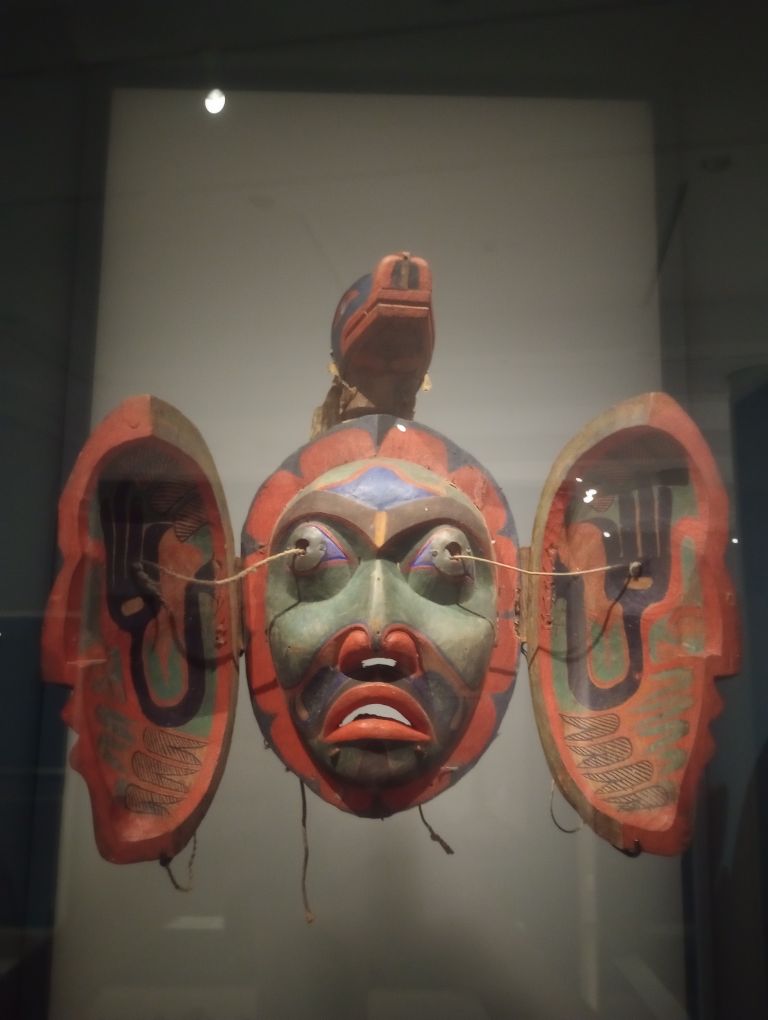
First nations (Room 202)
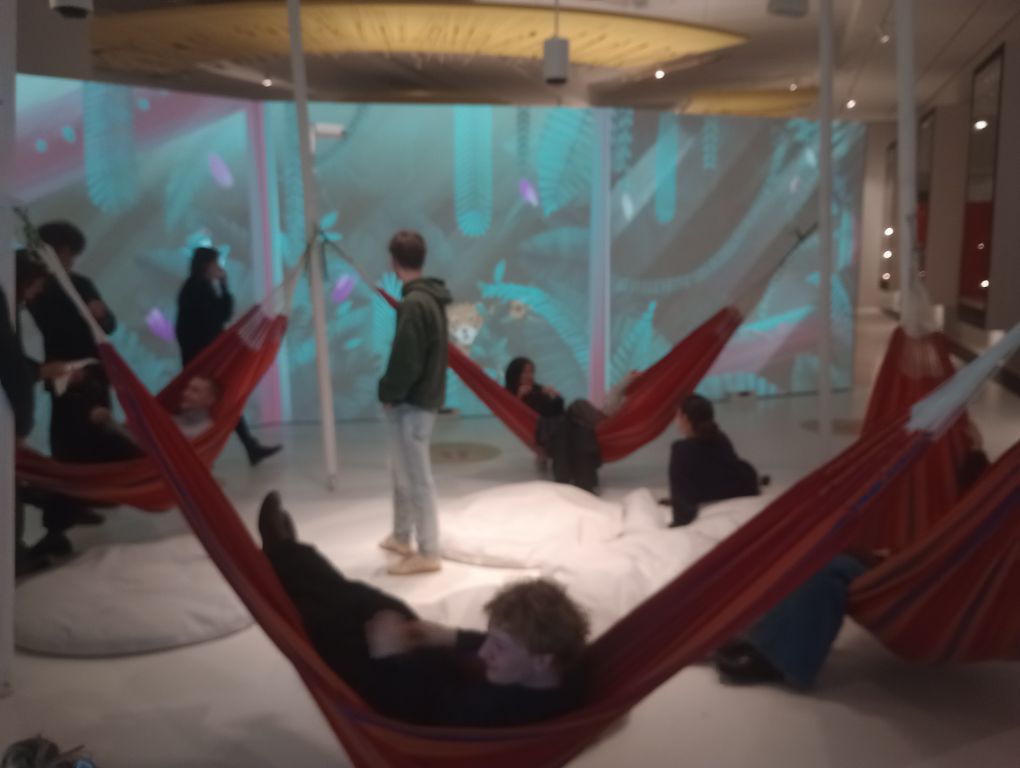
Amazonas (Room 206)
Imitation, social learning, dopamine &c.
MindBrain
The MindBrain is the living, learning, self-modifying system through which we perceive, remember, interpret and act.
Not just the brain. Not a ghost in the machine.
One thing: biology and mind, continuously reshaped by experience, action and other people.
Today's question: what does it copy — and what decides what it copies?
What a MindBrain can do
Copy — imitation, habituation & habit, memorization & recall
Change — plasticity, association, generalization, variation & recombination
Choose — attention, prediction, metacognition
Ten capacities. Each one is a door through which a meme can enter, mutate — or be thrown out.
Five roles in the memetic game
Host — it carries patterns it did not invent
Replicator — it repeats them: speech, gesture, drawing, habit
Mutator — it misremembers, reinterprets, recombines
Selector — it ignores most things and passes on a few
Product — its tastes and beliefs are partly made of memes
Same organ, five jobs.
Experiment · The Whispering Chain
Five volunteers. The first reads this text, hides it, and writes it down from memory for the next. Nobody sees the original.
On the third night the fox crossed the frozen river carrying seven blue apples, and nobody in the village believed the child who saw it.
We come back to it at the end.
Replicate · Vary · Select
Replication + Variation + Selection
Replication — imitation
Variation — play, curiosity, dreaming, forgetting, Fehlleistungen
Selection — Bandura says: mostly other people
True. But those people are primates with bodies. What do they select for?
A body first
Before it is a student, an artist or a meme host, the MindBrain belongs to an animal that has to:
eat
mate
stay safe
stay in the group — rank, grooming, coalitions, gossip: chimp-like business
Every meme has to get past these four gatekeepers.
Archetypes
“An instinctive trend.”
Jung: archetypes are inborn tendencies to form certain images — Mother, Child, Hero, Shadow, Trickster, Wise Old Man.
Not a blueprint, but a tendency. “As marked as the impulse of birds to build nests.”
Read memetically: archetypes are the MindBrain's pre-installed selection filters, the shape that food, sex, danger and tribe took in the imagination.
Stories that fit the filter spread. Stories that don't, die quietly.
Which memes win?
The ones that feed a need or press an archetype.
Food videos. Sex appeal. Outrage and threat. Gossip and rank. Belonging.
Hero stories, villain stories, the trickster's joke.
Think of the last thing you forwarded.
Which gatekeeper let it through?
Dopamine · wanting
Hebb: cells that fire together wire together. Dopamine decides which firing counts.
Dopamine is not the pleasure molecule.
It is the wanting molecule: go, get it, again. Liking is another system (Berridge).
Food, sex, safety, standing: the body pays for all four in the same currency.
It also teaches: it decides which connections get strengthened.
Dopamine · surprise and the herd
Dopamine reports better than expected, not reward (Schultz).
Expected and delivered: silence. Unexpected: burst. Expected and missing: dip.
That is how habits — and feeds — are built.
And a smile, praise, a good reputation, a like pay out in the same currency as food (Izuma).
A meme that predicts social reward gets copied.
Mirror neurons
See → do.
Macaque premotor cortex (Rizzolatti, Parma): the same neurons fire when the monkey grasps and when it sees a grasp.
A neural footprint of imitation: see → do.
Warning: popular claims race far ahead of evidence. Cecilia Heyes: mirror responses may themselves be learned, by being imitated.
The copying machine may be built by memes.
Prenatal · the first meme
Before any input: spontaneous kicks, spontaneous neural firing — variation with no outside cause.
From about the 25th week the fetus hears. Newborns know their mother's voice, prefer a story read to them in late pregnancy, and cry in the melody of their language.
Is the first meme a melody — and the first thing learned what is safe?
Infancy · the first selectors
Milk, warmth, a face: food and safety arrive bundled with a person.
Smile at six weeks. Serve and return. Tronick's still face: stop responding and the baby protests, then withdraws.
Do newborns imitate? Meltzoff 1977: yes. A 2016 study of 106 infants: no. Open question.
Parents are the first selectors — with the body's blessing.
Toddlers copy everything
Kuhl: nine-month-olds relearn Mandarin sounds from a live person — not from a video of the same person.
Over-imitation: children copy even useless steps. Chimps skip them.
Humans over-copy. That is how culture accumulates instead of leaking away.
Bandura
Bobo doll, 1961: children saw an adult hit it — and hit it too.
Model rewarded: more imitation. Model punished: less (1965).
Attention → retention → reproduction → motivation.
Even watching someone else's outcome fires prediction-error signals (Burke).
You can be selected without doing anything: by watching who gets punished.
Whom do we copy?
Those who look at us and speak slowly. The majority. The successful. The similar — same accent, same group.
Children track who has been right before.
Primate rules: rank, kin, coalition.
Selection is social because we are social primates.
Variation · play and curiosity
Play is copying with mistakes allowed.
Children explore more and exploit less than adults (Gopnik).
Curiosity pays: information itself is rewarded by dopamine.
Variation is not noise. It is the MindBrain paying itself to try something new.
Variation · dreaming and forgetting
Babies spend about half of their sleep in REM. Dreams remix what the day stored — why exactly, nobody knows.
Forgetting is fast: Ebbinghaus's curve. Before age three: almost nothing stays.
Bartlett: retell a story and it bends toward the teller's habits.
What we forget is also a selection — and a mutation.
Variation · Fehlleistungen
Versprechen, Verlesen, Vergessen, Verlieren: Freud's VER-.
Not random: a second plan breaking through the first.
Children say “goed” and “mouses”: a rule applied too well.
Mondegreens: “Lady Mondegreen” instead of “laid him on the green”.
A slip is a mutation where two patterns collide. Which one did you make this week?
Adolescence · sex and the herd take the wheel
Reward sensitivity peaks, self-control matures later.
Teens take more risks when peers watch (Chein). A “like” lights up the reward system (Sherman).
In Jung's language: Anima and Animus, the image of the other, are projected on real people.
Subcultures, slang, scenes: memeplexes with a sex- and status-engine.
Adolescence · the editor arrives
The prefrontal cortex keeps maturing into the mid-twenties.
Metacognition: I notice that I am copying.
Shadow: what I deny in myself I project onto others.
The host can learn to choose its diet.
Reveal and exercise
The last version of the chain versus the original: what dropped, what was added, what became more typical?
Which gatekeeper did it: food, sex, danger, group? Which archetype or story pattern?
Now find one meme from today.
Which need does it feed?
Take home
Replication: imitation, with a body that mirrors.
Variation: play, curiosity, dreams, forgetting, slips.
Selection: other people, driven by bodies that want food, sex, safety and the herd — paid in dopamine.
Questions, detours and objections welcome.
The Fascist Memplex: How Fascism Replicates, Mutates & Spreads
Parasites of human nature
Fascism is a memeplex whose components parasitize our inborn propensities.
Father & family → kinship. Leader → dominance hierarchy. Nation → tribe. Enemy → fear & disgust.
It invents nothing. It hijacks.
Mechanism: evolved social instincts exploited by replicating ideas
"Fascism" is a word
A word everyone uses, and no two people mean the same by.
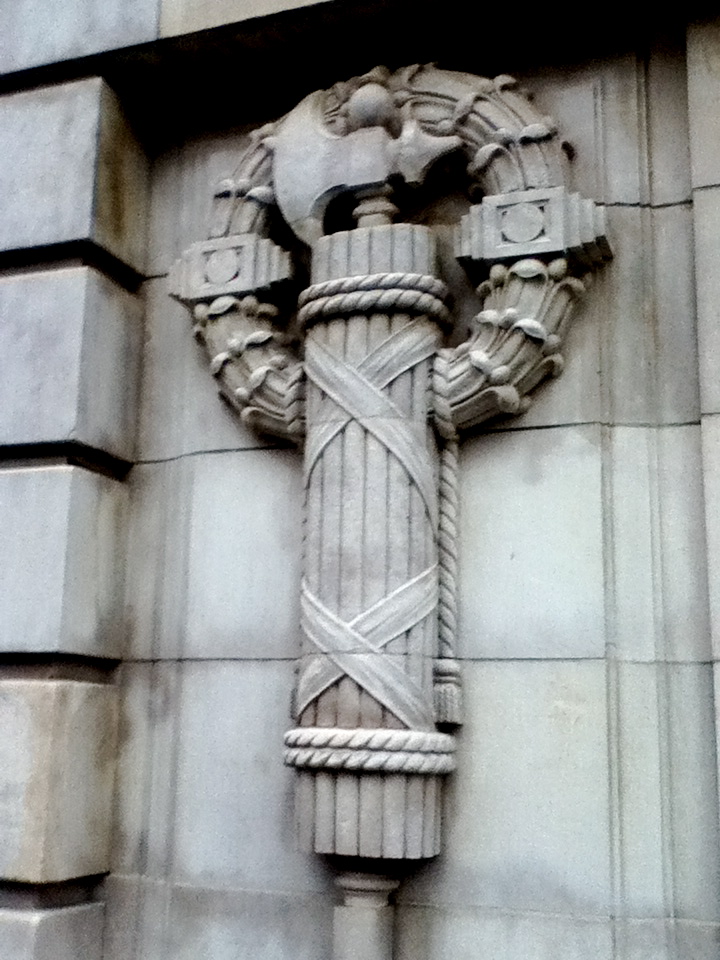
Etymology
Fascio: a bundle of rods. One rod breaks. The bundle does not.
Frequency of use
The more the word is used, the less it says.
Misuse
"Fascism" is an "-ism"
There are "-isms" and "-isms"
Other "-isms" (like fascism) lead to illness: both individual as well as collective/planetary/cosmic.
History of humankind is history of the (evolutionary) dance between the two.
Ur-Fascismo
Eco, 1995: fourteen features, no system — and one is enough for fascism to coagulate around it.
The fascist memeplex
The Chosen People
We are one exceptional people, united by blood, culture, or historical destiny.
Mechanism: Social identification, in-group cohesion, collective narcissism
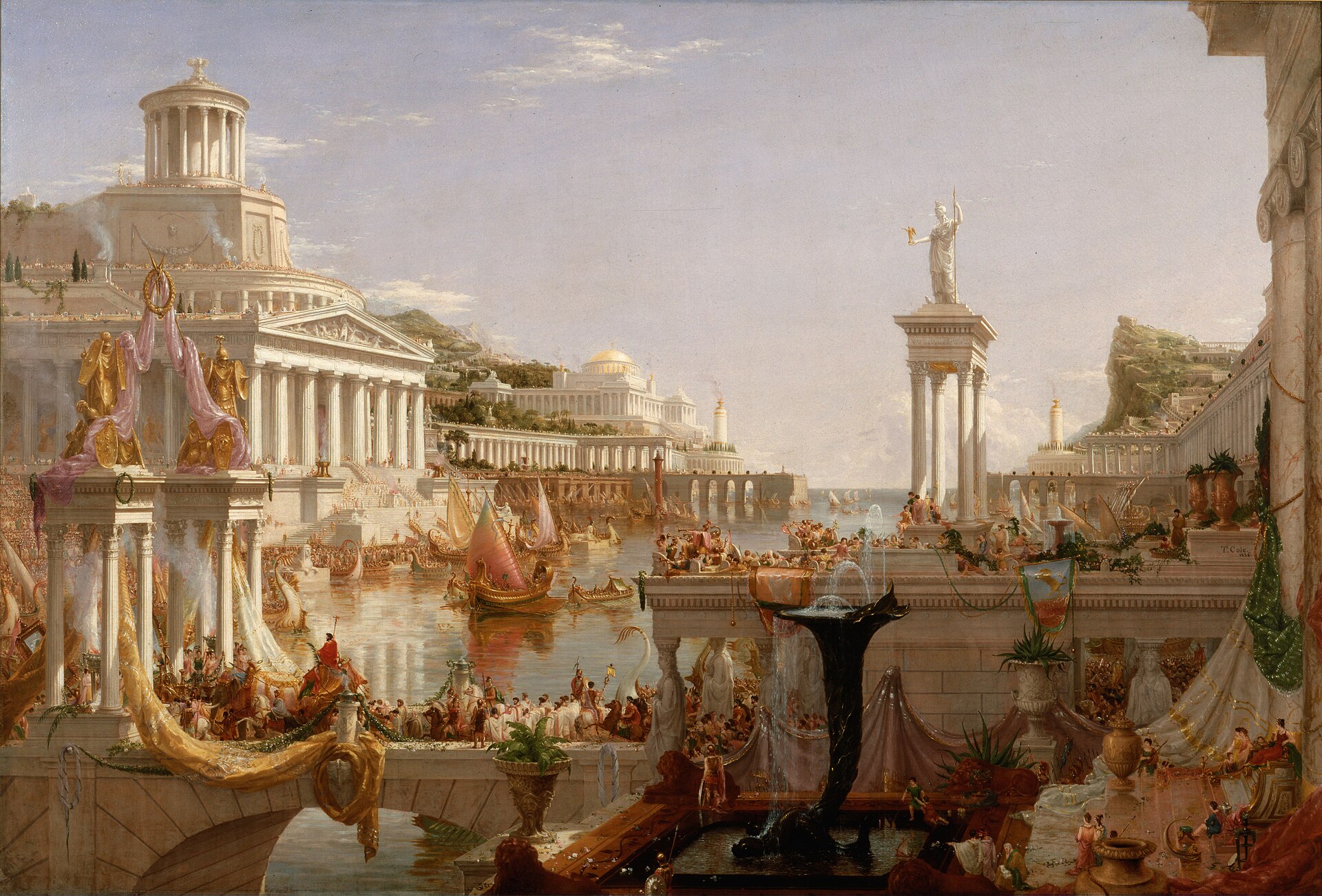
The Lost Golden Age
Once upon a time everything was good; it has been taken from us but the time will come when WE (not THEM) will be great again.
Mechanism: Nostalgia, idealization, selective cultural memory, reference to early childhood
The Existential Crisis
Our nation is declining and faces an existential threat.
Mechanism: Fear, perceived loss, urgency, threat amplification
The Enemy Within
The broken world is caused by enemies, traitors, parasites, secret societies, alien influences &c. We suffer because THEY are among US.
Mechanism: Scapegoating, out-group hostility, conspiracy thinking
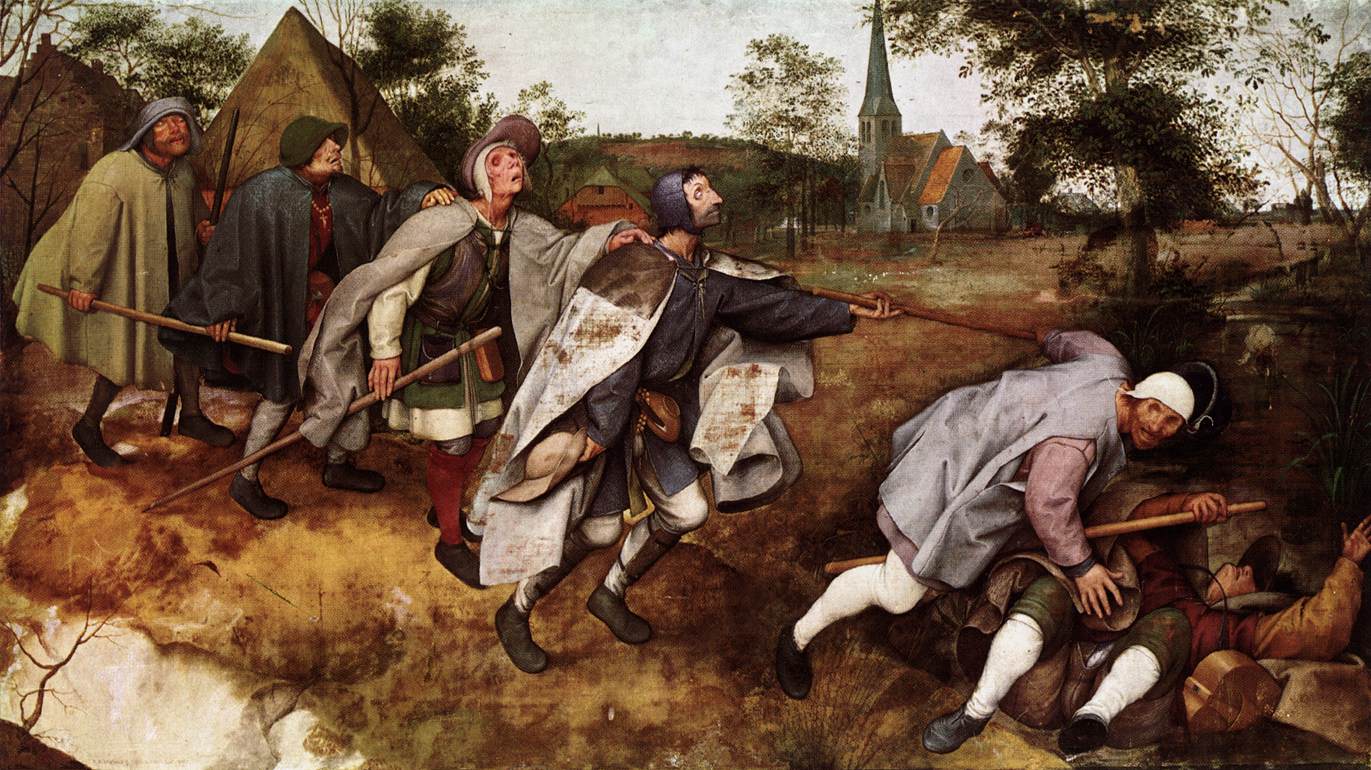
The Great Leader
Only an exceptional leader can save us and restore our greatness.
Mechanism: Authority bias, identification, charismatic attachment
Papas of the Nation
| Leader | Where, when | Father / family title or motif | Kind |
|---|---|---|---|
| Stalin | USSR, 1920s–1953 | “Father of Nations” (otets narodov); also vozhd (leader) | press epithet |
| Mao Zedong | China, 1949–1976 | Cultural Revolution song: “Dear father, dear mother — neither is as dear as Chairman Mao” | slogan |
| Kim Il Sung (and heirs) | North Korea, 1948– | “Parental Leader” (eobeoi suryeong); the nation as one family | state doctrine |
| Rafael Trujillo | Dominican Rep., 1930–1961 | “Benefactor of the Fatherland”, “Father of the New Fatherland” | official title |
| François Duvalier | Haiti, 1957–1971 | “Papa Doc” (his son: “Baby Doc”) | nickname |
| Mobutu Sese Seko | Zaire, 1965–1997 | “Father of the Nation”; also “Guide”, “Messiah” | official epithet |
| Idi Amin | Uganda, 1971–1979 | “Big Daddy” | nickname |
| Saparmurat Niyazov | Turkmenistan, 1990–2006 | Türkmenbaşy, usually rendered “Head / Father of all Turkmen” | adopted title |
| Alexander Lukashenko | Belarus, 1994– | Bats’ka (“Dad”) | popular epithet |
| Vladimir Putin | Russia, 2000– | no official title; “national leader”, strong-father and tsar-batyushka imagery in propaganda | motif |
Many different regimes, continents and decades — one and the same family metaphor: the nation is a household, the leader its father, dissent is disobedience.
Mechanism: authority bias, dependency, the family as the first hierarchy we learn
Leader, Brother, Uncle
| Leader | Where, when | Title | Role in the family |
|---|---|---|---|
| Hitler | Germany, 1933–1945 | Führer (leader) | mostly messianic and martial; father role not the core |
| Mussolini | Italy, 1922–1943 | Il Duce (leader) | leader first; family enters via birth-rate politics |
| Franco | Spain, 1939–1975 | Caudillo (warlord-leader), “by the grace of God” | war leader and guardian of the “great family” of Spain |
| Gaddafi | Libya, 1969–2011 | “Brother Leader” | big brother, not father |
| Pol Pot | Cambodia, 1975–1979 | “Brother Number One” | big brother |
| Ho Chi Minh | N. Vietnam, 1945–1969 | Bác Hồ (“Uncle Ho”) | uncle: kinder, but still family |
| Atatürk | Turkey, 1923–1938 | surname “Father-Turk” (1934) | literal father — but not a fascist |
So the guess holds almost: not always “father”, but nearly always a family member with authority — and the fascist originals lean more on leader and saviour than on papa.
Unity Above Individuality
The collective comes first; dissent weakens us and may constitute betrayal.
Mechanism: Conformity, social pressure, suppression of disagreement
The Redemptive Struggle
Strength, sacrifice, and violence are necessary to regenerate the nation.
Mechanism: Heroic identification, glorification of aggression, moral disengagement
The Natural Hierarchy
Some peoples and individuals are naturally superior and entitled to rule.
Mechanism: Status competition, dominance, essentialist categorization
The Sacred Collective
Through common symbols, rituals, gestures, and mass participation, we become one.
Mechanism: Emotional synchrony, behavioral imitation, ritual reinforcement
The Geo-Sentiment
Geo-sentiment (P. R. Sarkar, Neohumanism, 1982): attachment to one’s geographical environment.
“This land is ours by birth, blood, destiny and/or will of god(s). It is sacred, inseparable from our identity, and must be defended, purified, or reclaimed.”
Mechanism: place attachment, territorial identification, sacred-value attribution, in-group/out-group boundary formation, collective nostalgia, perceived territorial threat, emotional mobilization through geographical symbols.
How it replicates & spreads
A memeplex spreads through what we already have: bodies, symbols, belonging.
Symbols
A symbol is a meme small enough to fit on an armband.
Look first not at what the signs mean, but at how they are made.
Form is not guilt: the swastika is thousands of years older than the Nazis. But form is what lets a sign be copied, massed and obeyed.
Few lines, hard edges
Straight lines. Right angles. Nothing soft.
The Nazi swastika: four equal arms bent at 90°, tilted on its tip. The SS runes: two sharp lightning zigzags. The Hungarian Arrow Cross: an equal-armed cross ending in points.
Reduced to a few strokes, a sign can be drawn by anyone, in seconds, on any wall. Copyability is fitness.
Maluma or takete?
Scan. Choose. Don’t think.
Which one is maluma?
What your gut knew
Sounds have shapes. Shapes have moods.
Köhler (1929, 1947) and Ramachandran & Hubbard (2001): almost everyone calls the round form maluma / bouba, the spiky one takete / kiki.
Bar & Neta (2006): people prefer curved objects over sharp-angled ones — sharp contours read as threat.
Fascist forms use the spike on purpose: hard edges signal power before any word is read.
Symmetry, rotation, repetition
One module. Repeated until the individual disappears.
The swastika turns: four-fold rotational symmetry, a built-in motion. The fasces is a vertical bundle of identical rods.
Mass ornament: ranks of identical bodies, rows of banners, and at Nuremberg a hall of vertical searchlight beams. The crowd becomes the pattern.
Red, white, black
Three colours. Maximum contrast.
Red field, white disc, black sign: readable from far away, on cloth, on stone, in a photograph. A target shape: the eye is pulled to the centre.
Hitler himself explained each colour as a message — the design was a deliberate piece of propaganda.
The aestheticization of politics
Walter Benjamin, 1935: fascism gives the masses not rights, but a chance to express themselves.
Politics as spectacle: flags, uniforms, torches, light, visible body movements.
Ask: when you feel the pull of an image, what is it asking you to do?
Words
Fascist words come in two sets: order for us, vermin for them.
| for “us” | for “them” |
|---|---|
| Ordnung — order Reinheit — purity Volksgesundheit — the nation’s health Blut und Boden — blood and soil Wiedergeburt — rebirth | Ungeziefer — vermin Volksschädling — “pest of the people” (Nazi legal term, 1939) Ratten — rats inyenzi — cockroaches (Rwanda, 1994) “spit them out like a gnat” (Putin, 2022) |
Purity words make us clean. Pest words make them disgusting — and violence against them feel like pest control.
Mechanism: disgust, moral purity, dehumanisation
α-chimps, narcissism and psychological projection
Under every uniform, a primate counting its rank.
Four ingredients: belonging, rank, a grandiose leader, and projection of what we cannot bear in ourselves.
Humans are social 🐒
Belonging is a need. Fascism sells it.
Baumeister & Leary (1995): the need to belong is a fundamental human motivation.
Eisenberger et al. (2003): social exclusion activates brain regions also involved in physical pain.
Fascism offers belonging — paid for with someone else’s exclusion.
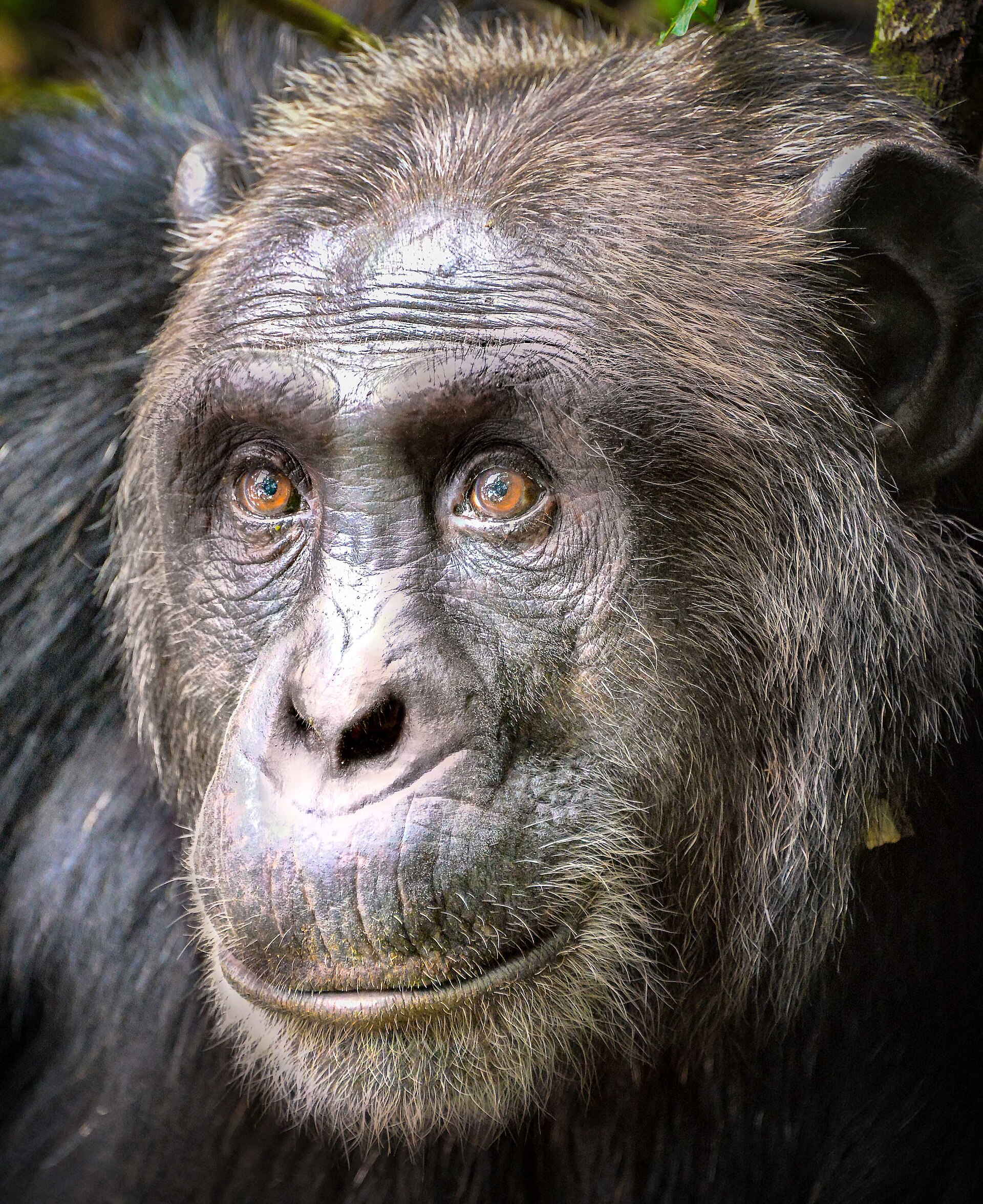
Alpha-male
Rank is the oldest story the herd knows.
Frans de Waal, Chimpanzee Politics (1982): a chimpanzee alpha rules through coalitions, favours and peacekeeping — not by brute force alone.
The popular “alpha wolf” comes from captive, unrelated wolves; in the wild a pack is mostly a family (L. D. Mech).
“Alpha” is partly a story we tell. Fascism offers the human edition: a dominance hierarchy with a flag.
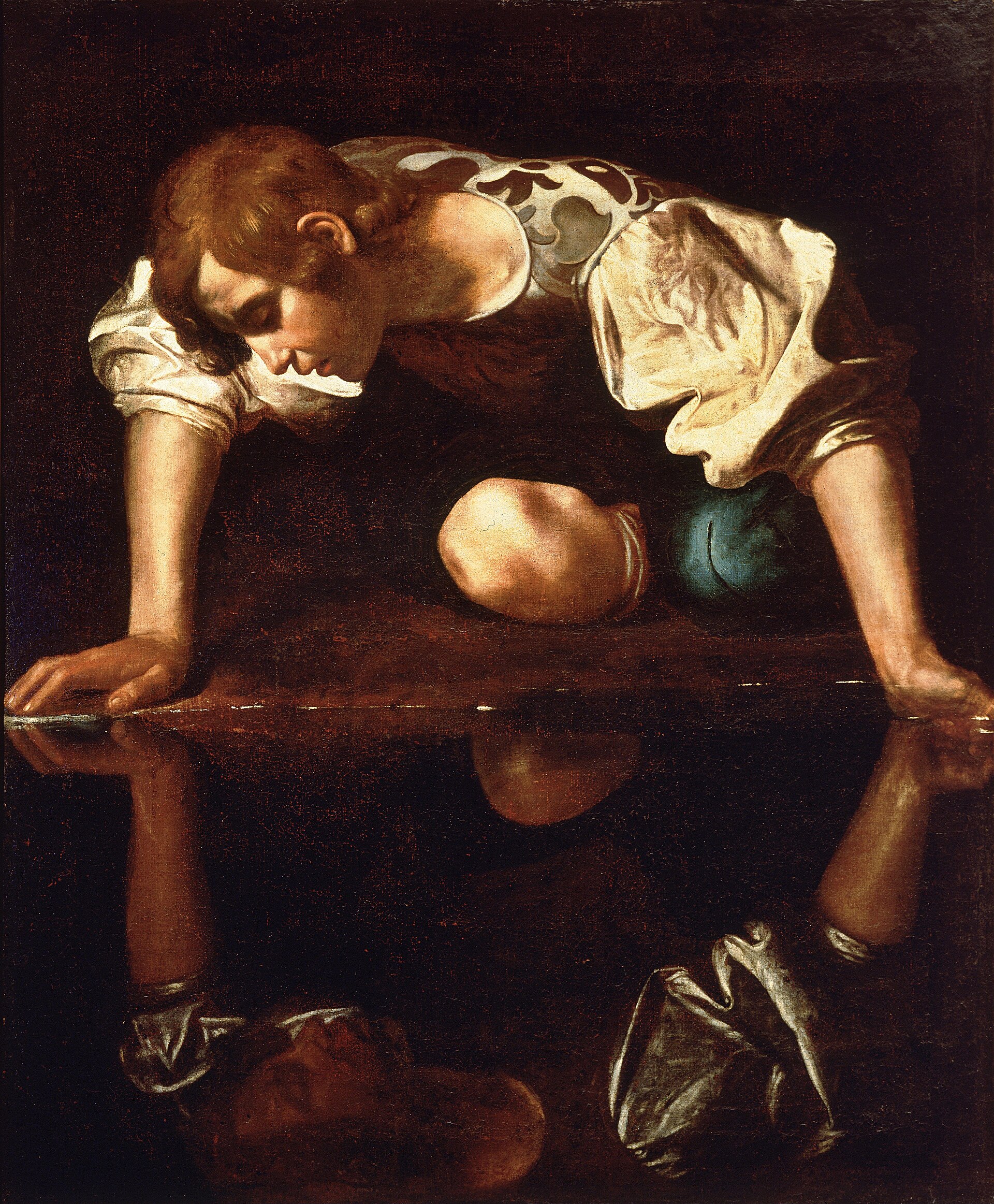
Narcistic Personality Disorder
The leader’s grandiosity needs a crowd to be real.
DSM-5 (APA, 2013): “a pervasive pattern of grandiosity (in fantasy or behavior), need for admiration, and lack of empathy” — five or more of nine criteria.
grandiosity · fantasies of unlimited success · “special” · craves admiration · entitlement · exploits others · no empathy · envy · arrogance (paraphrased)
ICD-11 (WHO) has no separate NPD category. A diagnosis needs a clinician, not a newspaper (the “Goldwater rule”).
What we can study in groups: collective narcissism (Golec de Zavala et al., 2009).
Psychological projection
What I cannot bear in myself, I find in you.
Projection (Freud; Anna Freud, 1936): a defence mechanism — attributing one’s own unacceptable impulses or traits to others.
Collectively: the nation is pure; the impurity is theirs. The Enemy Within is a mirror.
Hence: “Ukrainian fascists” (see Misuse).
How it mutates
It never returns in the same uniform.
Same genome, different host.
The host brings its myths. Fascism brings the structure.
And the host brings more: the whole evolutionary package — the primate in every one of us. Rank, belonging, fear of the outsider, imitation of the strong.
Myths change with the country. The chimp does not.
Same genome, different host
Italy 1922, Germany 1933, Spain 1939, Romania 1930s: four countries, four costumes.
Italy: the state, Roman antiquity, the fasces.
Germany: race, Volk, blood and soil.
Spain: national Catholicism.
Romania: Orthodox martyrdom and mysticism (Iron Guard).
What stays: the ten memes.
The cross-over operator
Mutation alters a meme. Cross-over marries two memeplexes.
fascism × Roman antiquity = Italian fascism
fascism × Catholicism = Francoism
fascism × Soviet victory cult × Orthodoxy × empire = ?
The offspring inherits features of both parents — and the host’s best-loved myth as camouflage.
Ruscism
An autopsy in ten principles.
Ruscism: a cross-over of fascism with the Soviet victory cult, Orthodoxy and empire.
Ten memes. Ten specimens. Count them.
1 · The Chosen People
One people — and they decide which others exist.
Specimen: Putin, On the Historical Unity of Russians and Ukrainians (July 2021): Russians and Ukrainians are “one people”.
2 · The Lost Golden Age
A catastrophe to undo.
Specimen: Putin, 2005: the collapse of the USSR was “the greatest geopolitical catastrophe of the century”.
3 · The Existential Crisis
The aggressor is always defending.
Specimen: the invasion of 24 February 2022 was presented as defence against NATO and a threat to Russia’s very existence.
4 · The Enemy Within
Traitors, agents, scum.
Specimen: the “foreign agents” law (2012, widened 2022); Putin, 16 March 2022: a “self-purification of society” from “traitors”.
5 · The Great (cca 165 - 170 cm) Leader
No Putin, no Russia.
Specimen: Volodin, 2014: “as long as there is Putin, there is Russia”. 2020 amendments reset presidential term limits.
 Read the report. Photo: Anna Artemyeva / Novaya Gazeta." loading="lazy"/>
6 · Unity Above Individuality
Dissent is treason. Silence is loyalty.
Specimen: March 2022 laws punishing “fakes” about, or “discrediting”, the army (up to 15 years). Memorial, the human-rights organisation, liquidated by court order, December 2021.
7 · The Redemptive Struggle
The war as purification.
Specimen: the cult of victory in 1945, the letters Z and V painted on tanks and printed on children’s clothes; “important conversations” lessons in schools since September 2022.
8 · The Natural Hierarchy
A nation that is “not really a nation”.
Specimen: RIA Novosti, 3 April 2022, What Russia should do with Ukraine: “denazification” as the dissolution of a Ukrainian identity.
9 · The Sacred Collective
Carry your dead grandfather through Moscow.
Specimen: the Immortal Regiment march, the St George ribbon, the Victory Day parade: emotional synchrony, ritual, imitation.
10 · The Sacred Soil
Land that is holy because it is ours.
Specimen: Putin, 18 March 2014: Crimea has a “sacred meaning” for Russia, like the Temple Mount for Jews and Muslims. The September 2022 annexations declared “forever”.
Verdict: ten of ten
Ten of ten.
And the final touch: the accusation of fascism hurled at the victim — projection.
The Soviet victory over fascism became the host symbol that hides the genome.
Caveat: does the label matter?
Historians disagree whether to call it fascism.
Eco: a family resemblance, not a definition.
The memetic anatomy needs no label. Count the memes.
How to defeat it
By dia(gnosis|logue)
enter the dialogue with the person
by focus on use of 1st person singular or plural ("I know", "We are certain" etc.) assess the extent of the infection (in what extent did the memplex already became a constitutive component of H's egoplex)
do not waste time on patients where the infection got into irreversible stage
identify the set of memes which constitute the memplex kernel
re-wire circuits in a manner which will channel the memetic libido of the memplex against its kernel
Note: it's less about reason, logics and evidence and more about emotions, sentiments and basic instincts (e.g. food, security etc.)By (public) action
By humor
“Every joke is a tiny revolution.”
— George Orwell, Funny, But Not Vulgar (1945)
“If you can make people laugh at him, then you’re one up on him.”
— Mel Brooks, on Hitler, 60 Minutes (2001)
“Artists are here to disturb the peace.”
— James Baldwin, interview with Studs Terkel (1961)
“You cannot fear something that you laugh at.”
— Bassem Youssef, NPR interview (2017)
“Laughter liberates not only from external censorship but first of all from the great interior censor.”
— Mikhail Bakhtin, Rabelais and His World (1968)
Earworms, mindworms, moving memes::Fashion, Style, Art &c.
Mediated memes, Urban memes
Memplexes
Memes in Law, Politics & Propaganda
Memes & Cyberspace
Memes, Memecoins, AIs
Memes revisited
The Congress
Medienhaus Chronicle ⁄ Kastalia Project (VK & KuM only)
The story begins ...
Formats
Artefacts
Kastalia KMS
In Josef Knechts handschriftlicher Übersetzung / Kastalia Archiv / Hermann Hesse, The Glass Bead Game
Kastalia instances
gardens.digital
fibel.digital
Grunewaldstrasse cafeteria
kastalia.medienhaus.udk-berlin.de
Narrative behind Kastalia KMS
the project of 2nd Archive resp. "2nd Foundation" germinated for many years
ultimate impetus for creation of KMS given by need of VK and KuM study programs for a unified aggregator and generator of Einführungveranstaltung (EV) presentations
first EV in winter semester 2016/2017 at url https://cloud.medienhaus.udk-berlin.de/community
first public demonstration at UdK Zukunfstag 2019
deployment of other instances in 2021
handbook generator (SQL->LaTex->PDF) deployed in Summer Semester 2022
Implementation
Perl Dancer app behind nginx proxy
PostgreSQL database with just three tables: "knots", "bounds" and "zeitgeist"
all knot-related ad hoc information stored in knots.attributes hstore
main predicates: "is_parent", "has_bookmark", "contains" common to all instances, certain predicates "is_uttered_as", "illustrates", "is_symbiont_with" etc. instance-specific)
Philosophy
Kastalia is composed of "knots" which have attributes and relations ("bounds") to other "knots".
Everything (e.g. user, institution, event, presentation slide, fairy tale, musical piece) is a knot.
A knot is a "Ding an sich".
Bounds are predicated. (hello sir Berners-Lee, hello Wikibase, hello "semantic web")
A knot is presented to an observer (e.g. human user) by means of a template.
Combination of a knot, other knots which are bound to it and a template yield "Ding für uns".
On Tracking : Dancing Piano II.
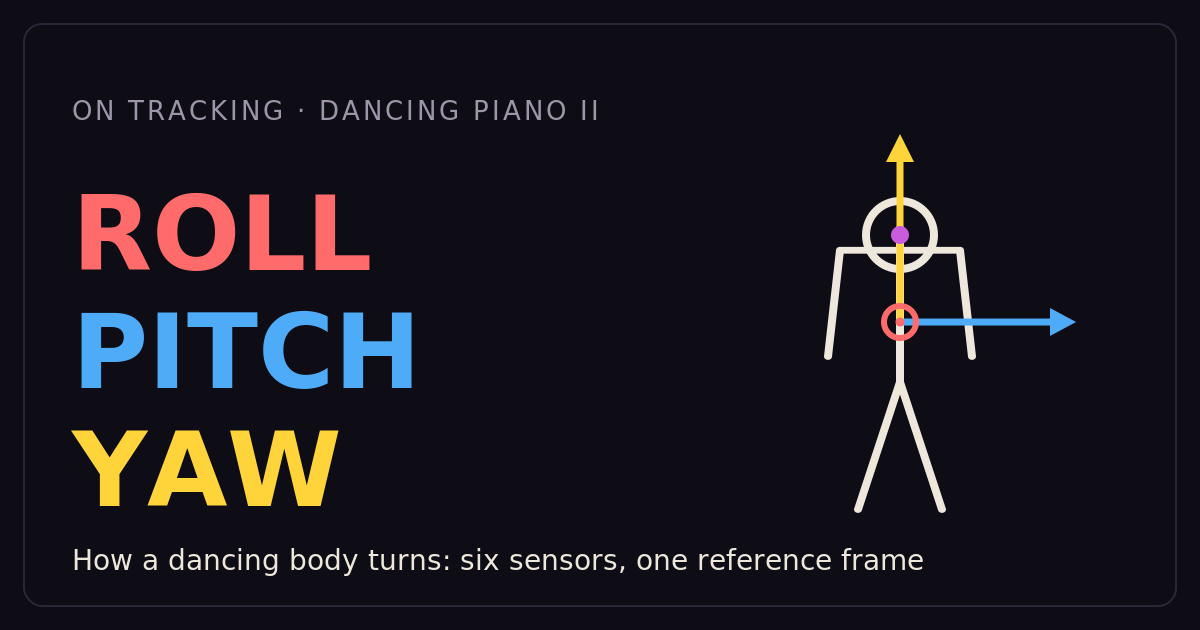
Roll, Pitch, Yaw
Why three angles?
Six small sensors on one dancer. Six streams of numbers. What do they actually say?
Each sensor answers one question: how am I turned, compared with the moment you pressed Calibrate?
The answer is always three numbers: roll, pitch and yaw.
Today: what these three words mean on a dancing body.
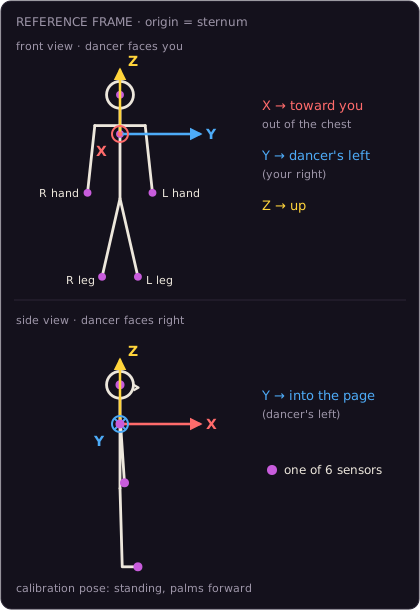
The body is the coordinate system
Origin: the sternum.
Calibration pose: standing straight, arms hanging, palms turned forward.
X points forward, out of the chest. Y points to the dancer's left. Z points up.
Like an aeroplane flying forward: nose, left wing, up.
Calibrate = declare this pose to be zero.
Six sensors, one skeleton
Two hands, two legs, torso, head.
Each sensor reports its orientation (roll, pitch, yaw), its rotation speed and its acceleration — at rest it feels gravity, 1 g pointing up.
Today we only need the first: orientation.
Three ways to turn
A rigid body in space can turn in exactly three independent ways.
Pilots named them. roll: tilt a wing down. pitch: nose up or down. yaw: nose left or right.
In our frame each one is a rotation about one axis: roll about X, pitch about Y, yaw about Z.
Which way is positive? The right-hand rule: thumb along the axis, fingers curl in the positive direction.
(In ShivaSynth the sign also depends on how a sensor is strapped on — more about that later.)
Roll, pitch, yaw are not parts of the body. They are rotations about the frame's axes.
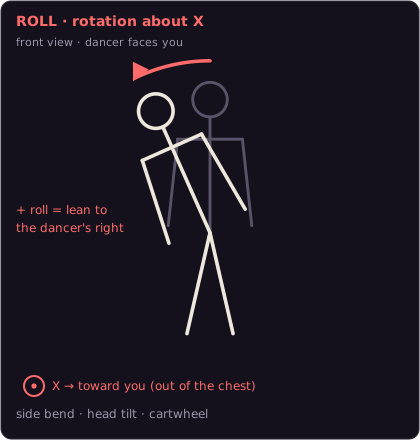
Roll · about X
Turn about the axis that points out of your chest.
Torso: side bend. Head: tilt, ear to shoulder. Whole body: cartwheel.
Positive roll: leaning to the dancer's right.
In the app: twist.
Try it: tilt your head as if to say “hmm, I'm not so sure”.
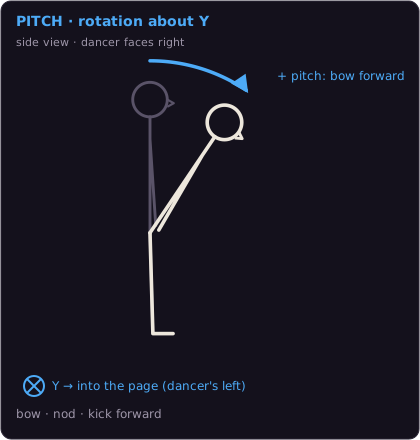
Pitch · about Y
Turn about the axis that runs through you from right to left.
Torso: bow. Head: nod. Leg: kick forward.
Positive pitch: bowing forward.
In the app: lean.
Try it: nod “yes”.
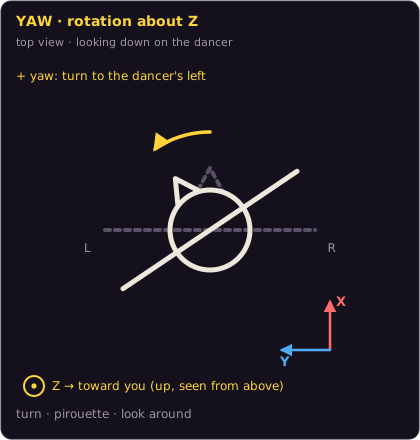
Yaw · about Z
Turn about the vertical axis.
Torso: turn, pirouette. Head: look around, shake “no”.
Positive yaw: turning to the dancer's left (counter-clockwise, seen from above).
In the app: turn.
Yaw is special: nothing in gravity says which way you face. More about that in a minute.
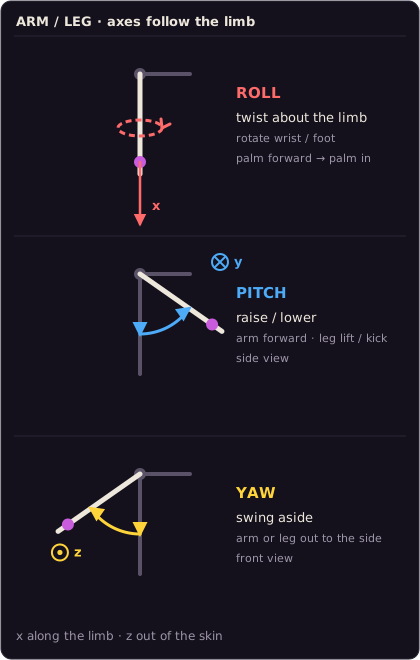
Arms and legs: the axes follow the limb
On a limb the frame travels with the limb.
x runs along the bone towards the hand or foot; z points out of the skin; y completes the triple.
roll = twist the limb about its own axis (wrist, foot). pitch = raise / lower. yaw = swing aside.
Palms forward at calibration fixes what “zero twist” means.
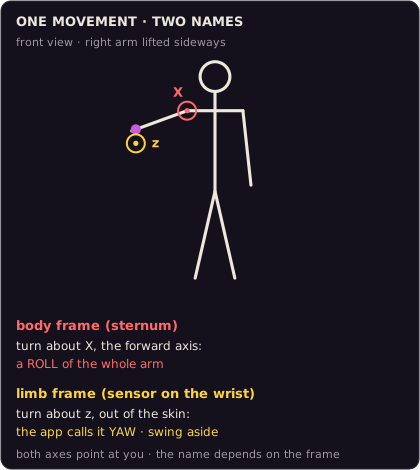
One movement, two names
Lift your right arm sideways, like a jumping jack.
In the body frame that is a turn about X, the forward axis: a roll.
For the sensor on the wrist it is a turn about its own z: the app calls it yaw, swing aside.
Same rotation, same numbers. Only the name changed.
Always say which frame you are in.
Exercise · the order matters
Hold your phone flat in front of you, screen up.
A: turn it 90° to the left (yaw), then tip its far edge down 90° (pitch). Note where the screen points.
B: start again. Pitch first, then yaw.
Same two quarter-turns, two different poses.
Rotations do not commute. So “roll, pitch, yaw” needs an agreed order of application.
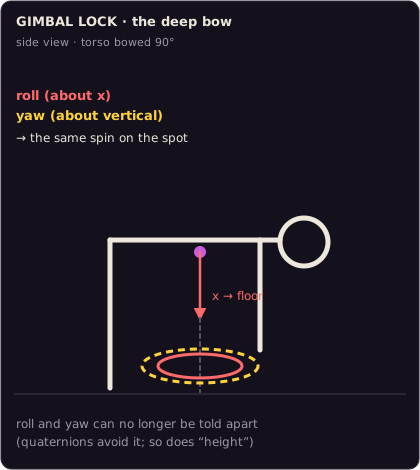
Gimbal lock
Bow deeply, torso horizontal: the axis out of your chest now points at the floor.
Now a turn about x (roll) and a turn about the vertical (yaw) are the same movement. The angles can no longer be told apart.
A glitch of the three-angle description — not of the body. Deep bows and raised arms bring any dancer there.
The cure: sensors compute with quaternions inside and use angles for display only. ShivaSynth's height is the angle between “up” now and “up” at calibration, which stays clean in every pose.
Three angles are a convenient language, not the truth of orientation.
Why yaw drifts
At rest, the accelerometer feels gravity. That gives roll and pitch — absolute.
Turning about the vertical does not change where gravity points. Yaw has no such anchor.
Two remedies: add up the gyroscope's rotation speed (small errors accumulate: drift) or consult a magnetic compass (disturbed by metal and electronics).
So: calibrate before you dance, and expect turn to be the least stable of the three.
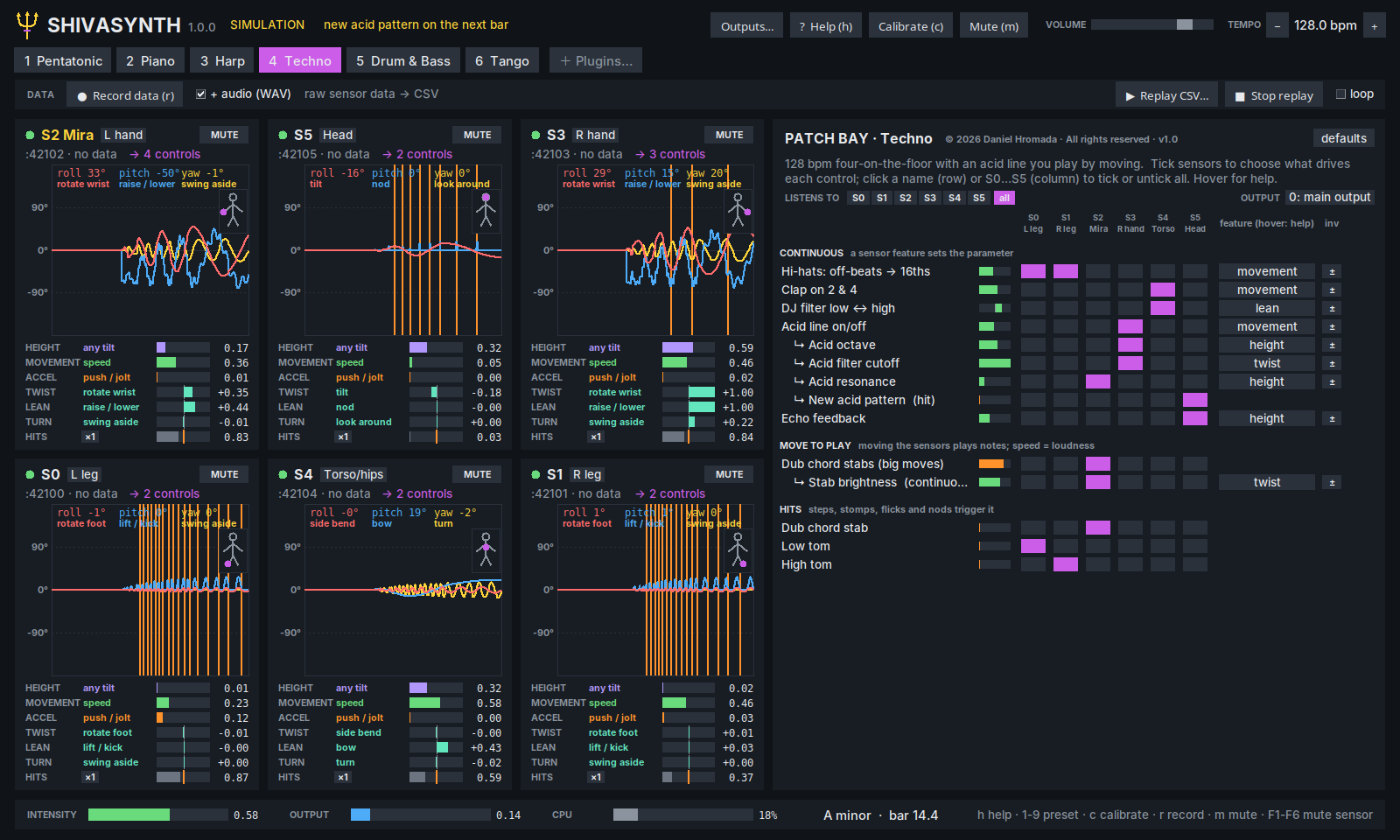
From angles to music
In the dashboard every sensor plots its roll (red), pitch (blue) and yaw (yellow).
The patch bay turns them into controls: twist = roll, lean = pitch, turn = yaw.
In the Techno patch, for instance, the DJ filter follows lean, the acid line's cutoff follows twist.
If a signed feature goes the wrong way, flip the ± in the patch bay: the strap may sit the other way round.
Your body's rotations become the instrument's parameters.
Exercise · name that movement
Which sensor, which angle? Do each movement and say it aloud.
Nod “yes” → head, pitch
Shake “no” → head, yaw
Ear to shoulder → head, roll
Bow → torso, pitch · Pirouette → torso, yaw · Side bend → torso, roll
Wave sideways → hand, yaw · Turn your foot out → leg, roll · Kick → leg, pitch
And which of these gets you into gimbal lock?
Take home
Frame: origin at the sternum, X forward, Y left, Z up.
roll about X, pitch about Y, yaw about Z — and on a limb, the axes follow the limb.
The names depend on the frame; the order of rotations matters; yaw drifts; angles break down at 90°.
Next: from orientation to rhythm — what can we do with the speed of these rotations?
Pulse: How Fast Does a Body Move?
Welcome: Movement Has a Pulse
Every movement, however free it looks, has a pulse. A step, a swing of the arm, a beat of a wing — each repeats, and each repetition takes time.
This session gives you the physical vocabulary for talking precisely about that pulse: period, frequency, and speed — and why they are not the same thing.
By the end, you'll be able to describe your own heartbeat, your own gait, even a hummingbird's wing, in exactly the same terms — which is also the first step toward tracking movement and turning it into sound, piano included.
Period and Frequency
A period (T) is the time it takes for one complete cycle of a repeating motion — one full step, one full wingbeat, one full swing.
Frequency (f) is simply how many of those cycles happen per second: f = 1 / T. If a step takes half a second, its frequency is 2 steps per second.
Frequency is measured in Hertz (Hz) — one Hz means one complete cycle every second. A slow, heavy motion has a long period and a low frequency; a quick, light motion has a short period and a high frequency.
The Pendulum: A Clock Made of Motion
The simplest periodic body in physics is the pendulum: a weight swinging from a fixed point.
Its period depends only on its length and on gravity — not on how wide it swings, and not on how heavy the weight is. A longer pendulum always swings more slowly than a short one.
This single fact — longer means slower — turns out to govern almost every example in today's session, from a child's leg to a hummingbird's wing.
The Heartbeat: Your Own Metronome
The most intimate periodic motion you own is your own heart: roughly one beat per second at rest — about 60-80 beats per minute, close to 1 Hz.
Under exertion — dancing included — that frequency can double or more, while the body's other rhythms (breath, stride) often tangle into related, overlapping periods.
Long before any machine measured it, the heartbeat was probably humanity's first unit of tempo.
Walking: Cadence and Stride
Walking is periodic too: dancers and gait researchers alike call its frequency cadence — steps per minute. A relaxed walk sits around 100-120 steps/min, roughly 1.7-2 Hz.
But cadence alone doesn't tell you how fast someone is actually travelling. A tall person and a short person can share the same cadence and still cover very different distances per step.
Which raises the question underneath this whole session: if frequency alone isn't speed, what else is needed?
Running and Sprinting: Frequency Is Not Speed
Speed is frequency multiplied by how far each cycle carries you — its amplitude, or in gait terms, the stride length.
Sprinters increase both: a faster leg-cycle frequency and a longer stride. Elite sprinters reach cadences above 4-5 steps/second with strides over two metres — two independent quantities, frequency and amplitude, multiplying into genuinely extreme speed.
Keep this multiplication in mind: speed = frequency × amplitude. It will come back, almost unchanged, when we get to the piano.
Why Small Creatures Move Faster
Remember the pendulum: a longer pendulum swings more slowly. The same logic applies to limbs and wings, which behave like pendulums built out of muscle and bone.
A short limb (or a short wing) is a "short pendulum" — it naturally wants to oscillate fast. A long limb is a "long pendulum" — it naturally wants to oscillate slowly.
This is why small animals move in a blur and large animals move almost in slow motion — not because of effort, but because of size itself.
Extremes in the Animal Kingdom
A hummingbird's wings beat around 50 times per second (50 Hz) — fast enough to hover motionless in the air.
A housefly's wings beat even faster, well above 150-200 Hz — too fast for the human eye to resolve as individual strokes.
Contrast that with an albatross, gliding on wings that may flap barely once per second, or an elephant's unhurried gait, with a period closer to two full seconds per step.
Same physics, three orders of magnitude apart — purely a function of size.
The Piano String Analogy
A piano string is, again, a pendulum in disguise — just a vibrating one instead of a swinging one.
Short, thin, tightly-strung strings (the piano's high notes) vibrate at a high frequency. Long, thick, loosely-strung strings (the low notes, wound in copper wire) vibrate at a low frequency.
Short and light vibrates fast; long and heavy vibrates slow — the exact same rule that separated a hummingbird's wing from an elephant's leg.
Tempo in Music: BPM as Period
Music names the same quantity differently: tempo, measured in beats per minute (BPM).
A tempo of 120 BPM means one beat every 0.5 seconds — a period of half a second, a frequency of 2 Hz. A slow adagio at 60 BPM is a 1-second period, exactly the frequency of a resting heartbeat.
Tempo is simply frequency wearing a musician's name.
Entrainment: When the Body Syncs to the Beat
Entrainment is what happens when an independent periodic body — a footstep, a heartbeat, a swinging arm — locks its own frequency onto an external one, such as a musical beat.
This is most of what dancing is, physically: a body voluntarily tuning its many natural periods — stride, swing, sway — to a shared external frequency.
Which means a dancer's movement is not just inspired by music — it can be measured, cycle for cycle, against it.
Tracking the Untrackable
Measuring a heartbeat or a pendulum is easy. Measuring a dancer's full-body period, in real time, on stage, is not — which is exactly the technical problem this course is named after.
Modern tools attack it from several angles: wearable accelerometers (measuring acceleration directly), motion-capture markers, and camera-based pose estimation (tracking joints frame by frame from ordinary video).
Each gives a stream of numbers over time — a position, a velocity — from which period, frequency and amplitude can all be recovered.
From Movement to Sound
Once a movement's frequency is captured as a number, it can be mapped — frequency to pitch, amplitude to volume, period to rhythm — onto a piano, real or sampled.
This is the project underneath Dancing Piano: using the exact physical quantities introduced today — the same ones that separate a hummingbird from an elephant — to let a tracked body play an instrument with its own motion.
Every session from here builds, piece by piece, toward that pipeline: track, measure, map, sound.
Closing: What's Next
Today's vocabulary — period, frequency, amplitude, speed, entrainment — is the physical foundation for everything that follows in this course.
Next sessions will get hands-on with the tracking side: how to actually capture a body's movement, and how to turn the resulting numbers into music.
Before then: notice your own rhythms this week — your stride, your pulse, the tempo of whatever you happen to be dancing to.
Onboarding
Before your first session, there are a few quick steps to take care of.
Onboarding consists of a 0th step and two further steps.

0th Step: Install an App
Choose whichever fits your device:
Computer — install Element.
Mobile — install Element X.
Browser — no install needed, just open udk.ai/classroom.
Step 1: Log In
Log in (or register) using the app you just installed.
UDK students — specify medienhaus.udk-berlin.de as your homeserver.
Motivated guests — Next week, You can request a free udk.ai account.
Step 2: Join the Room
Once logged in, join the seminar's room.
Either search for it directly, or wait to be invited into it.
Room names:
Session Structure
Applies to both two-hour Wednesday seminars — AI-Literacy (14:00) and Memetics (16:00).
14:00 / 16:00 — doors open
14:15 / 16:15 — Begrüßung
14:30 / 16:30 — check-in ends
15:00 / 17:00 — minute of silence ***
15:30 / 17:30 — checkout starts
15:45 / 17:45 — individual requests / onboarding help
*** minute of silence divides the session into analogue (off-the-microphone) and digital (fully archived) sections
